Exam questions · Biology · The Endocrine System
Contraception and Fertility Treatment
- 7 exam questions
- 22 marks
- 8 quick checks
-
1 State [2 marks]
State two hormones that are in the combined contraceptive pill.
Show answerHide answer
Model answer
Oestrogen and progesterone.
Mark scheme
- Oestrogen — 1 mark
- Progesterone — 1 mark
-
2 Explain [3 marks]
Explain how the combined contraceptive pill prevents pregnancy.
Show answerHide answer
Model answer
The pill contains oestrogen and progesterone, which keep the level of these hormones high. This stops the pituitary gland releasing FSH. Without FSH no egg matures in the ovary, so there is no egg to be fertilised.
Mark scheme
- Contains oestrogen and progesterone — 1 mark
- Stops FSH release — 1 mark
- No egg matures — 1 mark
-
3 Evaluate [4 marks]
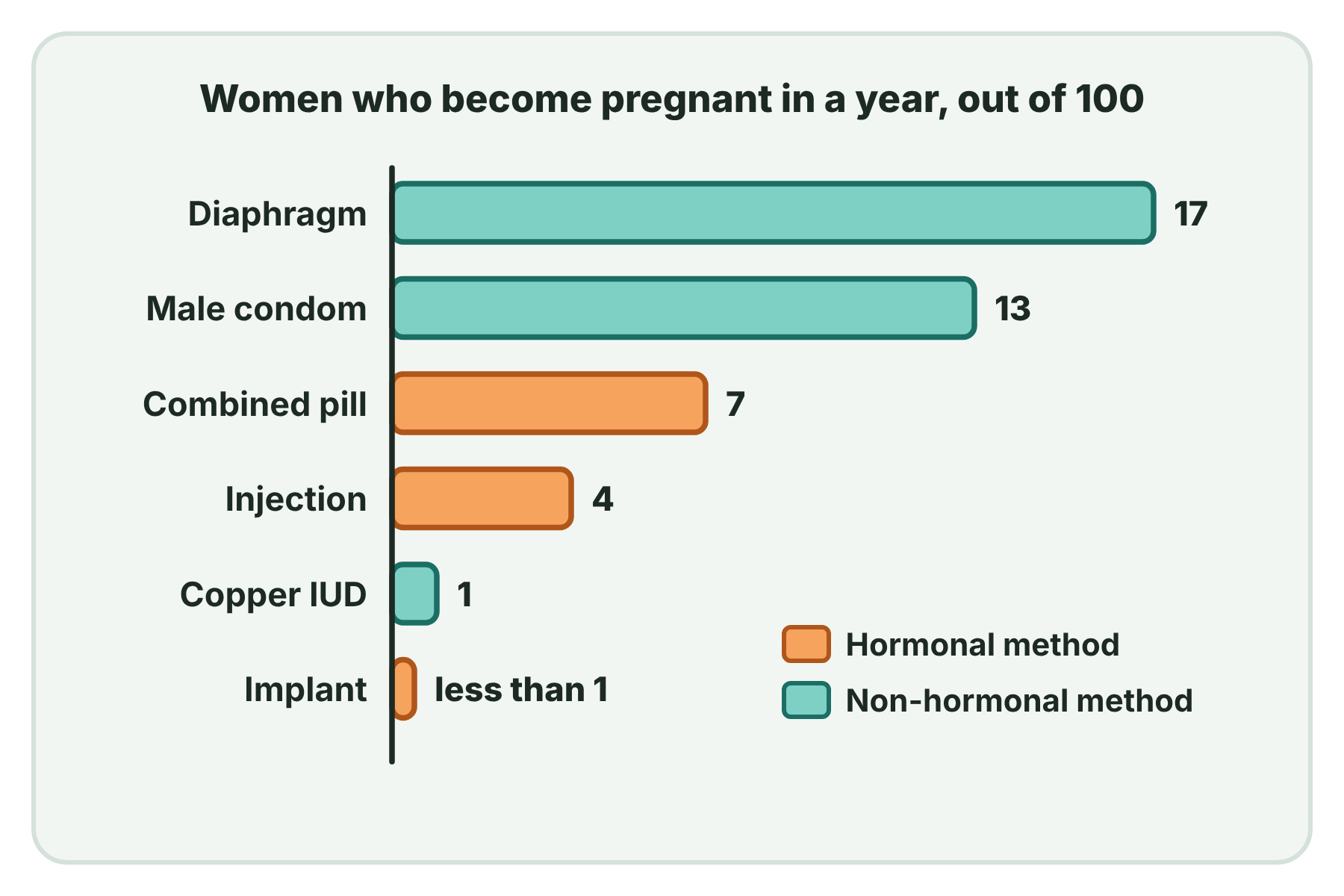
Figure 1 shows how many women out of 100 become pregnant in a year when using each method of contraception. Use the data in Figure 1 to evaluate the use of the male condom and the implant as methods of contraception.
Show answerHide answer
Model answer
The implant is much more effective, because fewer than 1 woman in 100 gets pregnant in a year, compared with 13 in 100 for the condom. The implant lasts for years and does not depend on remembering. However, the condom is the only one that protects against sexually transmitted infections, and the implant may have hormonal side effects.
Mark scheme
- Implant more effective, using the data — 1 mark
- Implant does not depend on remembering — 1 mark
- Condom protects against infection — 1 mark
- Implant may have side effects — 1 mark
-
4 Describe [3 marks]
Describe three non-hormonal methods of contraception.
Show answerHide answer
Model answer
Any three of: condoms, a diaphragm with spermicide, an IUD, abstaining at fertile times, sterilisation.
Mark scheme
- Any three methods — 3 marks
-
5 Explain [2 marks]
Explain why a progesterone injection can be more effective than the combined pill in real use.
Show answerHide answer
Model answer
The injection lasts for weeks, so it does not need to be remembered every day. The pill is often forgotten, which makes it less effective.
Mark scheme
- The injection is not taken daily — 1 mark
- The pill may be forgotten — 1 mark
-
6 Describe [4 marks]
Describe the main stages of in vitro fertilisation (IVF).
Show answerHide answer
Model answer
The woman is given FSH and LH so that several eggs mature. The eggs are collected from the ovaries. They are mixed with sperm in a dish, where they are fertilised. The embryos grow for a few days, and one or two are put into the uterus.
Mark scheme
- FSH and LH to mature eggs — 1 mark
- Eggs collected — 1 mark
- Fertilised with sperm in a dish — 1 mark
- Embryos put into the uterus — 1 mark
-
7 Evaluate [4 marks]
Evaluate the use of IVF to treat infertility.
Show answerHide answer
Model answer
IVF can give a baby to couples who cannot conceive in any other way. However, many cycles do not work, and the success rate falls with age. The hormones may have side effects, and more than one embryo can lead to multiple births, which carry more risk. It is stressful and expensive, and some people have ethical objections to unused embryos being destroyed.
Mark scheme
- Gives a baby to couples who cannot conceive — 1 mark
- Low success rate — 1 mark
- Health risks, such as multiple births — 1 mark
- Cost, stress or ethical issues — 1 mark
Quick check
-
1
Which two hormones are in the combined pill?
Show answerHide answer
C: Oestrogen and progesterone
The combined pill contains oestrogen and progesterone.
-
2
Which method of contraception also protects against sexually transmitted infections?
Show answerHide answer
B: The condom
Only the condom provides a barrier to infection.
-
3
How does the combined pill stop an egg maturing?
Show answerHide answer
A: It stops FSH release
It stops the pituitary releasing FSH.
-
4
Which of these is a permanent method of contraception?
Show answerHide answer
D: Sterilisation
Sterilisation is permanent.
-
5
In the chart, which method has the fewest pregnancies in a year?
Show answerHide answer
C: The implant
The implant has fewer than 1 pregnancy per 100 women in a year.
-
6
Why is the daily pill less effective in real use than the implant?
Show answerHide answer
B: It can be forgotten
The pill can be forgotten, but the implant needs no daily action.
-
7
Which hormones can be given to a woman who does not ovulate?
Show answerHide answer
A: FSH and LH
FSH and LH stimulate eggs to mature and be released.
-
8
Where does fertilisation happen in IVF?
Show answerHide answer
D: In a laboratory dish
In IVF the egg is fertilised by sperm in a laboratory dish.