Exam questions · Biology · Communities in Ecosystems
Abiotic and Biotic Factors
- 7 exam questions
- 21 marks
- 8 quick checks
-
1 State [2 marks]
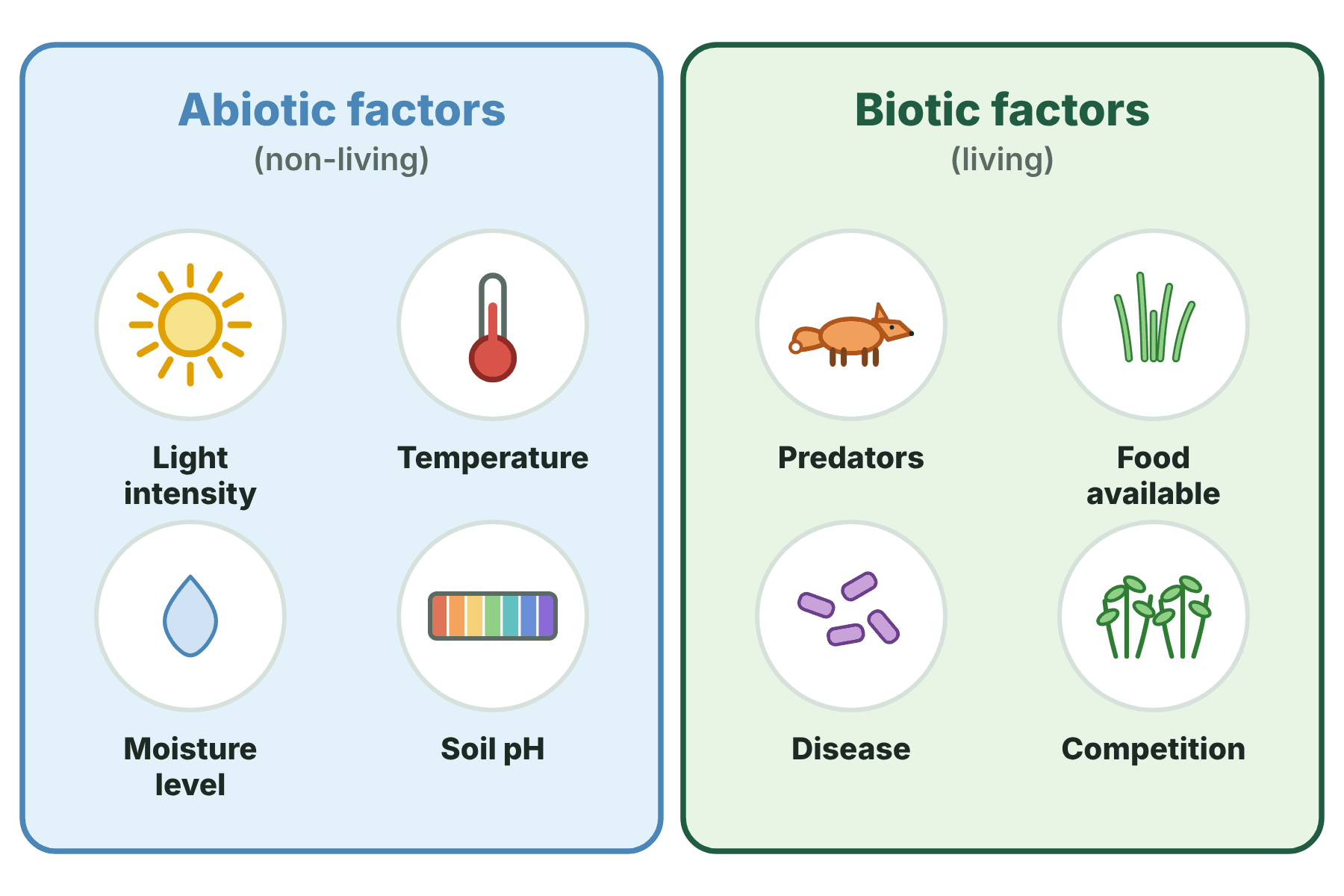
State two abiotic factors and one biotic factor that affect the organisms in a community.
Show answerHide answer
Model answer
Any two abiotic factors from temperature, light intensity, moisture level, soil pH, and one biotic factor from predators, food, disease, competition.
Mark scheme
- Two abiotic factors — 1 mark
- One biotic factor — 1 mark
-
2 Explain [3 marks]
Explain how the number of plants growing under a thick canopy of trees is affected by light.
Show answerHide answer
Model answer
The canopy blocks light, so the light intensity is low. The plants get less light for photosynthesis, so they make less glucose and grow less. Fewer plants can survive.
Mark scheme
- Light intensity is low under the canopy — 1 mark
- Less photosynthesis, so less growth — 1 mark
- Fewer plants survive — 1 mark
-
3 Explain [3 marks]
A disease kills many of the rabbits in a field. Explain how this could affect the foxes that live in the field.
Show answerHide answer
Model answer
Rabbits are food for the foxes. With fewer rabbits there is less food. Some foxes may starve or move away, so the fox population falls.
Mark scheme
- Rabbits are food for the foxes — 1 mark
- Less food available — 1 mark
- The fox population falls — 1 mark
-
4 Describe [4 marks]
Describe how a student could use a quadrat to estimate the number of daisies on a lawn.
Show answerHide answer
Model answer
Place the quadrat at random positions on the lawn, by using random numbers for the coordinates. Count the daisies in the quadrat each time. Repeat many times and calculate the mean number per quadrat. Multiply the mean by the number of quadrats that would fit in the whole lawn.
Mark scheme
- Place the quadrat at random — 1 mark
- Count the daisies in each quadrat — 1 mark
- Repeat and calculate a mean — 1 mark
- Multiply by the area of the lawn compared with the quadrat — 1 mark
-
5 Explain [3 marks]
Heather grows well on moors where the soil is acid, but it does not grow well in alkaline soil. Use Figure 1 to name the factor involved, say whether it is abiotic or biotic, and suggest an explanation.
Show answerHide answer
Model answer
The factor is soil pH, which is an abiotic factor. Soil pH affects how well the roots take up minerals, so the heather can only get what it needs in acid soil.
Mark scheme
- Soil pH — 1 mark
- Abiotic factor — 1 mark
- It affects how roots take up minerals — 1 mark
-
6 Suggest [3 marks]
A transect is taken from the edge of a wood into the middle of the wood. The number of grass plants falls along the transect. Suggest two reasons for this.
Show answerHide answer
Model answer
Less light reaches the ground in the middle of the wood because of the trees, so the grass cannot photosynthesise as well. The soil may also be drier or have less water, because the tree roots take up water.
Mark scheme
- Less light in the middle of the wood — 1 mark
- Less photosynthesis so less growth — 1 mark
- Another valid reason, such as less water — 1 mark
-
7 Evaluate [3 marks]
A student finds that there are more snails where the soil is damper. She says that this proves that moisture causes the snails to live there. Evaluate her conclusion.
Show answerHide answer
Model answer
The data shows a link between the moisture of the soil and the number of snails. However, it does not prove cause, because other factors, such as food or shelter, may also be different in damp places. More samples and tests are needed.
Mark scheme
- It shows a link — 1 mark
- It does not prove cause, as other factors could be involved — 1 mark
- More evidence needed — 1 mark
Quick check
-
1
Which of these is an abiotic factor?
Show answerHide answer
C: Temperature
Temperature is non-living, so it is abiotic.
-
2
Which of these is a biotic factor?
Show answerHide answer
A: A predator
A predator is a living thing, so it is a biotic factor.
-
3
Why does light intensity affect the growth of plants?
Show answerHide answer
D: They need it for photosynthesis
Plants need light for photosynthesis.
-
4
What happens to prey when the number of predators increases?
Show answerHide answer
B: It falls
More prey are eaten, so the population of prey falls.
-
5
What is a transect?
Show answerHide answer
C: A line along which samples are taken
A transect is a line along which samples are taken.
-
6
Which instrument measures light intensity?
Show answerHide answer
A: A light meter
A light meter measures light intensity.
-
7
Why should a student take many samples?
Show answerHide answer
B: To get a mean that is reliable
Many samples give a reliable mean for the whole area.
-
8
Which factor limits the number of rabbits if all the grass is eaten?
Show answerHide answer
D: Food
Food is a biotic factor, and the population falls when it runs out.