Exam questions · Biology
Communities in Ecosystems
- 27 exam questions
- 79 marks
- 32 quick checks
Levels of Organisation in an Ecosystem
Just this lesson-
1 Name [3 marks]
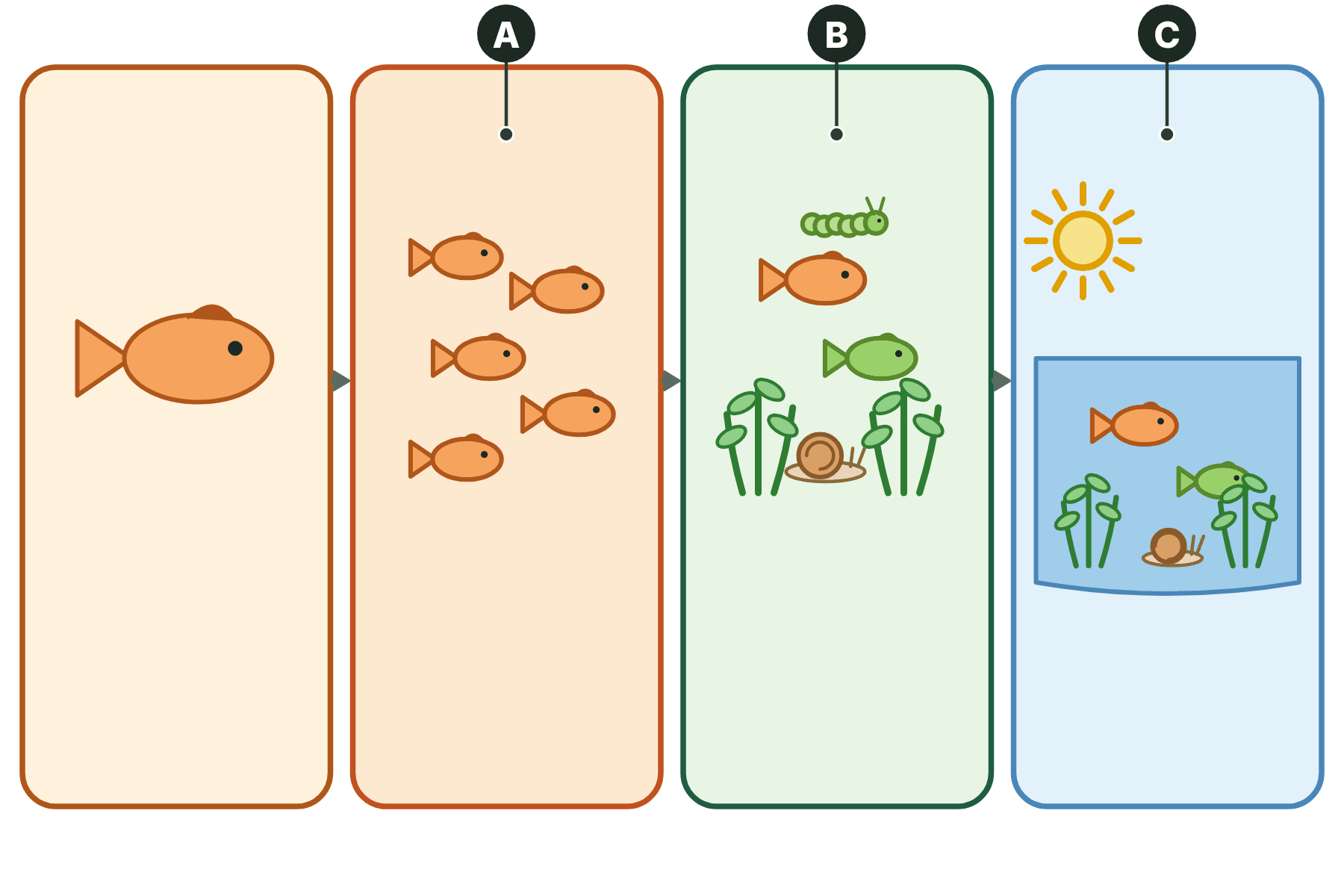
Figure 1 shows levels of organisation in a pond. Name the levels shown at A, B and C.
Show answerHide answer
Model answer
A is a population. B is a community. C is an ecosystem.
Mark scheme
- A: population — 1 mark
- B: community — 1 mark
- C: ecosystem — 1 mark
-
2 State [2 marks]
State what is meant by a population and by a habitat.
Show answerHide answer
Model answer
A population is all the organisms of one species living in an area. A habitat is the place where an organism lives.
Mark scheme
- Population: all the organisms of one species in an area — 1 mark
- Habitat: the place where an organism lives — 1 mark
-
3 Explain [2 marks]
Explain the difference between a community and an ecosystem.
Show answerHide answer
Model answer
A community is all the living things, the populations of all the different species, in an area. An ecosystem is the community together with the non-living, abiotic, parts of the environment.
Mark scheme
- A community is only the living things — 1 mark
- An ecosystem also includes the abiotic parts — 1 mark
-
4 Describe [3 marks]
A woodland contains 40 oak trees, 300 bluebells, 25 foxes and thousands of beetles. Describe the populations and the community in the woodland.
Show answerHide answer
Model answer
The 40 oak trees are one population, and the bluebells, the foxes and the beetles are other populations, each made of one species. All the populations together form the woodland community.
Mark scheme
- Each species is a separate population — 1 mark
- Oak trees, bluebells, foxes and beetles named as populations — 1 mark
- All the populations together are the community — 1 mark
-
5 Calculate [3 marks]
A student counts the animals in a rock pool community. There are 45 limpets, 15 crabs and 40 sea anemones. Calculate the percentage of the animals that are limpets, and the fraction that are crabs, in its simplest form.
Show answerHide answer
Model answer
Limpets are 45 per cent of the animals. Crabs are three twentieths of the animals (15 out of 100).
Mark scheme
- Total = 45 + 15 + 40 = 100 — 1 mark
- Limpets: 45 per cent — 1 mark
- Crabs: 15/100 = 3/20 — 1 mark
-
6 Explain [3 marks]
A pond is polluted and the temperature of the water rises. Explain why this could affect the whole ecosystem.
Show answerHide answer
Model answer
The abiotic factors in the ecosystem have changed. Some species may not survive in the changed conditions, so their populations fall. The other species that feed on them, or compete with them, are affected, so the whole community can change.
Mark scheme
- Abiotic factors change — 1 mark
- Some populations fall or die — 1 mark
- Other populations are affected, so the community changes — 1 mark
Quick check
-
1
What is a population?
Show answerHide answer
B: All the organisms of one species in an area
A population is all the organisms of one species in an area.
-
2
Which level of organisation includes the abiotic factors?
Show answerHide answer
D: Ecosystem
An ecosystem is the community and its non-living surroundings.
-
3
What is a community?
Show answerHide answer
A: All the populations in an area
A community is all the populations of different species living in an area.
-
4
Which of these is a habitat?
Show answerHide answer
C: A pond
A habitat is the place where an organism lives, such as a pond.
-
5
What is the smallest level of organisation?
Show answerHide answer
B: Organism
An organism is a single living thing.
-
6
Which is an example of a community?
Show answerHide answer
D: All the plants and animals in a wood
A community is all the different species living in an area.
-
7
In a pond, which of these is an abiotic part of the ecosystem?
Show answerHide answer
C: The temperature of the water
The temperature of the water is non-living.
-
8
How many species are there in a population?
Show answerHide answer
A: One
A population is made of organisms of one species.
Abiotic and Biotic Factors
Just this lesson-
1 State [2 marks]
State two abiotic factors and one biotic factor that affect the organisms in a community.
Show answerHide answer
Model answer
Any two abiotic factors from temperature, light intensity, moisture level, soil pH, and one biotic factor from predators, food, disease, competition.
Mark scheme
- Two abiotic factors — 1 mark
- One biotic factor — 1 mark
-
2 Explain [3 marks]
Explain how the number of plants growing under a thick canopy of trees is affected by light.
Show answerHide answer
Model answer
The canopy blocks light, so the light intensity is low. The plants get less light for photosynthesis, so they make less glucose and grow less. Fewer plants can survive.
Mark scheme
- Light intensity is low under the canopy — 1 mark
- Less photosynthesis, so less growth — 1 mark
- Fewer plants survive — 1 mark
-
3 Explain [3 marks]
A disease kills many of the rabbits in a field. Explain how this could affect the foxes that live in the field.
Show answerHide answer
Model answer
Rabbits are food for the foxes. With fewer rabbits there is less food. Some foxes may starve or move away, so the fox population falls.
Mark scheme
- Rabbits are food for the foxes — 1 mark
- Less food available — 1 mark
- The fox population falls — 1 mark
-
4 Describe [4 marks]
Describe how a student could use a quadrat to estimate the number of daisies on a lawn.
Show answerHide answer
Model answer
Place the quadrat at random positions on the lawn, by using random numbers for the coordinates. Count the daisies in the quadrat each time. Repeat many times and calculate the mean number per quadrat. Multiply the mean by the number of quadrats that would fit in the whole lawn.
Mark scheme
- Place the quadrat at random — 1 mark
- Count the daisies in each quadrat — 1 mark
- Repeat and calculate a mean — 1 mark
- Multiply by the area of the lawn compared with the quadrat — 1 mark
-
5 Explain [3 marks]
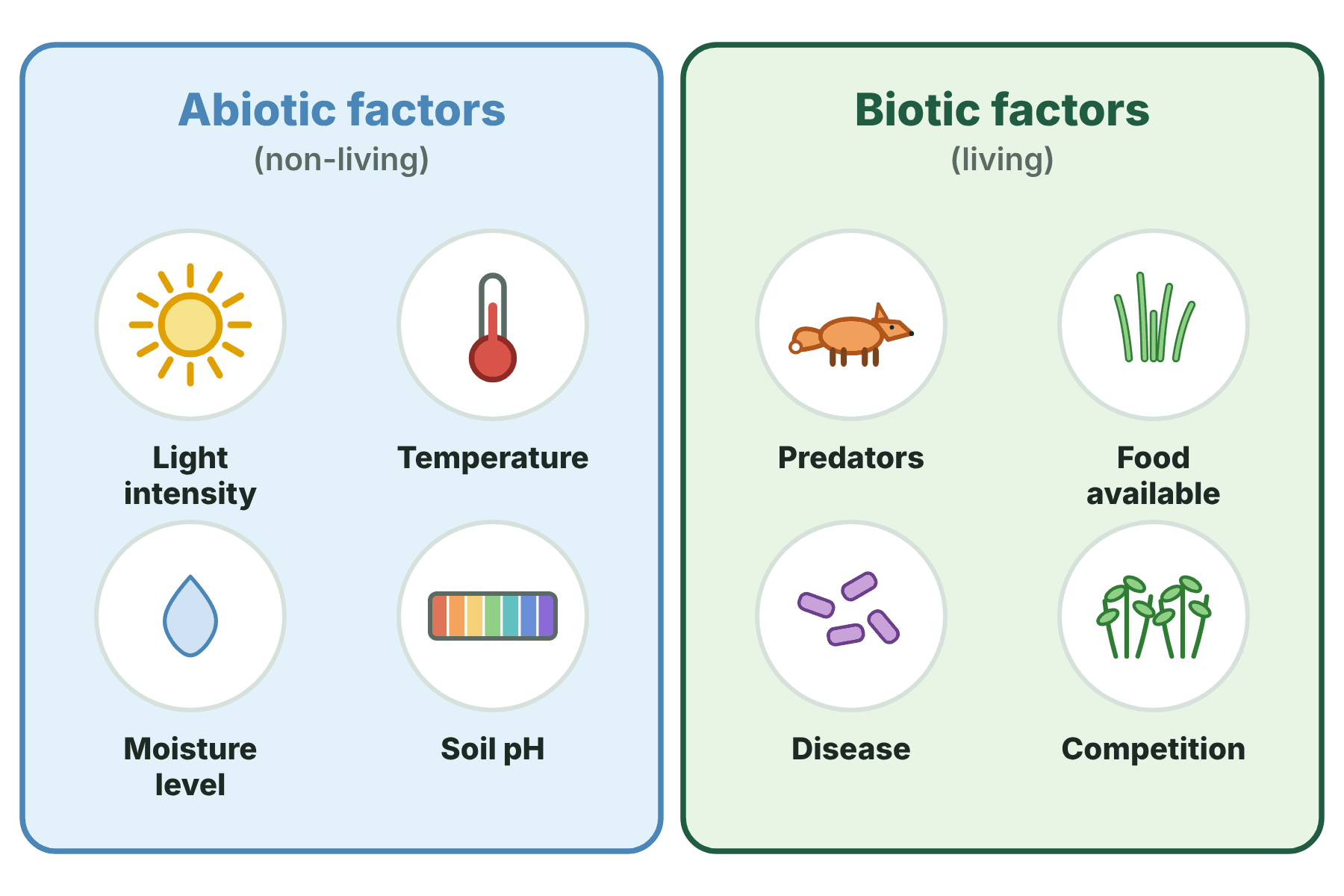
Heather grows well on moors where the soil is acid, but it does not grow well in alkaline soil. Use Figure 1 to name the factor involved, say whether it is abiotic or biotic, and suggest an explanation.
Show answerHide answer
Model answer
The factor is soil pH, which is an abiotic factor. Soil pH affects how well the roots take up minerals, so the heather can only get what it needs in acid soil.
Mark scheme
- Soil pH — 1 mark
- Abiotic factor — 1 mark
- It affects how roots take up minerals — 1 mark
-
6 Suggest [3 marks]
A transect is taken from the edge of a wood into the middle of the wood. The number of grass plants falls along the transect. Suggest two reasons for this.
Show answerHide answer
Model answer
Less light reaches the ground in the middle of the wood because of the trees, so the grass cannot photosynthesise as well. The soil may also be drier or have less water, because the tree roots take up water.
Mark scheme
- Less light in the middle of the wood — 1 mark
- Less photosynthesis so less growth — 1 mark
- Another valid reason, such as less water — 1 mark
-
7 Evaluate [3 marks]
A student finds that there are more snails where the soil is damper. She says that this proves that moisture causes the snails to live there. Evaluate her conclusion.
Show answerHide answer
Model answer
The data shows a link between the moisture of the soil and the number of snails. However, it does not prove cause, because other factors, such as food or shelter, may also be different in damp places. More samples and tests are needed.
Mark scheme
- It shows a link — 1 mark
- It does not prove cause, as other factors could be involved — 1 mark
- More evidence needed — 1 mark
Quick check
-
1
Which of these is an abiotic factor?
Show answerHide answer
C: Temperature
Temperature is non-living, so it is abiotic.
-
2
Which of these is a biotic factor?
Show answerHide answer
A: A predator
A predator is a living thing, so it is a biotic factor.
-
3
Why does light intensity affect the growth of plants?
Show answerHide answer
D: They need it for photosynthesis
Plants need light for photosynthesis.
-
4
What happens to prey when the number of predators increases?
Show answerHide answer
B: It falls
More prey are eaten, so the population of prey falls.
-
5
What is a transect?
Show answerHide answer
C: A line along which samples are taken
A transect is a line along which samples are taken.
-
6
Which instrument measures light intensity?
Show answerHide answer
A: A light meter
A light meter measures light intensity.
-
7
Why should a student take many samples?
Show answerHide answer
B: To get a mean that is reliable
Many samples give a reliable mean for the whole area.
-
8
Which factor limits the number of rabbits if all the grass is eaten?
Show answerHide answer
D: Food
Food is a biotic factor, and the population falls when it runs out.
Interdependence and Competition
Just this lesson-
1 Explain [3 marks]
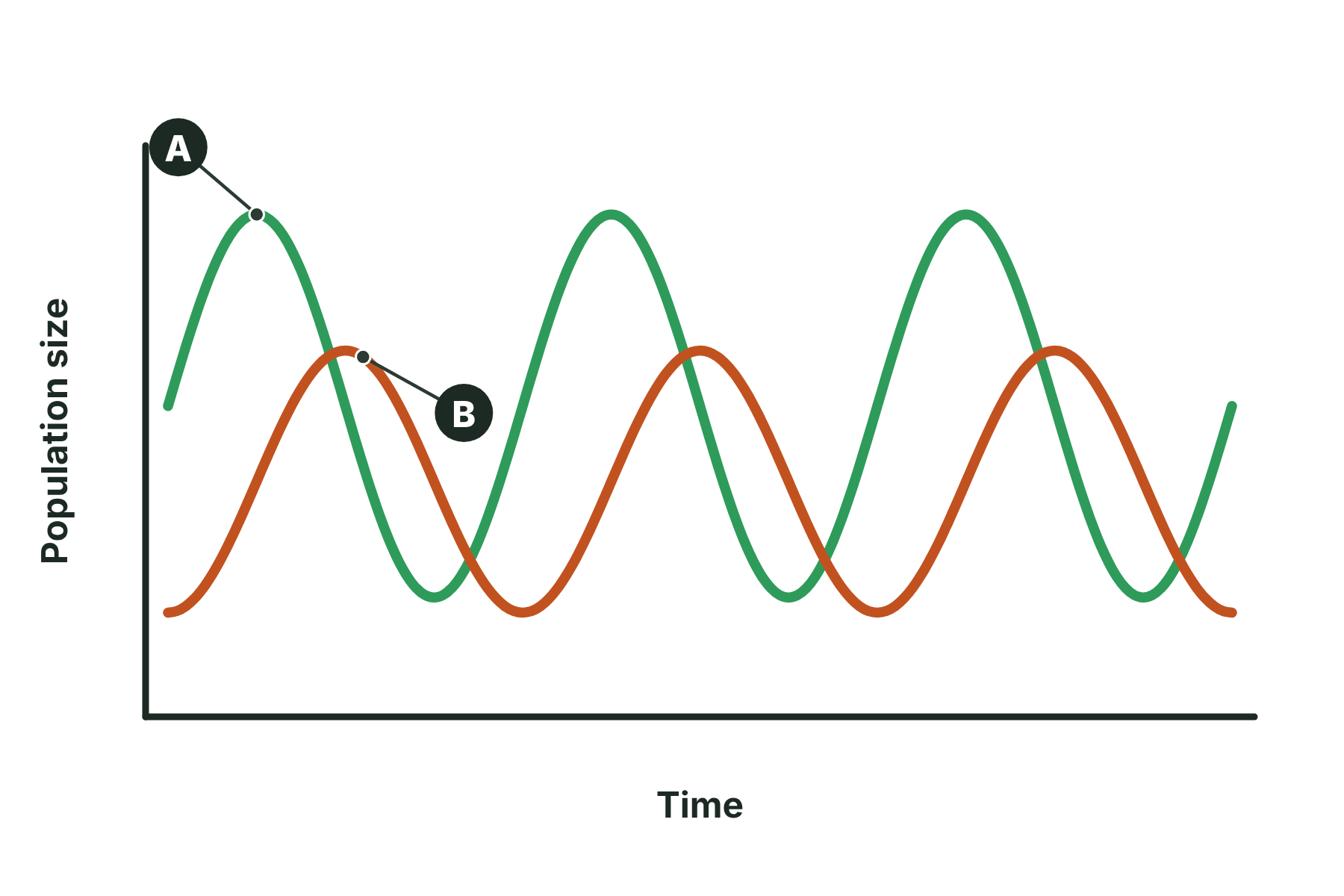
Figure 1 shows the numbers of two animals in a community over time. Which line, A or B, shows the predators? Explain your answer.
Show answerHide answer
Model answer
B shows the predators. The line B peaks after line A, because the predators increase after the prey increase, as they have more food.
Mark scheme
- B — 1 mark
- It peaks after the other line — 1 mark
- The predators increase after the prey, because they have more food — 1 mark
-
2 State [2 marks]
State what is meant by mutualism and give one example.
Show answerHide answer
Model answer
Mutualism is an interaction in which both organisms benefit. An example is nitrogen-fixing bacteria in the root nodules of a clover plant.
Mark scheme
- Both organisms benefit — 1 mark
- A correct example — 1 mark
-
3 Compare [3 marks]
Compare parasitism with mutualism.
Show answerHide answer
Model answer
In parasitism the parasite benefits and the host is harmed. In mutualism both organisms benefit. In both interactions the two organisms live closely together.
Mark scheme
- Parasitism: parasite benefits, host harmed — 1 mark
- Mutualism: both benefit — 1 mark
- Both involve two species living closely together — 1 mark
-
4 Describe [3 marks]
Describe what two plants growing close together compete for.
Show answerHide answer
Model answer
Any three of: light, water, mineral ions (nutrients), space.
Mark scheme
- Three resources — 3 marks
-
5 Explain [3 marks]
Explain why competition limits the size of a population.
Show answerHide answer
Model answer
The resources, such as food, are limited. As the population increases there is less for each individual. Individuals that do not get enough die or do not reproduce, so the population stops growing.
Mark scheme
- Resources are limited — 1 mark
- Less for each individual as the population grows — 1 mark
- Some die or fail to reproduce — 1 mark
-
6 Explain [4 marks]
Explain how the numbers of foxes and rabbits in a field change over time, if the foxes eat only rabbits.
Show answerHide answer
Model answer
When there are many rabbits, the foxes have plenty of food and the fox population increases. The foxes eat more rabbits, so the number of rabbits falls. With less food, the number of foxes falls. With fewer foxes, the rabbit population can rise again, and the cycle repeats.
Mark scheme
- More rabbits, so more food and more foxes — 1 mark
- More foxes, so fewer rabbits — 1 mark
- Less food, so fewer foxes — 1 mark
- Fewer foxes, so rabbits increase again — 1 mark
-
7 Suggest [3 marks]
A disease kills most of the frogs in a pond. Suggest how this could affect the dragonfly larvae, which are eaten by frogs, and the herons, which eat frogs.
Show answerHide answer
Model answer
The dragonfly larvae are no longer eaten by frogs, so their numbers may increase. The herons have less food, so they may move away or their numbers fall.
Mark scheme
- Dragonfly larvae increase — 1 mark
- Because they are eaten less — 1 mark
- Herons have less food, so their numbers fall — 1 mark
Quick check
-
1
In which interaction do both organisms benefit?
Show answerHide answer
C: Mutualism
In mutualism both organisms benefit.
-
2
Which of these is a parasite?
Show answerHide answer
B: A tapeworm
A tapeworm lives in a host and feeds on it.
-
3
What do the nitrogen-fixing bacteria in clover roots get from the plant?
Show answerHide answer
D: Sugars
The plant gives the bacteria sugars, and the bacteria give the plant nitrogen compounds.
-
4
What do animals compete for?
Show answerHide answer
A: Food and mates
Animals compete for food, water, mates, shelter and territory.
-
5
On a predator-prey graph, which peak comes first?
Show answerHide answer
B: The prey
The prey peak comes before the predator peak.
-
6
What happens to a prey population when the predators are removed?
Show answerHide answer
C: It rises
Fewer prey are eaten, so the population is likely to increase.
-
7
What is a stable community?
Show answerHide answer
A: One where the populations stay fairly constant
In a stable community the populations stay fairly constant.
-
8
Which interaction harms both organisms?
Show answerHide answer
D: Competition
In competition each organism has less of the resource, so both are harmed.
Trophic Levels, Pyramids of Biomass and Efficiency
Just this lesson-
1 Name [3 marks]
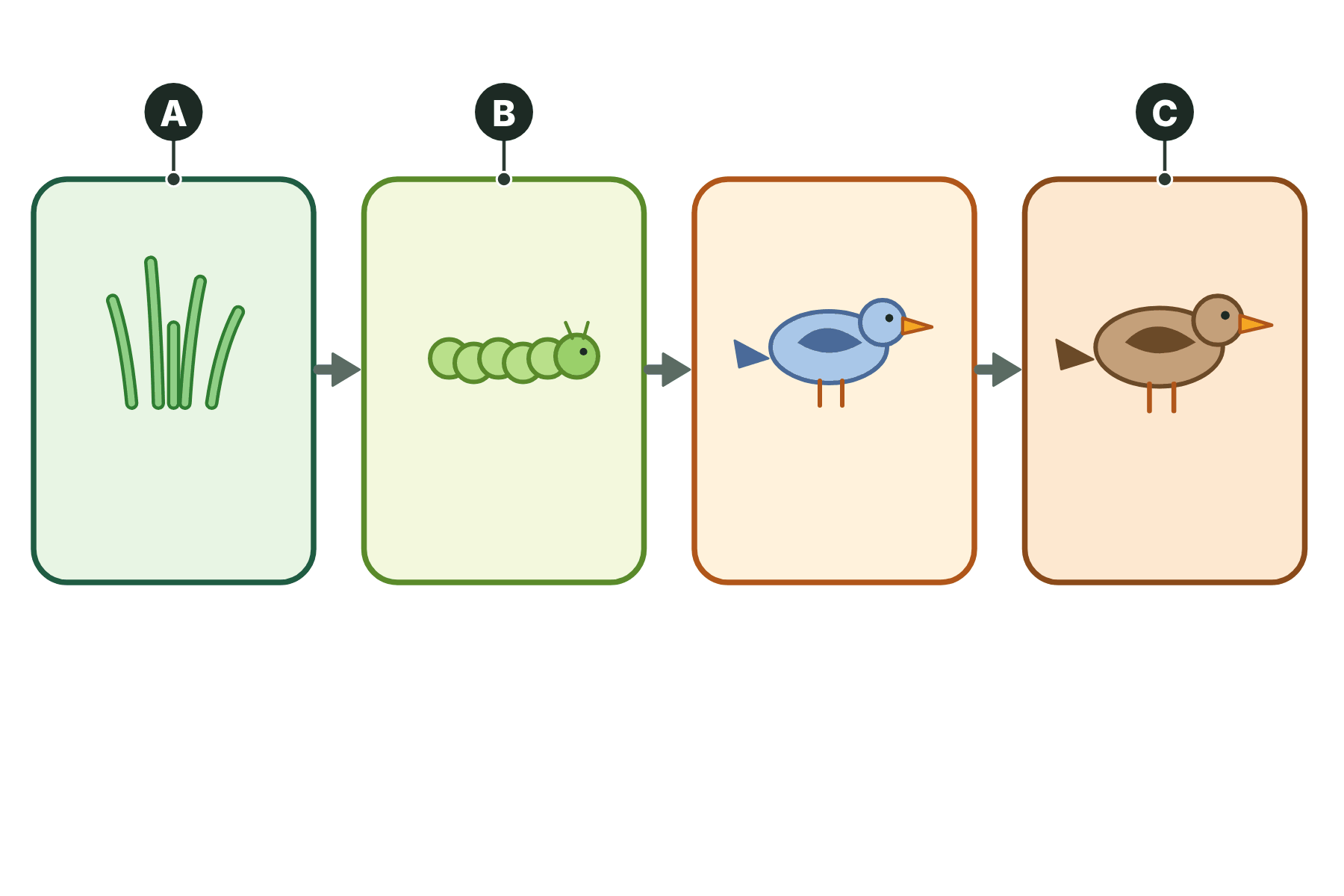
Figure 1 shows a food chain. Name the trophic levels shown at A, B and C.
Show answerHide answer
Model answer
A is the producer (trophic level 1). B is the primary consumer (trophic level 2). C is the tertiary consumer (trophic level 4).
Mark scheme
- A: producer — 1 mark
- B: primary consumer — 1 mark
- C: tertiary consumer — 1 mark
-
2 State [2 marks]
State what a pyramid of biomass shows, and why biomass is used instead of numbers.
Show answerHide answer
Model answer
A pyramid of biomass shows the mass of living material at each trophic level. Biomass is used because the numbers do not show the size of the organisms, as one large organism counts the same as one small one.
Mark scheme
- It shows the mass of living material at each trophic level — 1 mark
- Numbers do not show the size of the organisms — 1 mark
-
3 Explain [4 marks]
Explain why only about 10 per cent of the biomass at one trophic level is passed on to the next.
Show answerHide answer
Model answer
Some parts of the organism, such as bones and roots, are not eaten. Some of the food is not digested and is lost as faeces. Some biomass is lost as urea in urine. A lot of the glucose is used in respiration, which releases energy and carbon dioxide.
Mark scheme
- Some parts are not eaten — 1 mark
- Egestion as faeces — 1 mark
- Excretion of urea — 1 mark
- Respiration — 1 mark
-
4 Calculate [3 marks]
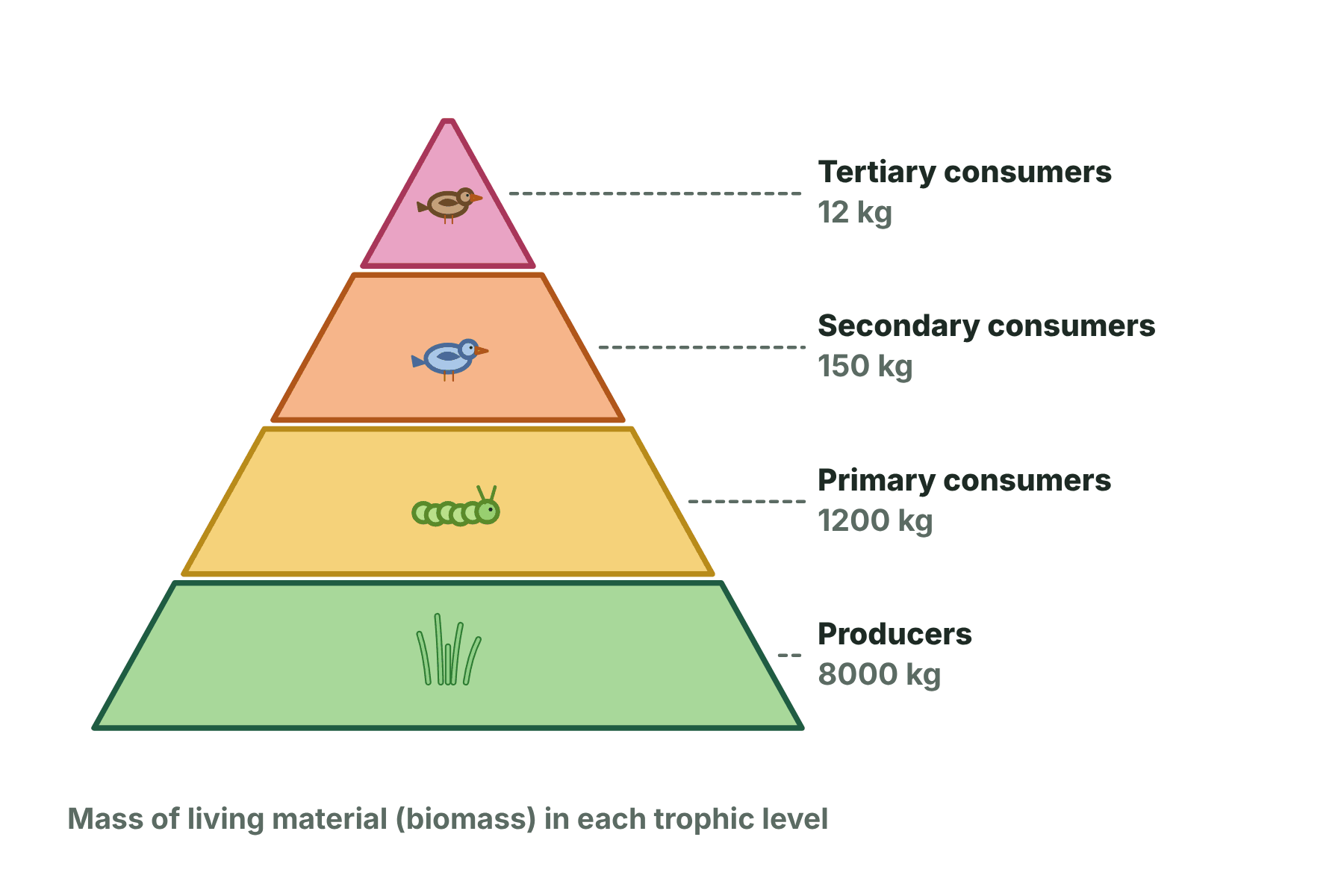
Use Figure 2 to calculate the efficiency of the biomass transfer from the primary consumers to the secondary consumers. Give your answer as a percentage.
Show answerHide answer
Model answer
The efficiency is 12.5 per cent.
Mark scheme
- \(\frac{150}{1200}\) — 1 mark
- \(\times 100\) — 1 mark
- 12.5% — 1 mark
-
5 Calculate [3 marks]
A herbivore eats 400 kg of grass. The herbivore gains 36 kg of biomass. Calculate the efficiency of the biomass transfer, and suggest where the rest of the biomass went.
Show answerHide answer
Model answer
The efficiency is 9 per cent. The rest was lost by egestion, excretion and respiration, and parts of the grass that were not eaten.
Mark scheme
- \(36 \div 400 \times 100\) — 1 mark
- 9% — 1 mark
- Lost by egestion, excretion, respiration — 1 mark
-
6 Explain [3 marks]
Explain why food chains rarely have more than five trophic levels.
Show answerHide answer
Model answer
Biomass is lost at each step, because of respiration, egestion and excretion. The efficiency of each transfer is low, about 10 per cent. After a few steps there is too little biomass left to support another trophic level.
Mark scheme
- Biomass is lost at each transfer — 1 mark
- The efficiency is low — 1 mark
- Too little biomass left to support another level — 1 mark
-
7 Explain [3 marks]
Explain why a field of wheat can provide food for more people than the same field used to raise cattle.
Show answerHide answer
Model answer
If people eat the wheat, there is one transfer from producer to consumer. If the wheat is fed to cattle first, there is another transfer, and a lot of biomass is lost by the cattle in respiration and in other ways. So less of the original biomass reaches people as beef.
Mark scheme
- Wheat has one transfer to people — 1 mark
- Cattle add another trophic level — 1 mark
- Cattle lose much biomass, so less reaches people — 1 mark
Quick check
-
1
Which organisms are at the first trophic level?
Show answerHide answer
A: Producers
Producers, such as plants, are at the first trophic level.
-
2
What is a secondary consumer?
Show answerHide answer
C: An animal that eats primary consumers
A secondary consumer eats primary consumers.
-
3
What does a pyramid of biomass show?
Show answerHide answer
B: The mass of living material at each trophic level
It shows the mass of living material at each trophic level.
-
4
Which of these is NOT a way that biomass is lost between trophic levels?
Show answerHide answer
D: Photosynthesis
Photosynthesis makes biomass; it does not lose it.
-
5
What is egestion?
Show answerHide answer
A: Loss of faeces
Egestion is the loss of undigested food as faeces.
-
6
A level has 500 kg of biomass and the next has 50 kg. What is the efficiency of the transfer?
Show answerHide answer
C: 10%
50 divided by 500 times 100 is 10 per cent.
-
7
Why are food chains short?
Show answerHide answer
B: Biomass is lost at each transfer
A lot of biomass is lost at each transfer, so there is too little at the top.
-
8
Why is eating plants more efficient than eating animals?
Show answerHide answer
D: There are fewer trophic levels, so less biomass is lost
Fewer trophic levels means less biomass is lost.