Exam questions · Biology · Communities in Ecosystems
Interdependence and Competition
- 7 exam questions
- 21 marks
- 8 quick checks
-
1 Explain [3 marks]
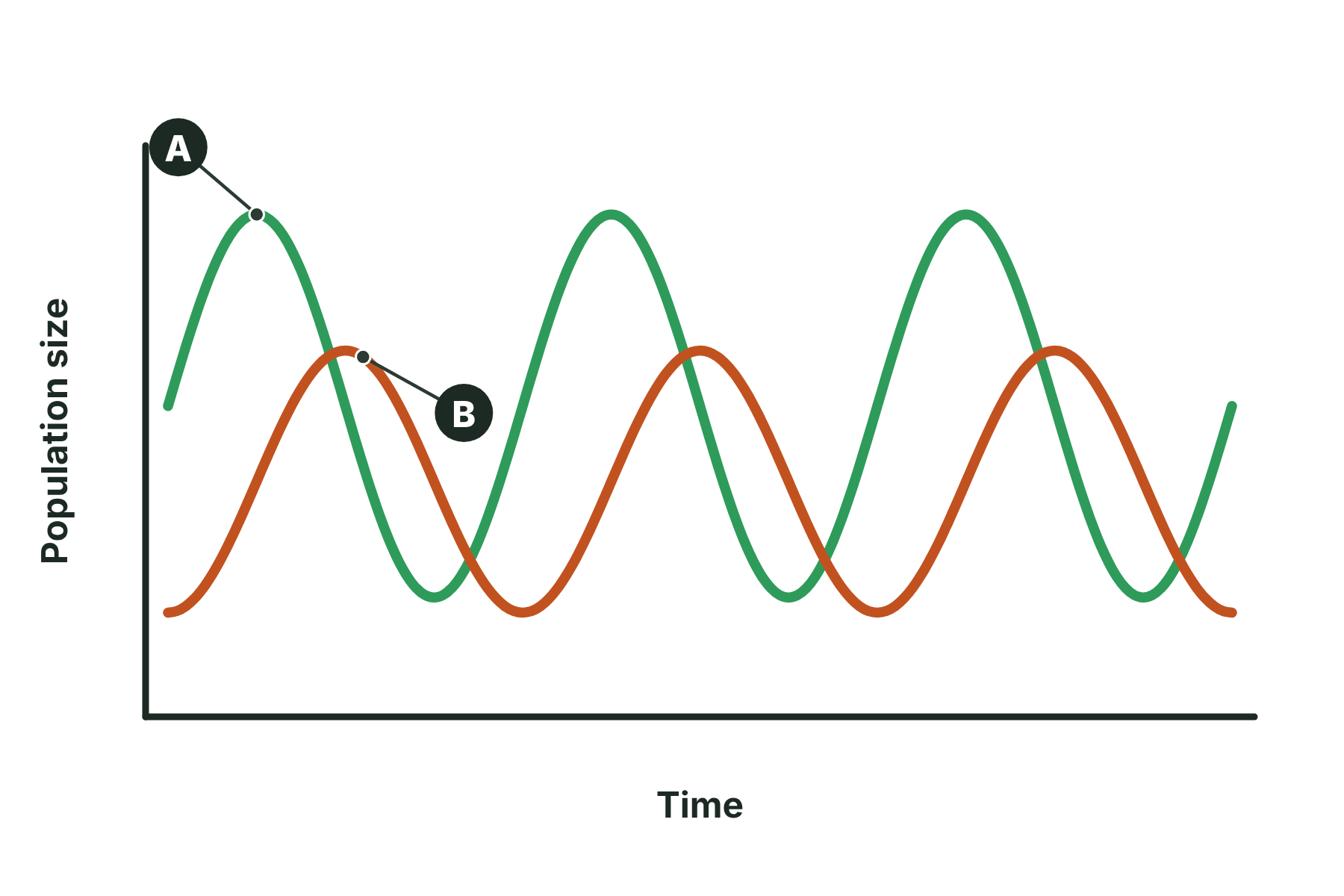
Figure 1 shows the numbers of two animals in a community over time. Which line, A or B, shows the predators? Explain your answer.
Show answerHide answer
Model answer
B shows the predators. The line B peaks after line A, because the predators increase after the prey increase, as they have more food.
Mark scheme
- B — 1 mark
- It peaks after the other line — 1 mark
- The predators increase after the prey, because they have more food — 1 mark
-
2 State [2 marks]
State what is meant by mutualism and give one example.
Show answerHide answer
Model answer
Mutualism is an interaction in which both organisms benefit. An example is nitrogen-fixing bacteria in the root nodules of a clover plant.
Mark scheme
- Both organisms benefit — 1 mark
- A correct example — 1 mark
-
3 Compare [3 marks]
Compare parasitism with mutualism.
Show answerHide answer
Model answer
In parasitism the parasite benefits and the host is harmed. In mutualism both organisms benefit. In both interactions the two organisms live closely together.
Mark scheme
- Parasitism: parasite benefits, host harmed — 1 mark
- Mutualism: both benefit — 1 mark
- Both involve two species living closely together — 1 mark
-
4 Describe [3 marks]
Describe what two plants growing close together compete for.
Show answerHide answer
Model answer
Any three of: light, water, mineral ions (nutrients), space.
Mark scheme
- Three resources — 3 marks
-
5 Explain [3 marks]
Explain why competition limits the size of a population.
Show answerHide answer
Model answer
The resources, such as food, are limited. As the population increases there is less for each individual. Individuals that do not get enough die or do not reproduce, so the population stops growing.
Mark scheme
- Resources are limited — 1 mark
- Less for each individual as the population grows — 1 mark
- Some die or fail to reproduce — 1 mark
-
6 Explain [4 marks]
Explain how the numbers of foxes and rabbits in a field change over time, if the foxes eat only rabbits.
Show answerHide answer
Model answer
When there are many rabbits, the foxes have plenty of food and the fox population increases. The foxes eat more rabbits, so the number of rabbits falls. With less food, the number of foxes falls. With fewer foxes, the rabbit population can rise again, and the cycle repeats.
Mark scheme
- More rabbits, so more food and more foxes — 1 mark
- More foxes, so fewer rabbits — 1 mark
- Less food, so fewer foxes — 1 mark
- Fewer foxes, so rabbits increase again — 1 mark
-
7 Suggest [3 marks]
A disease kills most of the frogs in a pond. Suggest how this could affect the dragonfly larvae, which are eaten by frogs, and the herons, which eat frogs.
Show answerHide answer
Model answer
The dragonfly larvae are no longer eaten by frogs, so their numbers may increase. The herons have less food, so they may move away or their numbers fall.
Mark scheme
- Dragonfly larvae increase — 1 mark
- Because they are eaten less — 1 mark
- Herons have less food, so their numbers fall — 1 mark
Quick check
-
1
In which interaction do both organisms benefit?
Show answerHide answer
C: Mutualism
In mutualism both organisms benefit.
-
2
Which of these is a parasite?
Show answerHide answer
B: A tapeworm
A tapeworm lives in a host and feeds on it.
-
3
What do the nitrogen-fixing bacteria in clover roots get from the plant?
Show answerHide answer
D: Sugars
The plant gives the bacteria sugars, and the bacteria give the plant nitrogen compounds.
-
4
What do animals compete for?
Show answerHide answer
A: Food and mates
Animals compete for food, water, mates, shelter and territory.
-
5
On a predator-prey graph, which peak comes first?
Show answerHide answer
B: The prey
The prey peak comes before the predator peak.
-
6
What happens to a prey population when the predators are removed?
Show answerHide answer
C: It rises
Fewer prey are eaten, so the population is likely to increase.
-
7
What is a stable community?
Show answerHide answer
A: One where the populations stay fairly constant
In a stable community the populations stay fairly constant.
-
8
Which interaction harms both organisms?
Show answerHide answer
D: Competition
In competition each organism has less of the resource, so both are harmed.