Flashcards · Biology · Communities in Ecosystems
Interdependence and Competition
-
What is interdependence?
Species in a community depending on each other.
-
What is predation?
A predator hunting and eating its prey.
-
What is mutualism?
An interaction in which both organisms benefit.
-
Give an example of mutualism.
Nitrogen-fixing bacteria in the root nodules of clover.
-
What is parasitism?
A parasite living on or in a host and feeding on it, which harms the host.
-
Give an example of a parasite.
A tapeworm, a tick or a flea.
-
What do plants compete for?
Light, water, mineral ions and space.
-
What do animals compete for?
Food, water, mates, shelter and territory.
-
What happens to the prey when the predators increase?
The prey population falls.
-
Which peaks first on a predator-prey graph?
The prey.
-
Why does the predator peak come later?
The predators need the extra prey to reproduce and grow.
-
What is a stable community?
One where the populations stay fairly constant.
-
What happens if a species is removed from a community?
The species that depend on it are affected.
-
Who benefits in parasitism?
The parasite.
-
Do both organisms benefit in competition?
No, both are harmed, because they need the same resource.
-
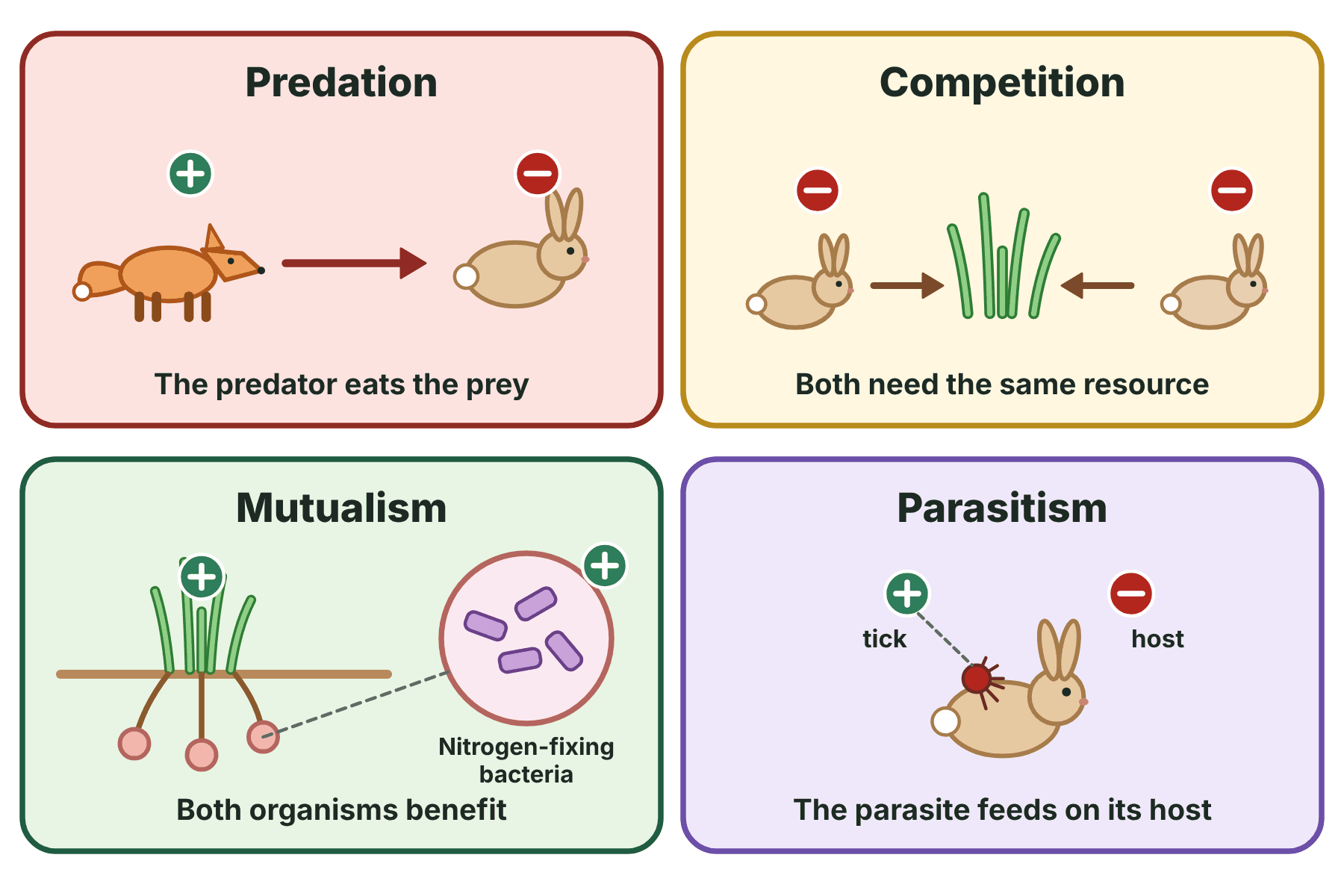 Name the type of interaction and say who benefits.
 Predation: the predator benefits and the prey is harmed. Competition: both are harmed. Mutualism: both benefit. Parasitism: the parasite benefits and the host is harmed.