Exam questions · Biology · Cycles in Ecosystems
The Water Cycle
- 7 exam questions
- 20 marks
- 8 quick checks
-
1 Name [3 marks]
Figure 1 shows the water cycle. Name the processes shown at A, B and C.
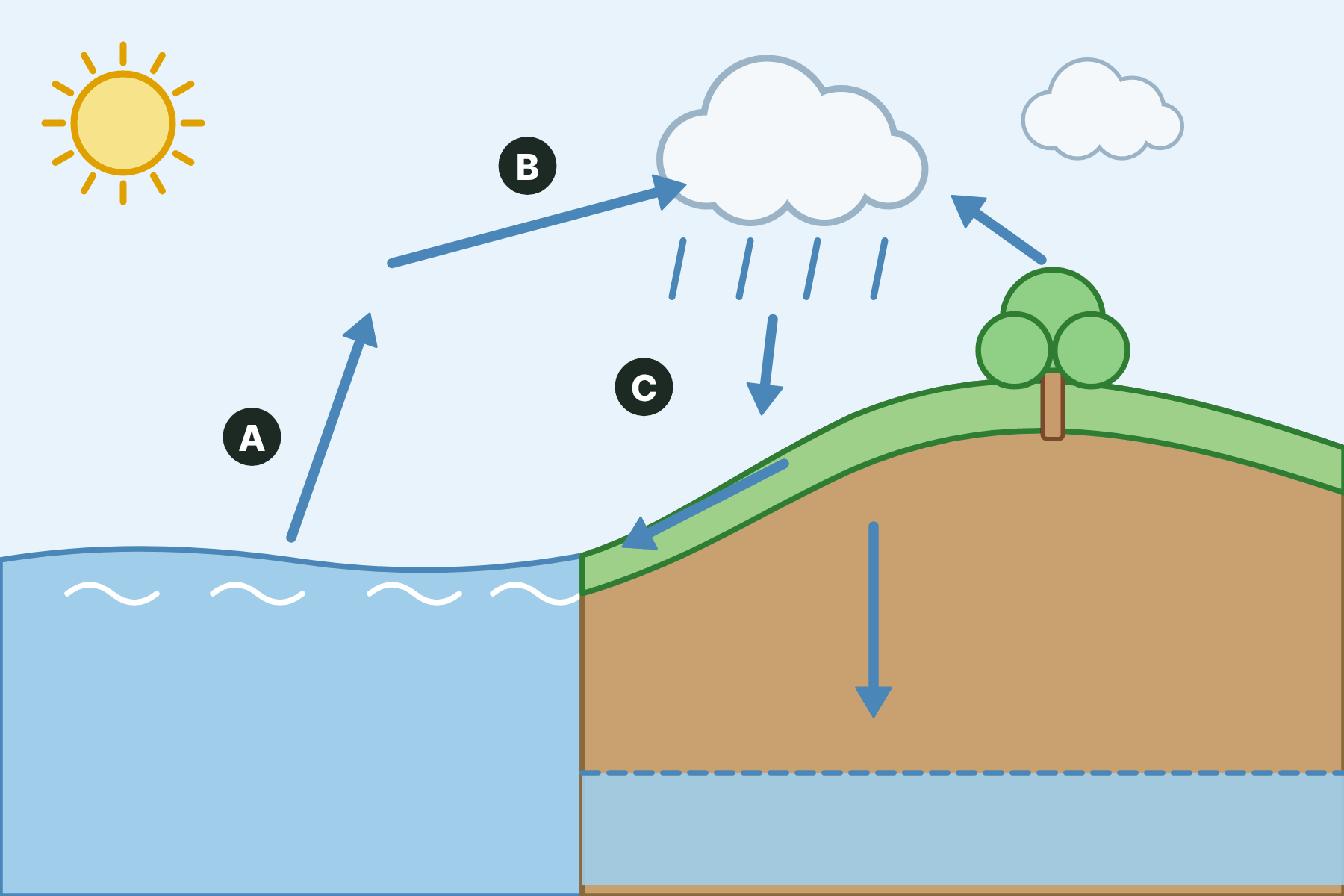
Show answerHide answer
Model answer
A is evaporation. B is condensation. C is precipitation.
Mark scheme
- A: evaporation — 1 mark
- B: condensation — 1 mark
- C: precipitation — 1 mark
-
2 State [2 marks]
State two ways in which water vapour gets into the air.
Show answerHide answer
Model answer
Evaporation (from the sea, lakes and soil) and transpiration (from plants).
Mark scheme
- Evaporation — 1 mark
- Transpiration — 1 mark
-
3 Describe [3 marks]
Describe how clouds form.
Show answerHide answer
Model answer
The Sun heats water, which evaporates and rises as water vapour. The air higher up is colder, so the vapour cools. It condenses into tiny droplets of liquid water, which form clouds.
Mark scheme
- Water evaporates and rises as vapour — 1 mark
- The vapour cools — 1 mark
- It condenses into droplets that form clouds — 1 mark
-
4 Explain [3 marks]
Explain why the rain that falls on land is fresh water even though most of the water that evaporates comes from the sea.
Show answerHide answer
Model answer
When sea water evaporates, only the water turns into vapour. The salt and other dissolved substances are left behind in the sea. The vapour condenses to make clouds of pure water, so the rain is fresh water.
Mark scheme
- Only the water evaporates — 1 mark
- The salt is left behind — 1 mark
- The vapour condenses into fresh water — 1 mark
-
5 Explain [3 marks]
Explain why the water cycle is important in maintaining habitats.
Show answerHide answer
Model answer
Rain refills rivers, lakes and ponds, which are the habitats of aquatic organisms. It also keeps the soil moist, which land plants and animals need. Without it, the habitats would dry up.
Mark scheme
- Rain refills rivers, lakes and ponds — 1 mark
- It keeps the soil moist — 1 mark
- Habitats would dry up without it — 1 mark
-
6 Explain [3 marks]
Explain how the water cycle helps the flow of nutrients in an ecosystem.
Show answerHide answer
Model answer
Water dissolves mineral ions in the soil. The water in the soil carries the mineral ions to the roots of plants, so the plants can take them up. Rain and run-off also carry nutrients from the land into rivers and lakes.
Mark scheme
- Water dissolves mineral ions — 1 mark
- Plants take up the dissolved ions through their roots — 1 mark
- Run-off carries nutrients into rivers and lakes — 1 mark
-
7 Suggest [3 marks]
A forest is cut down. Suggest how this could change the water cycle in the area.
Show answerHide answer
Model answer
The trees no longer take up water or lose water vapour by transpiration, so less water vapour enters the air and there may be less rain. More rain runs off the surface instead of soaking into the soil, which can cause floods and wash away nutrients.
Mark scheme
- Less transpiration, so less water vapour in the air — 1 mark
- More run-off, less infiltration — 1 mark
- Nutrients may be washed away / floods — 1 mark
Quick check
-
1
What is the source of energy for the water cycle?
Show answerHide answer
C: The Sun
Heat from the Sun makes water evaporate and drives the cycle.
-
2
What is transpiration?
Show answerHide answer
A: Water vapour lost from plant leaves
Transpiration is the loss of water vapour from the leaves of plants.
-
3
What happens in condensation?
Show answerHide answer
D: Water vapour turns into droplets
Water vapour cools and turns into liquid water droplets.
-
4
Which of these is precipitation?
Show answerHide answer
B: Snow
Rain, snow, sleet and hail are all precipitation.
-
5
What is run-off?
Show answerHide answer
C: Water flowing over the land surface
Run-off is water flowing over the surface of the land into rivers and the sea.
-
6
Why is the rain fresh water?
Show answerHide answer
A: The salt is left behind when water evaporates
The salt is left behind in the sea when the water evaporates.
-
7
How does the water cycle help plants?
Show answerHide answer
D: It supplies water to the soil
It supplies water to the soil, which plants take up through their roots.
-
8
Which two processes put water vapour into the air?
Show answerHide answer
B: Evaporation and transpiration
Evaporation and transpiration both put water vapour into the air.