Exam questions · Biology · Feeding the Human Race
Benefits and Risks of Gene Technology in Agriculture
- 8 exam questions
- 25 marks
- 8 quick checks
-
1 State [1 mark]
State one benefit of growing a crop that has been genetically modified to resist insect pests.
Show answerHide answer
Model answer
Less insecticide has to be used (or a higher yield, or lower costs).
Mark scheme
- Any one suitable benefit, such as less pesticide or a higher yield — 1 mark
-
2 Describe [2 marks]
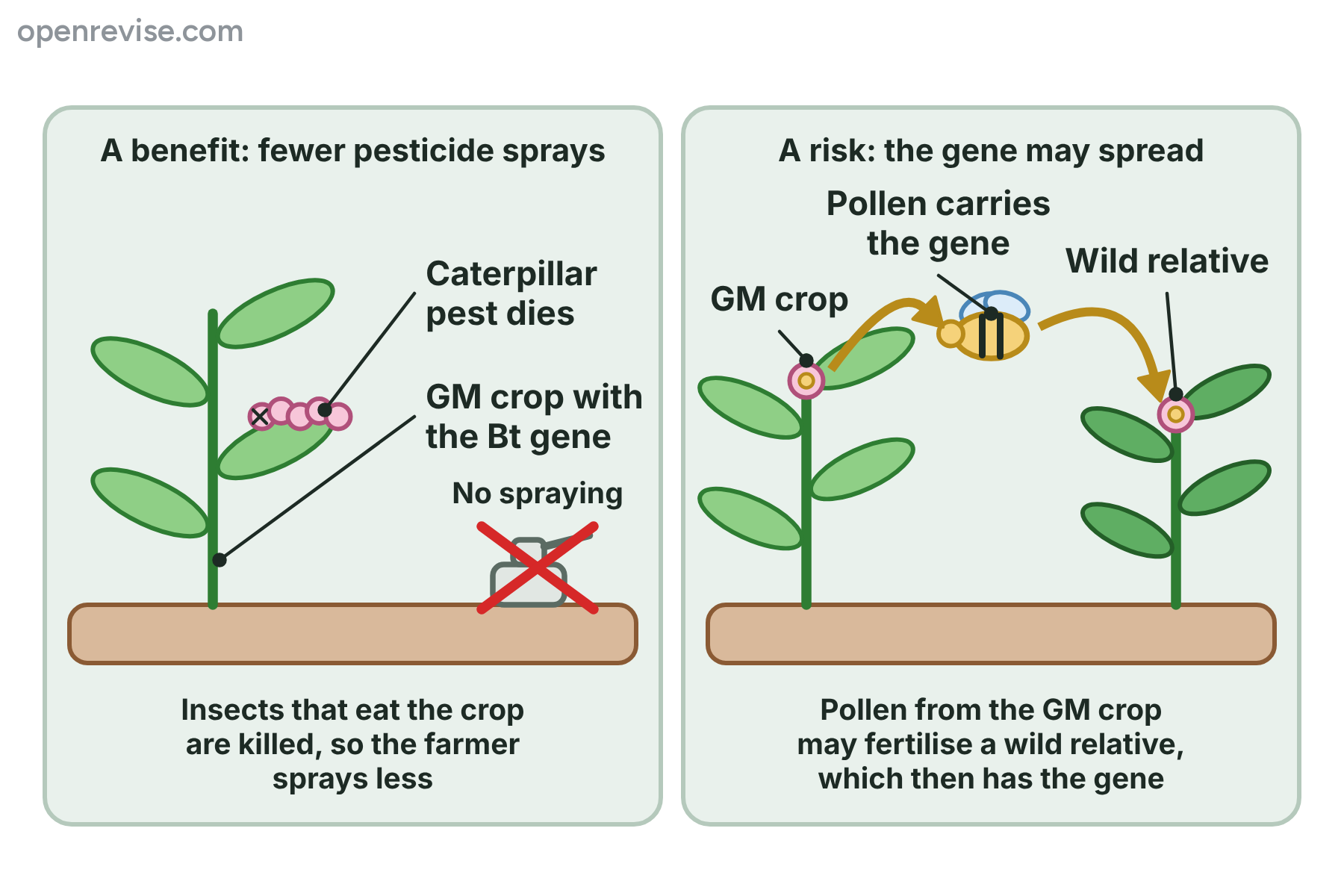
Look at the diagram. Describe one possible risk of growing GM crops that is shown in the diagram.
Show answerHide answer
Model answer
Pollen from the GM crop is carried by a bee to a wild relative of the crop. The gene may spread into the wild plant, which could then have the new characteristic, such as resistance to a herbicide.
Mark scheme
- Pollen carried from the GM crop to a wild relative — 1 mark
- The gene may spread to the wild plants, with a possible harm — 1 mark
-
3 Explain [3 marks]
A farmer grows Bt maize for many years. Explain why the insect pests may become resistant to the Bt protein.
Show answerHide answer
Model answer
Some of the insects have a variation that makes them resistant to the Bt protein. These insects survive when they eat the maize, and they reproduce. They pass on the resistance to their offspring, so the proportion of resistant insects increases, and the Bt protein no longer controls the pest.
Mark scheme
- Some insects are resistant (variation) — 1 mark
- They survive, reproduce and pass on the resistance — 1 mark
- The proportion of resistant insects increases over time — 1 mark
-
4 Calculate [3 marks]
Source: In a trial, 20 fields were planted with a GM maize that is resistant to a herbicide and 20 fields with non-GM maize. The mean yield of the GM maize was 10.4 tonnes per hectare. The mean yield of the non-GM maize was 8.0 tonnes per hectare. Calculate the percentage increase in the mean yield of the GM maize compared with the non-GM maize.
Show answerHide answer
Model answer
Increase = 10.4 - 8.0 = 2.4 tonnes per hectare. Percentage increase = \(\frac{2.4}{8.0} \times 100 = 30\%\).
Mark scheme
- \(10.4 - 8.0 = 2.4\) — 1 mark
- \(2.4 \div 8.0 \times 100\) — 1 mark
- 30% — 1 mark
-
5 Explain [3 marks]
Farmers can use herbicide to kill the weeds in a field of herbicide-resistant GM soya without killing the soya. Explain one benefit of this and one problem that it could cause.
Show answerHide answer
Model answer
The weeds are killed and no longer compete with the soya for light, water and minerals, so the yield is higher (benefit). However, if the same herbicide is used year after year, weeds that are resistant to it survive and reproduce, so the resistance becomes common, and the herbicide stops working (problem).
Mark scheme
- Benefit: weeds are killed, so there is less competition and a higher yield — 1 mark
- Problem: weeds with resistance survive and reproduce — 1 mark
- The resistant weeds become common, so the herbicide stops working — 1 mark
-
6 Explain [4 marks]
Some people object to the use of genetic engineering in agriculture. Explain one practical consideration and one ethical consideration that people may raise.
Show answerHide answer
Model answer
A practical consideration is that the gene could spread by pollen to wild relatives, and so produce plants that are hard to control. This is about what could happen in the environment. An ethical consideration is whether it is right to alter the genome of an organism, or move genes between species, because some people think that it is unnatural. This is about right and wrong, instead of what will happen.
Mark scheme
- A practical consideration, such as gene flow, harm to other organisms or cost — 1 mark
- Explanation of why this matters — 1 mark
- An ethical consideration, such as the right to alter genes, ownership by companies or consumer choice — 1 mark
- Explanation of why people think it is a concern — 1 mark
-
7 Explain [3 marks]
Explain why growing one GM variety of a crop over a very large area could be a risk.
Show answerHide answer
Model answer
All of the plants have the same genes, so there is little variation. If a new pest or disease appears, and the variety has no resistance to it, then all of the plants could be damaged. Much of the crop could be lost, and food supplies would be threatened.
Mark scheme
- Little genetic variation, because all the plants are alike — 1 mark
- A new disease or pest could infect all of them — 1 mark
- A large part of the crop could be lost — 1 mark
-
8 Evaluate [6 marks]
The world needs to produce more food. Evaluate the use of genetically modified crops to help to feed the growing human population.
Show answerHide answer
Model answer
GM crops could help to feed more people because they can be given resistance to pests and diseases, so less of the crop is lost and the yield is higher. Some are engineered to tolerate drought or to contain extra vitamins, so food can be grown on poor land and may be more nutritious. Crops that make their own insecticide mean that farmers spray less, which saves money and reduces damage to wildlife. However, there are risks. The gene could spread by pollen to wild plants, and pests and weeds can become resistant, so the benefit may not last. A protein that kills pests may harm harmless insects, and seed is more expensive and sometimes patented, so poor farmers may not benefit. Some people also object to changing the genes of organisms, and the long-term effects on health are still being studied. Overall, GM crops can be a useful way of helping to improve yields, so long as they are carefully tested, regulated and monitored, and used alongside other approaches.
Mark scheme
- Level 3 (5 to 6 marks): several benefits and several risks are explained and linked to evidence or to people, and a supported conclusion is reached — A balanced evaluation with a clear judgement
- Level 2 (3 to 4 marks): benefits and risks are described, but explanation is limited, or the answer is unbalanced — Some reasoning, but no supported conclusion
- Level 1 (1 to 2 marks): a few simple statements about GM crops — Points made without explanation
- Possible points: higher yield; less pesticide; nutrition; drought tolerance; gene flow; non-target harm; resistance; cost and patents; ethics; uncertainty — Content that can earn credit at any level
Quick check
-
1
Which of these is a possible benefit of a GM crop?
Show answerHide answer
B: Less pesticide needs to be sprayed
A crop that resists pests needs fewer sprays, which also reduces damage to wildlife and saves money.
-
2
What is gene flow?
Show answerHide answer
C: Genes spreading to other plants by pollen
Gene flow is the spread of genes between populations, for example by pollen from a GM crop to wild plants.
-
3
Which of these is an ethical consideration about GM crops?
Show answerHide answer
A: Whether it is right to alter the genome of a living organism
Whether it is right to change the genes of living things is a question of right and wrong.
-
4
Why do some people want GM foods to be labelled?
Show answerHide answer
D: So that people can choose what to buy
Labelling lets consumers know what they are eating, so that they can choose non-GM food if they prefer.
-
5
What is a superweed?
Show answerHide answer
B: A weed that is resistant to a herbicide
A superweed has become resistant to a herbicide because the herbicide has been used repeatedly.
-
6
Which is a possible risk of a protein that kills pests in a GM crop?
Show answerHide answer
C: It could harm other insects that are not pests
The protein could harm harmless insects that eat the crop or its pollen.
-
7
The yield of a GM crop is 6.0 tonnes per hectare and a non-GM crop gives 5.0. What is the percentage increase?
Show answerHide answer
A: 20%
The increase is 1.0, and 1.0 divided by 5.0, multiplied by 100, is 20%.
-
8
Why can planting one GM variety over a huge area be a risk?
Show answerHide answer
D: A new disease could damage all of the plants
There is little genetic variation, so a new disease could damage the whole crop.