Flashcards · Biology · Feeding the Human Race
Benefits and Risks of Gene Technology in Agriculture
-
Give two benefits of GM crops.
A higher yield and less pesticide, or more nutritious crops, or crops that survive drought.
-
Why does a Bt crop need fewer insecticide sprays?
It makes a protein that kills the caterpillars that eat it.
-
How can GM crops help in drought-prone areas?
They can be engineered to tolerate drought, so food can be grown on poorer land.
-
What is gene flow?
The spread of a gene to other populations, for example by pollen from a GM crop to a wild relative.
-
Why is gene flow a risk?
A wild plant could gain resistance to a herbicide and become hard to control.
-
How can GM crops harm other organisms?
The toxin or herbicide could harm harmless insects or plants that are not the target.
-
How can pests become resistant to the Bt protein?
Resistant pests survive and reproduce, so the resistance becomes more common.
-
What is a superweed?
A weed that has become resistant to a herbicide.
-
Why is GM seed a concern for poor farmers?
It is more costly, and it is often patented, so new seed may have to be bought each year.
-
Why do some people want long-term studies of GM food?
The effects on health and ecosystems might take years to show.
-
Give one ethical objection to GM crops.
It is wrong to alter genomes or to move genes between species, or companies should not own life forms.
-
Give one ethical argument for GM crops.
It would be wrong not to use a technology that could reduce hunger and malnutrition.
-
What is the difference between a practical and an ethical consideration?
Practical: what will work, cost and happen. Ethical: what is right or wrong.
-
Why might organic farmers object to GM crops?
Pollen from GM crops could cross-pollinate their crops.
-
Why can growing one GM variety over a large area be a risk?
It reduces genetic variation, so a new disease could damage the whole crop.
-
What should a good evaluation answer finish with?
A conclusion that follows from the benefits and risks that have been explained.
-
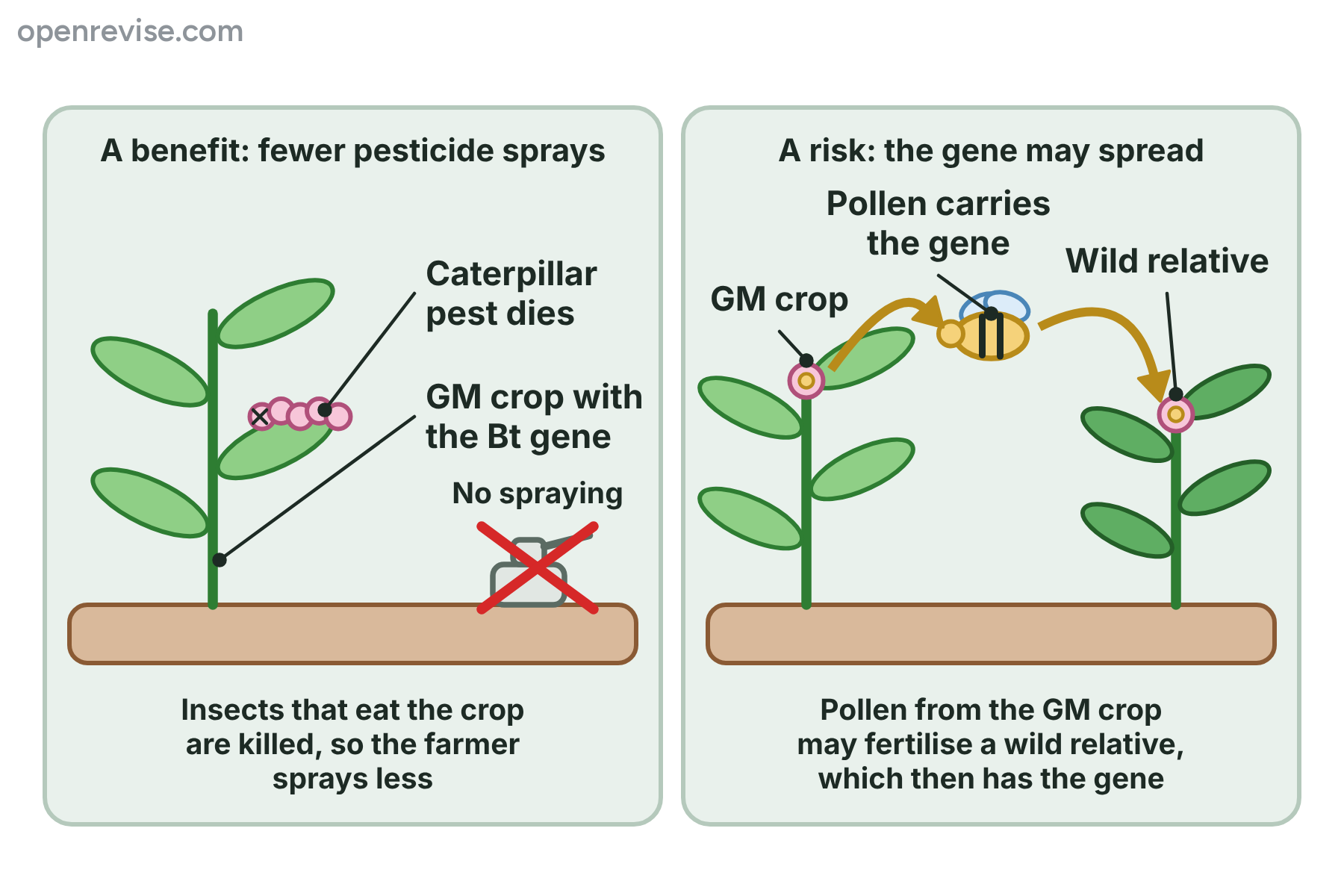 Describe one benefit and one risk of GM crops shown in the diagram.
 Benefit: the crop makes a protein that kills caterpillar pests, so the farmer needs to spray less. Risk: pollen from the GM crop may fertilise a wild relative, so the gene spreads into wild plants.