Exam questions · Biology · Feeding the Human Race
Genetic Engineering
- 7 exam questions
- 21 marks
- 8 quick checks
-
1 Describe [2 marks]
Describe what is meant by genetic engineering.
Show answerHide answer
Model answer
Genetic engineering is a process that changes the genome of an organism. A gene is inserted into the organism (often from another species) to give it a desirable characteristic.
Mark scheme
- Modifying the genome of an organism — 1 mark
- By inserting a gene to give a desirable characteristic — 1 mark
-
2 Describe [3 marks]
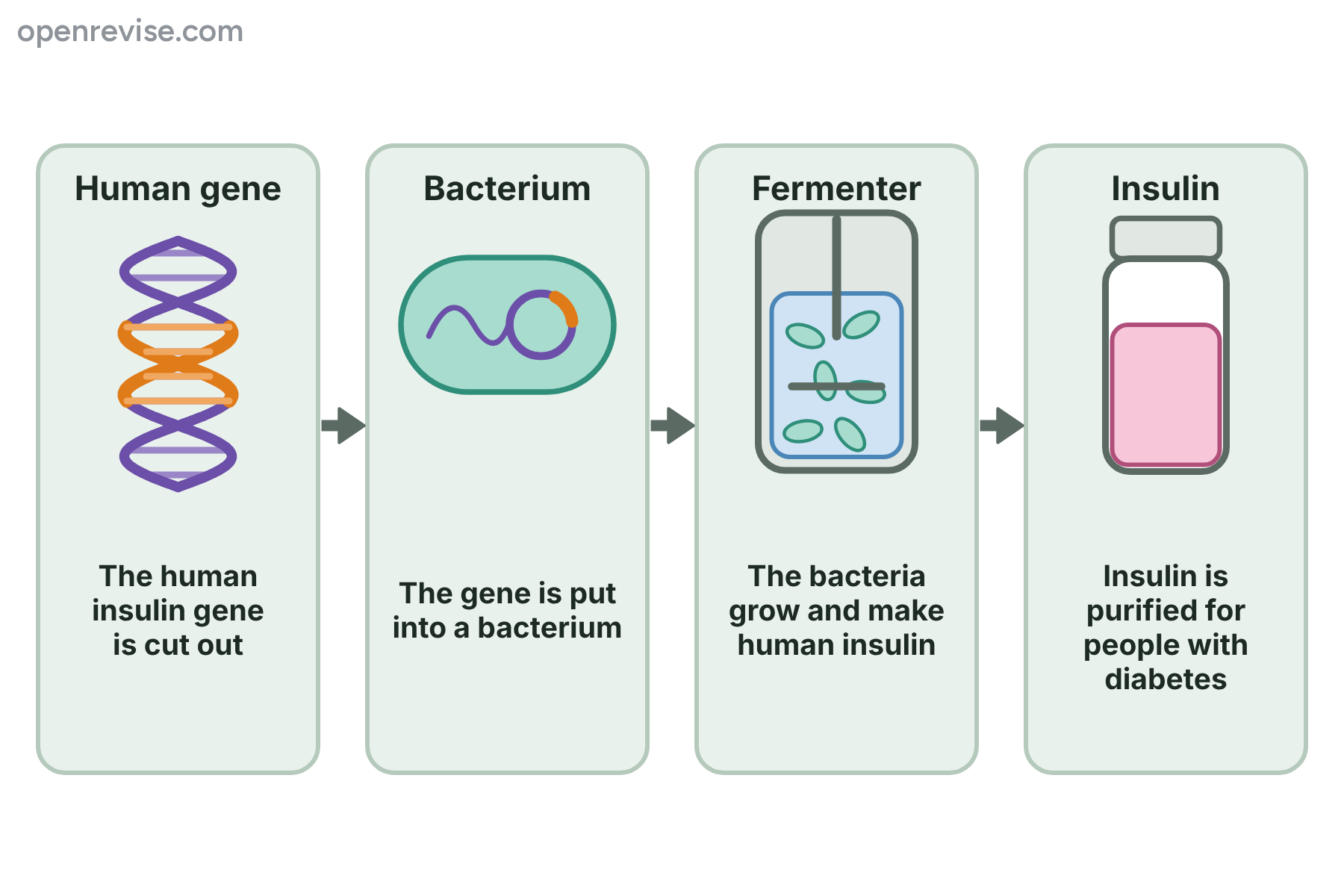
The diagram shows how genetically engineered bacteria are used to make human insulin. Describe how the insulin is produced.
Show answerHide answer
Model answer
The human insulin gene is cut out of human DNA and inserted into a bacterium. The bacteria are grown in a fermenter, where they divide and make human insulin. The insulin is collected and purified so that it can be used by people with diabetes.
Mark scheme
- The human insulin gene is cut out and put into bacteria — 1 mark
- The bacteria grow and make insulin in a fermenter — 1 mark
- The insulin is collected and purified — 1 mark
-
3 Give [2 marks]
Give two differences between genetic engineering and selective breeding.
Show answerHide answer
Model answer
In genetic engineering a chosen gene is put directly into the genome, but in selective breeding the parents with the wanted characteristics are chosen and bred. Genetic engineering can use a gene from any species and can make the change in one step, whereas selective breeding needs many generations and can only use alleles that already exist in the species.
Mark scheme
- A gene is transferred directly, not through breeding — 1 mark
- Can use genes from other species, or takes one step instead of many generations — 1 mark
-
4 Explain [3 marks]
A gene for resistance to a pest is inserted into a single cell from a maize plant. The cell is grown into a whole plant. Explain why every cell in the new plant has the gene.
Show answerHide answer
Model answer
The cell divides by mitosis to grow into the plant. Mitosis produces genetically identical cells, so the gene is copied each time. All the cells in the plant therefore contain the new gene.
Mark scheme
- The cell divides by mitosis — 1 mark
- Mitosis makes genetically identical cells, or the DNA is copied — 1 mark
- So every cell in the plant has the inserted gene — 1 mark
-
5 Explain [4 marks]
Maize can be genetically engineered to contain the Bt gene from a bacterium. Explain how this could increase the yield of the maize crop.
Show answerHide answer
Model answer
The Bt gene is cut out of the bacterium and inserted into the maize cells. The maize cells then make the protein that the gene codes for. This protein harms the caterpillars that eat the maize plants. So fewer plants are damaged by the pest, and more of the crop survives to be harvested, which increases the yield.
Mark scheme
- The gene is inserted into the maize cells — 1 mark
- The maize makes the protein coded for by the gene — 1 mark
- The protein kills or harms caterpillars that eat the plant — 1 mark
- Less damage by pests, so a higher yield — 1 mark
-
6 Explain [3 marks]
Before 1982 insulin for people with diabetes was taken from the pancreases of pigs. Explain two advantages of using insulin made by genetically engineered bacteria instead.
Show answerHide answer
Model answer
The bacteria make human insulin, which is identical to the person's own, so it is less likely to cause a reaction than pig insulin. The bacteria reproduce quickly, so a very large amount of insulin can be made cheaply.
Mark scheme
- It is human insulin, identical to the person's own — 1 mark
- So there is less risk of a reaction (or it works better) — 1 mark
- A second advantage, such as large amounts made quickly and cheaply, or no animals used — 1 mark
-
7 Describe [4 marks]
Describe the main stages in producing a crop plant that is genetically engineered to resist an insect pest.
Show answerHide answer
Model answer
A gene that makes a protein that harms the pest is found in another organism, such as the Bt gene in a bacterium. The gene is cut out of the DNA of the donor using enzymes. It is inserted into the DNA of a plant cell. The cell is then grown into a whole plant, which makes the protein in all of its cells and can be tested to see whether it resists the pest.
Mark scheme
- Find a gene for pest resistance in another organism — 1 mark
- Cut it out with enzymes — 1 mark
- Insert it into plant cells — 1 mark
- Grow the cells into plants (and test them) — 1 mark
Quick check
-
1
What is genetic engineering?
Show answerHide answer
B: Changing the genome by inserting a gene
Genetic engineering modifies the genome of an organism, by inserting a gene, to give it a desirable characteristic.
-
2
Why can a gene from a bacterium be used in a maize plant?
Show answerHide answer
C: The maize cells make the protein that the gene codes for
The gene is put into the genome of the maize cells, which then make the protein that the gene codes for.
-
3
Why is a new gene usually inserted into a cell at an early stage?
Show answerHide answer
A: So that it is copied into every cell by mitosis
Mitosis copies the gene into every new cell, so that every cell in the adult organism has it.
-
4
What does the Bt gene do in maize?
Show answerHide answer
D: It makes the maize produce a protein that kills caterpillars
The Bt gene makes the maize produce a protein that harms the caterpillars that feed on it.
-
5
Where are GM bacteria that make insulin grown?
Show answerHide answer
B: In a fermenter
Large tanks called fermenters give the bacteria the conditions to grow and make insulin.
-
6
Which is an advantage of insulin made by GM bacteria, compared with insulin from pigs?
Show answerHide answer
C: It is identical to human insulin
Bacteria make human insulin, which is identical to the person's own, so there is less chance of a reaction.
-
7
How is genetic engineering different from selective breeding?
Show answerHide answer
A: A gene is moved directly, in one step
Genetic engineering moves a chosen gene in one step, while selective breeding takes many generations.
-
8
Which of these organisms is genetically modified?
Show answerHide answer
D: A bacterium that makes human insulin
Bacteria with the human insulin gene have had their genome changed by genetic engineering.