Biology · Feeding the Human Race
Genetic Engineering
Selective breeding takes many generations to change a crop, but genetic engineering can add a useful gene in a single step. This lesson is for both Combined Science and separate Biology. It covers what genetic engineering is, how it differs from selective breeding, and two big examples: GM crops and bacteria that make human insulin. The detailed steps, which are Higher tier, are in the next lesson.
Learning Objectives
- 1Describe genetic engineering as a process that modifies the genome of an organism to introduce a desirable characteristic.
- 2Describe how a gene from one organism can be transferred to another so that the recipient makes a new protein.
- 3Describe examples of genetic engineering in crops and in the production of human insulin.
- 4Compare genetic engineering with selective breeding.
Retrieval practice
-
1
What is a gene?
Show answerHide answer
A small section of DNA on a chromosome that codes for a particular protein.
-
2
What is the genome of an organism?
Show answerHide answer
The entire genetic material of that organism.
-
3
What is selective breeding?
Show answerHide answer
Choosing parents with wanted characteristics and breeding them over many generations.
-
4
What does insulin do?
Show answerHide answer
It is a hormone that lowers the blood glucose level.
Changing the genome directly
Every characteristic of an organism depends on its genes, so if you can move a gene, you can move a characteristic. Genetic engineering is a process that changes the genome of an organism by adding a gene, usually from a different species, in order to give it a desirable characteristic. The organism that has received the gene is called genetically modified, or GM. Because the gene is put in directly, the change can be made in one step instead of over many generations of breeding.
Moving a gene from one organism to another
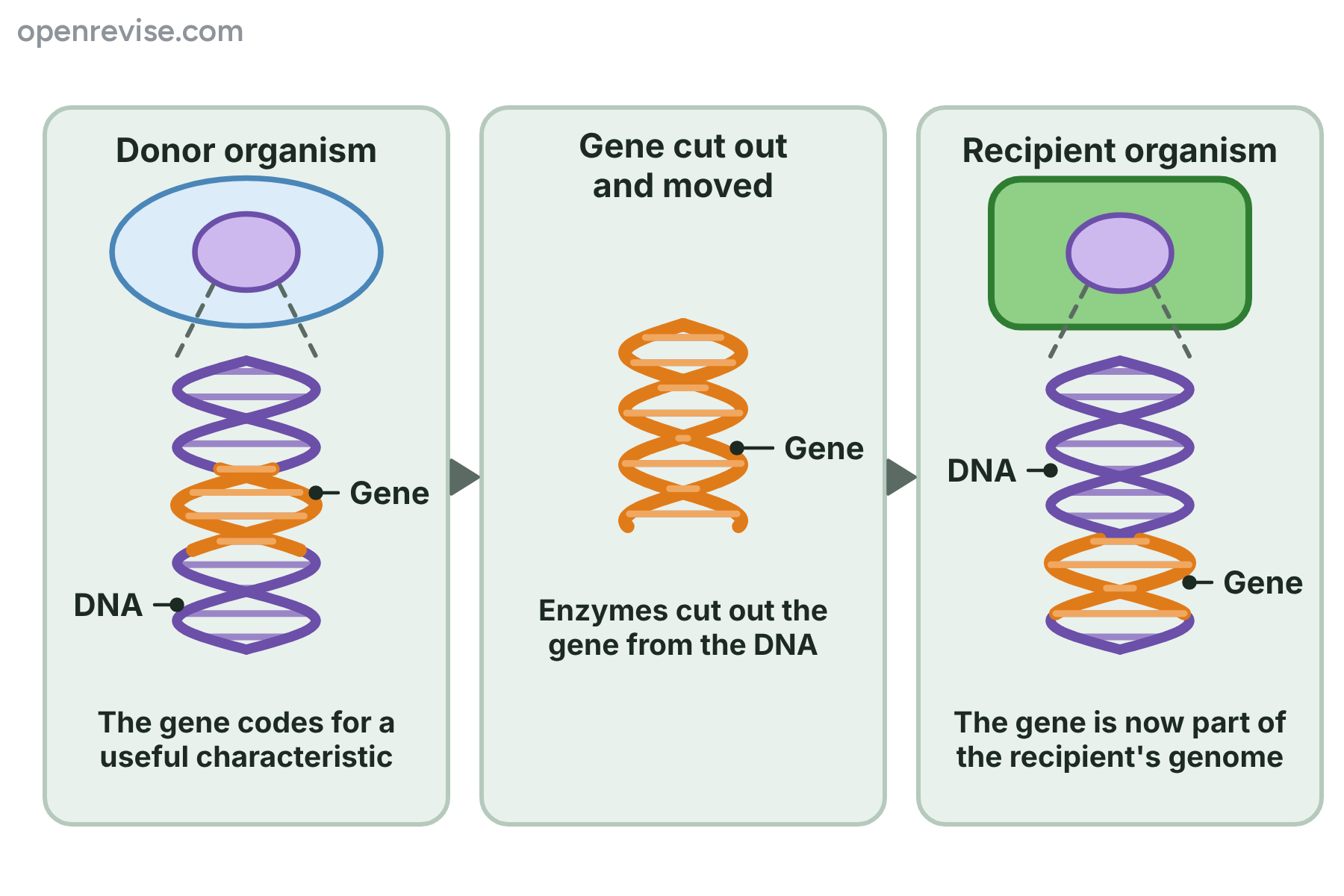
The gene is cut out of the donor and inserted into the genome of the recipient.
How genetic engineering works
The idea is to give one organism a gene that another organism has, so that it makes a new protein.
-
Find the gene
Scientists find a gene in a donor organism that gives the characteristic that they want, for example the gene for a protein that kills insect pests.
-
Cut it out
Enzymes are used to cut the gene out of the DNA of the donor.
-
Insert it
The gene is put into the DNA of the recipient cell, which becomes part of the genome of that cell.
-
The cell reads it
The gene still codes for the same protein, so the recipient cell makes that protein, and the organism shows the new characteristic.
Making sure every cell has the gene
A whole organism is useful only if the new gene is in all of its cells.
-
Early stage
The gene is inserted into a single cell, or into an embryo or egg at a very early stage, before the organism has grown.
-
Copying
As the cell divides by mitosis, the new gene is copied into every new cell, so every cell of the adult organism carries it.
-
Growing a plant
A plant cell that has taken up the gene can be grown into a whole new plant, and the seeds of this plant carry the gene as well.
-
Passed on
Because the gene is in the genome, the characteristic is inherited by offspring in the same way as any other.
GM crops
Crops are the most common GM organisms, and they have been grown commercially since the 1990s.
-
Insect resistance
Maize and cotton have been given a gene from the bacterium Bacillus thuringiensis (the Bt gene). The plant makes a protein that harms caterpillars that eat it, so less insecticide is needed.
-
Herbicide resistance
Soya and other crops have been given a gene that lets them survive a weedkiller, so the farmer can spray the field and kill the weeds without killing the crop.
-
Disease resistance
Papaya trees in Hawaii were given a gene from the virus that attacks them, which protected the papaya industry from ringspot virus in the 1990s.
-
Other changes
Plants can also be modified to have a longer shelf life, a better yield in a drought, or extra vitamins and other nutrients.
Case study
Bacteria that make human insulin
People with type 1 diabetes cannot make enough insulin, so they have to inject it. Insulin used to be taken from the pancreases of pigs and cattle, which was expensive and could cause reactions because it was not identical to human insulin. In 1978 scientists put the human insulin gene into bacteria, and in 1982 the first insulin from GM bacteria was approved for use. The bacteria divide quickly in large tanks called fermenters, and the insulin that they make is collected and purified.
How GM bacteria make human insulin
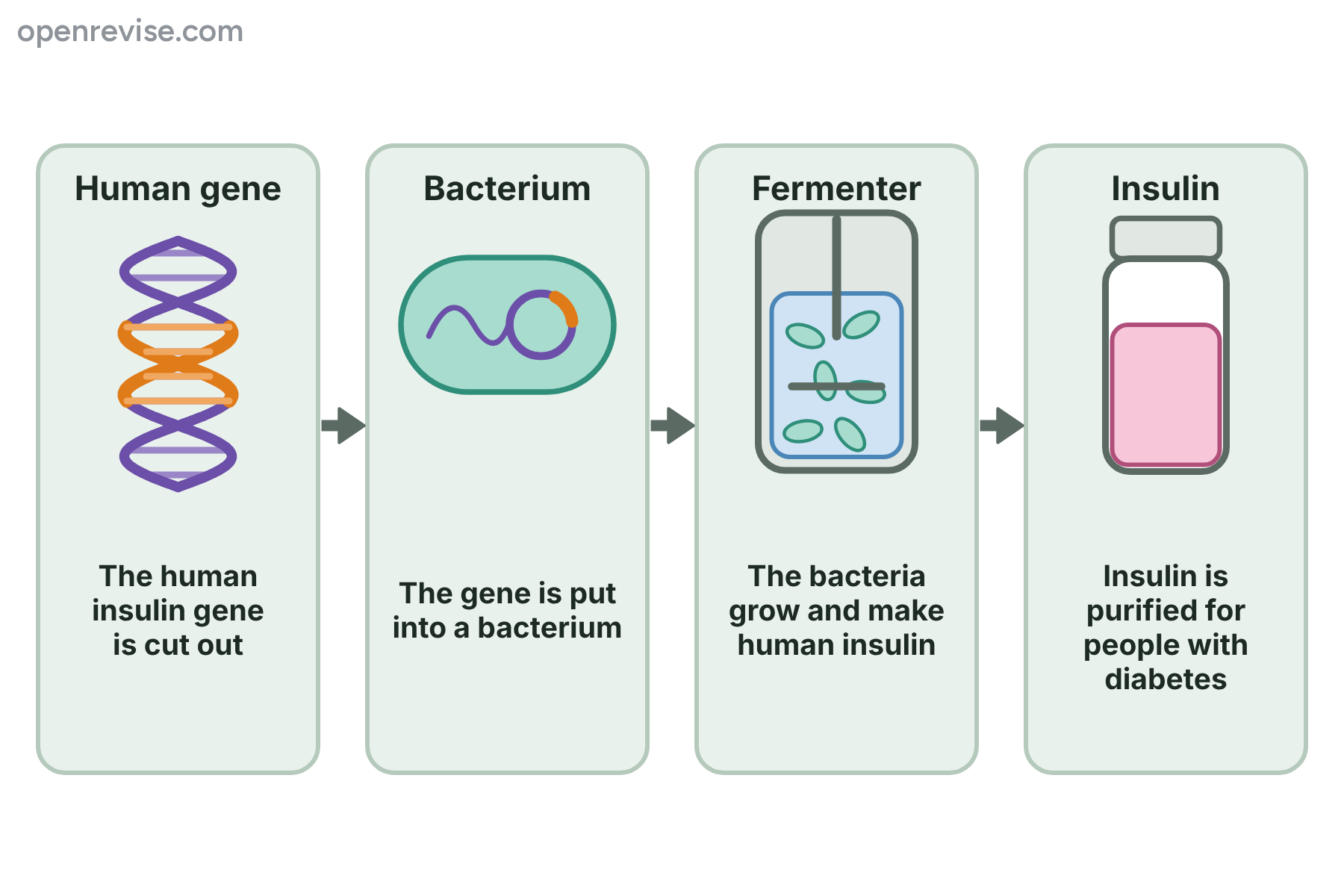
Bacteria with the human insulin gene make insulin in a fermenter.
Why use bacteria to make insulin
Genetically engineered bacteria have several advantages over taking insulin from animals.
-
Identical to human insulin
The bacteria make human insulin, so there is a smaller chance of the body reacting to it.
-
Large supply
Bacteria reproduce fast, and a fermenter can produce huge amounts at a low cost, so there is enough for everyone who needs it.
-
Ethical
No animals have to be killed, and the insulin is acceptable to people who object to using animal products.
-
Pure
The product can be purified so that it is free of other animal materials.
Genetic engineering and selective breeding
Genetic engineering
- A chosen gene is moved into the genome
- The gene can come from any species
- The change can be made in one step
- Only the new gene is added
Selective breeding
- Parents with the wanted characteristic are chosen
- Only alleles that are already in the species are used
- Takes many generations
- Many other alleles are mixed in as well
The big idea
Genetic engineering changes the genome by adding one chosen gene, so the organism makes a new protein and shows a new characteristic.
Genetic engineering
Genetic engineering
-
Definition
- modifying the genome
- desirable characteristic
-
Method
- find the gene
- cut it out
- insert it
- recipient makes the protein
-
GM crops
- Bt maize
- herbicide resistance
- virus-resistant papaya
-
Insulin
- human gene in bacteria
- fermenter
- purified
-
Compared with
- selective breeding
- one step
- any species
-
Every cell
- early stage
- mitosis copies the gene
Summary and exam focus
- Genetic engineering modifies the genome of an organism by adding a gene, to give it a desirable characteristic.
- A gene is cut out of one organism and inserted into the cells of another, which then makes the protein that the gene codes for.
- The gene is inserted at an early stage, so that mitosis copies it into every cell, and the characteristic is inherited.
- GM crops include maize with the Bt gene, which resists insect pests, and soya that resists a weedkiller.
- Bacteria that carry the human insulin gene make insulin in fermenters for people with diabetes.
Exam focus
Describe how bacteria can be genetically engineered to make human insulin. (3 marks) (3 marks)
Say where the gene comes from and what is done to it: the human insulin gene is cut out and put into the bacteria. Then say what the bacteria do: they make insulin as they grow, in a fermenter, and the insulin is collected. Do not say that bacteria turn into humans or that the insulin gene is created by the bacteria.
Key terms
The words this lesson expects you to use. Each one is linked from the first place it appears above.
- Genetic engineering
- Modifying the genome of an organism by inserting a gene, to give it a desirable characteristic.
- Genetically modified (GM)
- Describes an organism whose genome has been changed by genetic engineering.
- Genome
- The entire genetic material of an organism.
- Gene
- A small section of DNA that codes for a particular protein.
- Desirable characteristic
- A feature that people want, such as resistance to pests or a higher yield.
- Bt gene
- A gene from the bacterium Bacillus thuringiensis that makes a protein harming caterpillars, put into crops such as maize.
- Insulin
- A hormone, made by the pancreas, that lowers the blood glucose level.
- Fermenter
- A large tank in which microorganisms are grown in the right conditions to make a product.
You've finished the notes
Check your understanding
Test yourself while it is fresh. Start with the flashcards, then try the exam questions.
Something here looks wrong?
Tell us what and we will go and look. It goes to whoever writes these pages, nobody else, and we do not ask who you are — so there is nothing to sign and nothing comes back to you.