Exam questions · Biology · Feeding the Human Race
Selective Breeding of Plants and Animals
- 8 exam questions
- 27 marks
- 8 quick checks
-
1 State [1 mark]
State one characteristic that a farmer could select for when breeding dairy cattle.
Show answerHide answer
Model answer
A high milk yield (also accept: disease resistance, fertility, calm temperament).
Mark scheme
- Any suitable characteristic, such as a high milk yield — 1 mark
-
2 Describe [4 marks]
Describe how selective breeding is used to produce wheat plants that have a higher yield.
Show answerHide answer
Model answer
The breeder chooses the wheat plants that have the highest yield of grain and breeds them together. From their offspring the plants with the highest yield are selected again and bred. This is repeated for many generations, until the wheat plants all give a high yield.
Mark scheme
- Choose plants with a high yield — 1 mark
- Breed them together — 1 mark
- Select the best offspring and breed from them — 1 mark
- Repeat over many generations — 1 mark
-
3 Describe [3 marks]
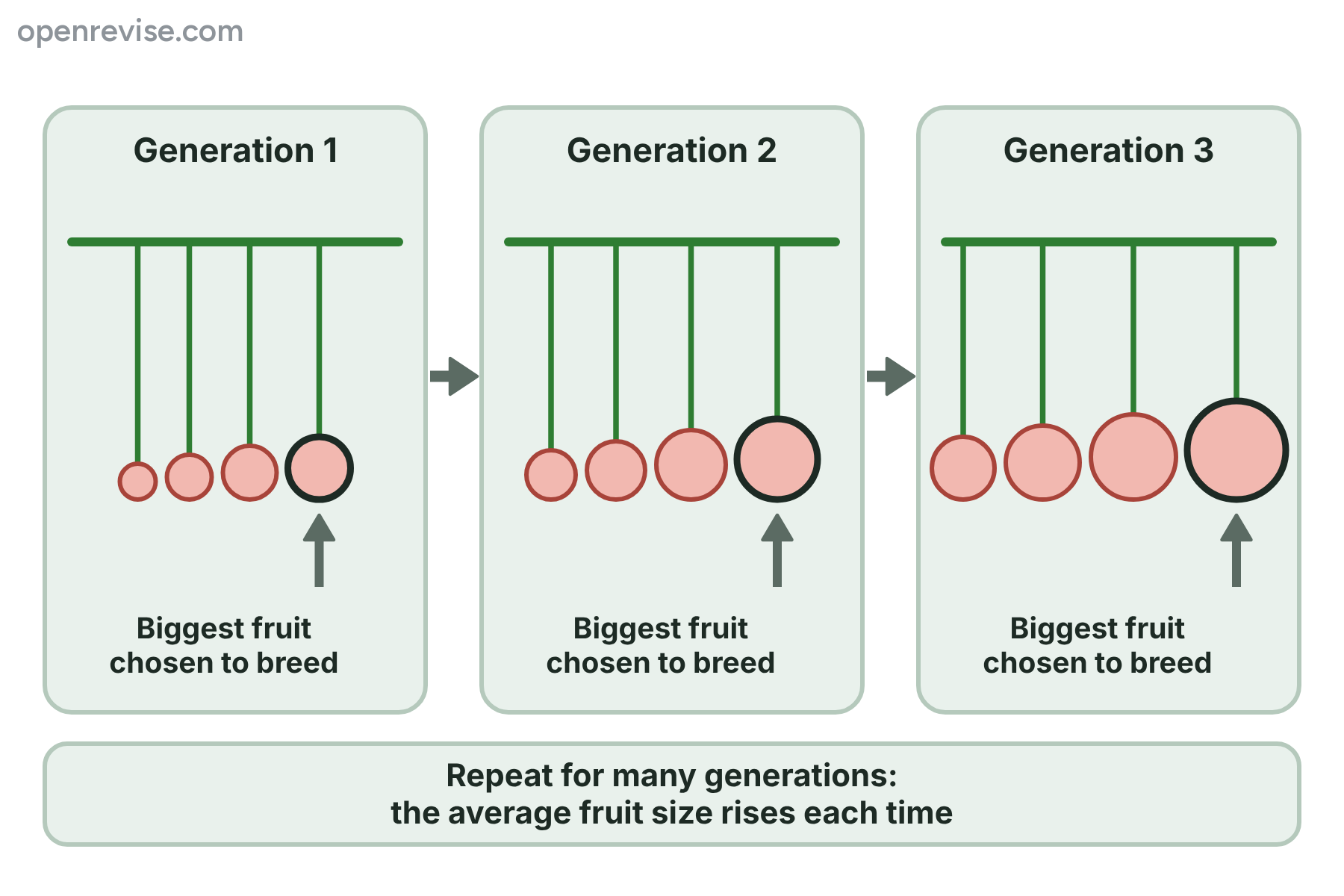
The diagram shows part of a selective breeding programme for a fruit crop. Describe what the breeder did and what happened to the size of the fruit.
Show answerHide answer
Model answer
In each generation the breeder chose the biggest fruit and bred from the plant that produced it. The fruit in each generation was bigger on average than in the generation before, so after three generations the fruits were much larger than the first ones.
Mark scheme
- Chose the plant with the biggest fruit to breed from — 1 mark
- Repeated in each generation — 1 mark
- The average fruit size increased with each generation — 1 mark
-
4 Calculate [3 marks]
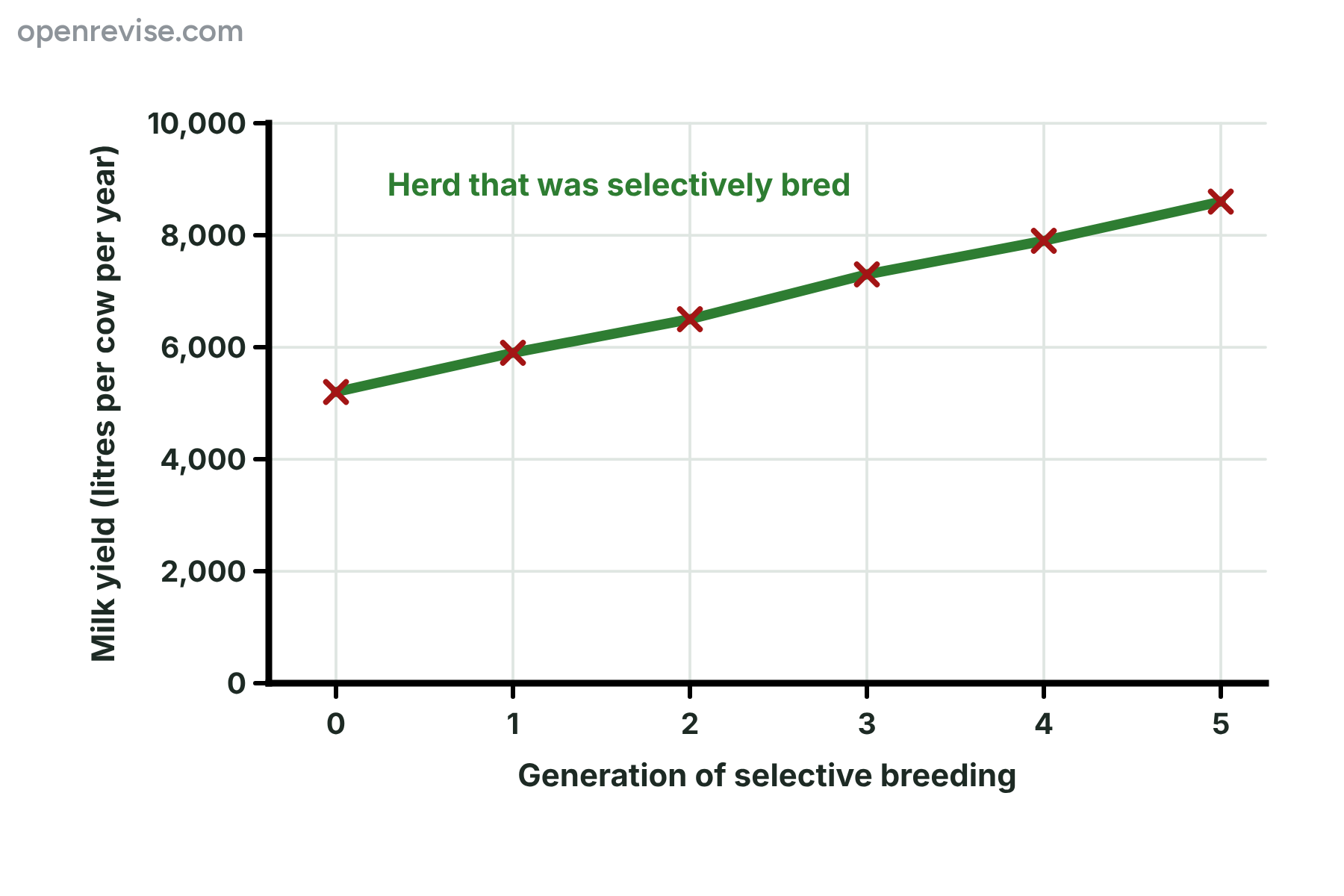
The graph shows the mean milk yield of a herd of cows over five generations of selective breeding. Calculate the percentage increase in the mean milk yield from generation 0 to generation 5. Give your answer to the nearest whole number.
Show answerHide answer
Model answer
Increase = 8600 - 5200 = 3400 litres. Percentage increase = \(\frac{3400}{5200} \times 100 = 65.4\%\), which is 65% to the nearest whole number.
Mark scheme
- Reads 5 200 and 8 600 correctly and finds the increase of 3 400 — 1 mark
- \(3400 \div 5200 \times 100\) — 1 mark
- 65% — 1 mark
-
5 Explain [3 marks]
A breeder has bred a pedigree dog for many generations using only a few closely related parents. Explain why the dogs are likely to suffer from inherited disorders.
Show answerHide answer
Model answer
Breeding closely related dogs is inbreeding. It reduces the variation in the population, because there are fewer different alleles. The offspring are therefore more likely to inherit two copies of the same harmful recessive allele, and so they develop the inherited disorder.
Mark scheme
- Inbreeding (breeding closely related individuals) — 1 mark
- Reduces the variation or the number of different alleles — 1 mark
- Offspring are more likely to inherit two copies of a harmful recessive allele — 1 mark
-
6 Explain [4 marks]
A banana farmer grows a single variety of banana plant over a very large area. Explain why one new disease could destroy the whole crop.
Show answerHide answer
Model answer
The plants have been bred from one variety, so there is very little variation between them and they are genetically very similar. If one plant is not resistant to the disease, then none of the others will be either, because they all carry the same alleles. The pathogen can spread easily from plant to plant. There are no resistant plants left to breed from, so the whole crop could be lost.
Mark scheme
- The plants are genetically similar, with little variation — 1 mark
- None of the plants has an allele for resistance — 1 mark
- The disease spreads easily between the plants — 1 mark
- So the whole crop is lost, with no resistant plants left — 1 mark
-
7 Compare [3 marks]
Compare selective breeding with natural selection.
Show answerHide answer
Model answer
In selective breeding, people choose which individuals will breed, whereas in natural selection the environment decides which individuals survive and reproduce. Selective breeding picks features that people want, such as a high yield, whereas natural selection favours features that help the organism to survive. Both processes change the alleles in a population over many generations, because the individuals chosen pass on their alleles.
Mark scheme
- People choose the parents, but in natural selection the environment does — 1 mark
- Selective breeding is for the characteristics that people want, natural selection is for survival — 1 mark
- Both change the population over many generations by passing on alleles — 1 mark
-
8 Evaluate [6 marks]
Selective breeding has made modern dairy cows produce much more milk than their ancestors. Evaluate the use of selective breeding in dairy cattle.
Show answerHide answer
Model answer
Selective breeding has increased milk yields a great deal, so a farmer can produce more milk from fewer cows, and food is cheaper and more of it is available, which helps food security. Cows can also be selected for disease resistance, which reduces the cost of treating illness. However, the process takes many generations, and it often uses a few top bulls, so the herd becomes inbred and there is less variation. This makes the herd more vulnerable to a new disease, and it can allow harmful alleles to spread. Very high milk yields have also been linked with udder infections and lameness, which is a welfare problem. Overall, selective breeding has brought great benefits, but breeders should select for health and fertility as well as milk yield and avoid using closely related animals.
Mark scheme
- Level 3 (5 to 6 marks): advantages and disadvantages are both explained, and a supported conclusion is reached — A balanced answer with a clear judgement
- Level 2 (3 to 4 marks): some advantages and some disadvantages, with limited explanation — Points made, but not fully developed
- Level 1 (1 to 2 marks): one or two simple points, such as a higher yield or inbreeding — Little explanation or no link to the question
- Possible points: higher yield; cheaper food; disease resistance; takes many generations; inbreeding; less variation; welfare — Content that can earn credit at any level
Quick check
-
1
What is selective breeding?
Show answerHide answer
C: Choosing the parents with wanted characteristics
In selective breeding people choose parents with wanted characteristics and breed them over many generations.
-
2
A farmer wants a bigger tomato. What should the farmer do first?
Show answerHide answer
A: Breed the plants with the biggest tomatoes together
Parents with the characteristic are selected first. The best offspring are then bred, and the steps repeated.
-
3
Which of these came from the wild cabbage by selective breeding?
Show answerHide answer
D: Broccoli
Broccoli, cabbage, kale and cauliflower were all bred from one wild plant.
-
4
Why do modern wheat plants have short stems?
Show answerHide answer
B: So they stay upright and put more energy into the grain
Short stems stop the plants from being blown over, and more energy is put into making grain.
-
5
What is inbreeding?
Show answerHide answer
B: Breeding closely related individuals
Inbreeding is breeding between closely related individuals, which reduces variation.
-
6
Why is a crop with little variation at risk from disease?
Show answerHide answer
C: Because no plant may be resistant
If no plant has an allele for resistance, a new disease can infect all of them.
-
7
A herd's mean milk yield rose from 4 000 to 5 000 litres. What is the percentage increase?
Show answerHide answer
A: 25%
The rise is 1 000 litres, and 1 000 divided by 4 000, multiplied by 100, is 25%.
-
8
Which of these is a possible disadvantage of selective breeding in animals?
Show answerHide answer
D: Leg problems in fast-growing chickens
Features such as very rapid growth or very high milk yield can cause health and welfare problems.