Flashcards · Biology · Feeding the Human Race
Selective Breeding of Plants and Animals
-
What is selective breeding?
People choosing parents with wanted characteristics and breeding them for many generations.
-
What is another name for selective breeding?
Artificial selection.
-
What is the first step of selective breeding?
Decide on the characteristic that is wanted.
-
What do you do with the offspring in selective breeding?
Select the ones with the characteristic and breed from them, repeating over many generations.
-
Why are modern wheat varieties bred with short stems?
The plants do not fall over in wind and rain, and more energy goes into the grain.
-
Give two characteristics selected in crop plants.
Higher yield, disease resistance, larger fruit, sweetness or seedlessness.
-
Which wild plant did cabbage, broccoli and kale come from?
The wild cabbage (wild mustard).
-
Give two characteristics selected in dairy cattle.
A high milk yield and resistance to disease.
-
Give one example of selective breeding in chickens.
Breeding hens that lay many eggs, or chickens that grow fast for meat.
-
What is inbreeding?
Breeding closely related individuals.
-
What happens to variation when there is inbreeding?
It falls, because there are fewer different alleles in the population.
-
Why do inherited disorders become more common with inbreeding?
Offspring are more likely to inherit two copies of a harmful recessive allele.
-
Why is a crop with little variation at risk?
A single disease could infect every plant, because none has an allele for resistance.
-
Give one welfare problem caused by selective breeding.
Fast-growing chickens may have leg problems, or high-yielding cows may have udder infections.
-
How does selective breeding differ from natural selection?
People choose which organisms breed, instead of the environment.
-
How do you calculate a percentage increase?
Increase divided by the starting value, multiplied by 100.
-
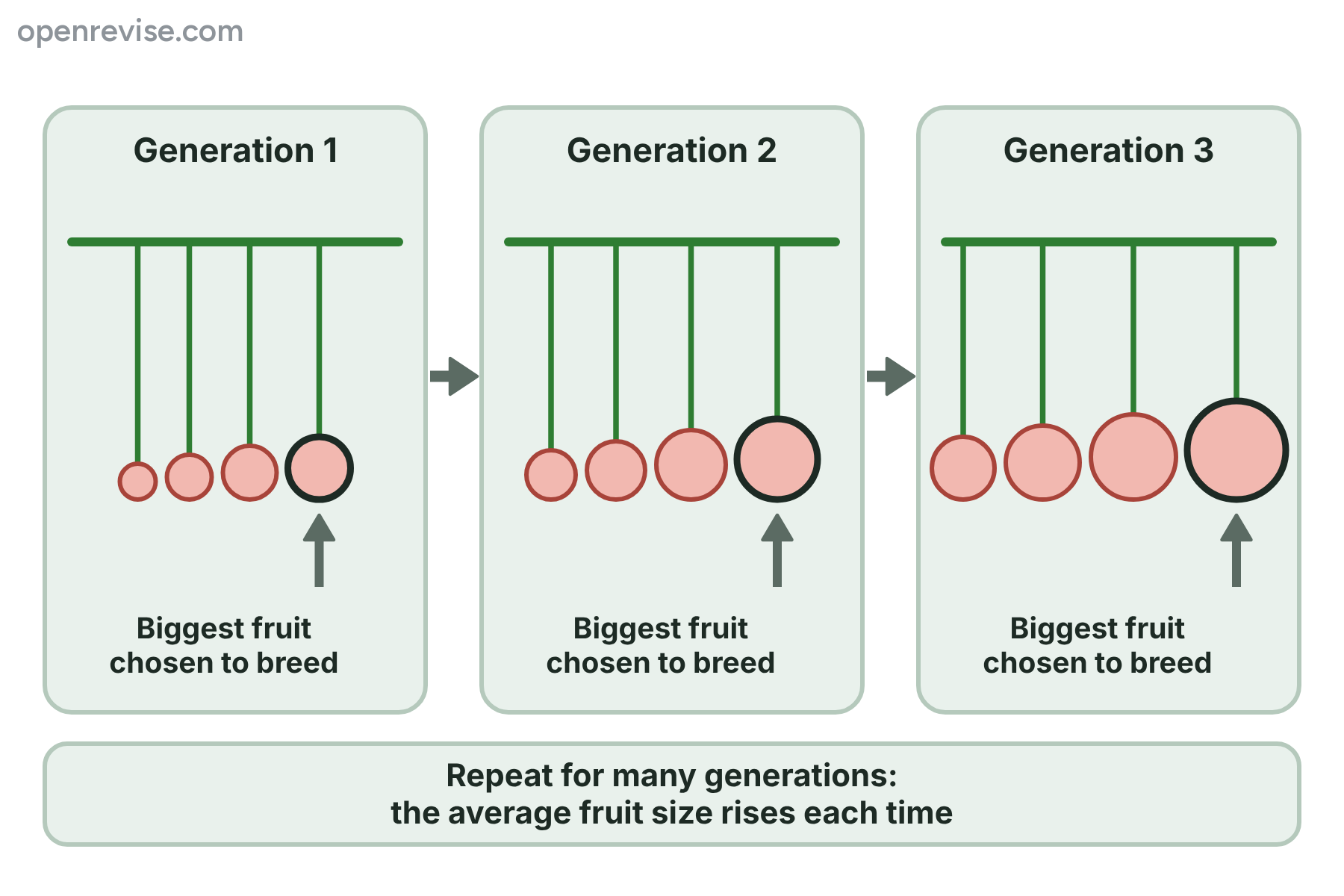 Describe what is happening in this diagram.
 In each generation the biggest fruit is chosen as the parent of the next generation. Over many generations the average fruit size increases.
-
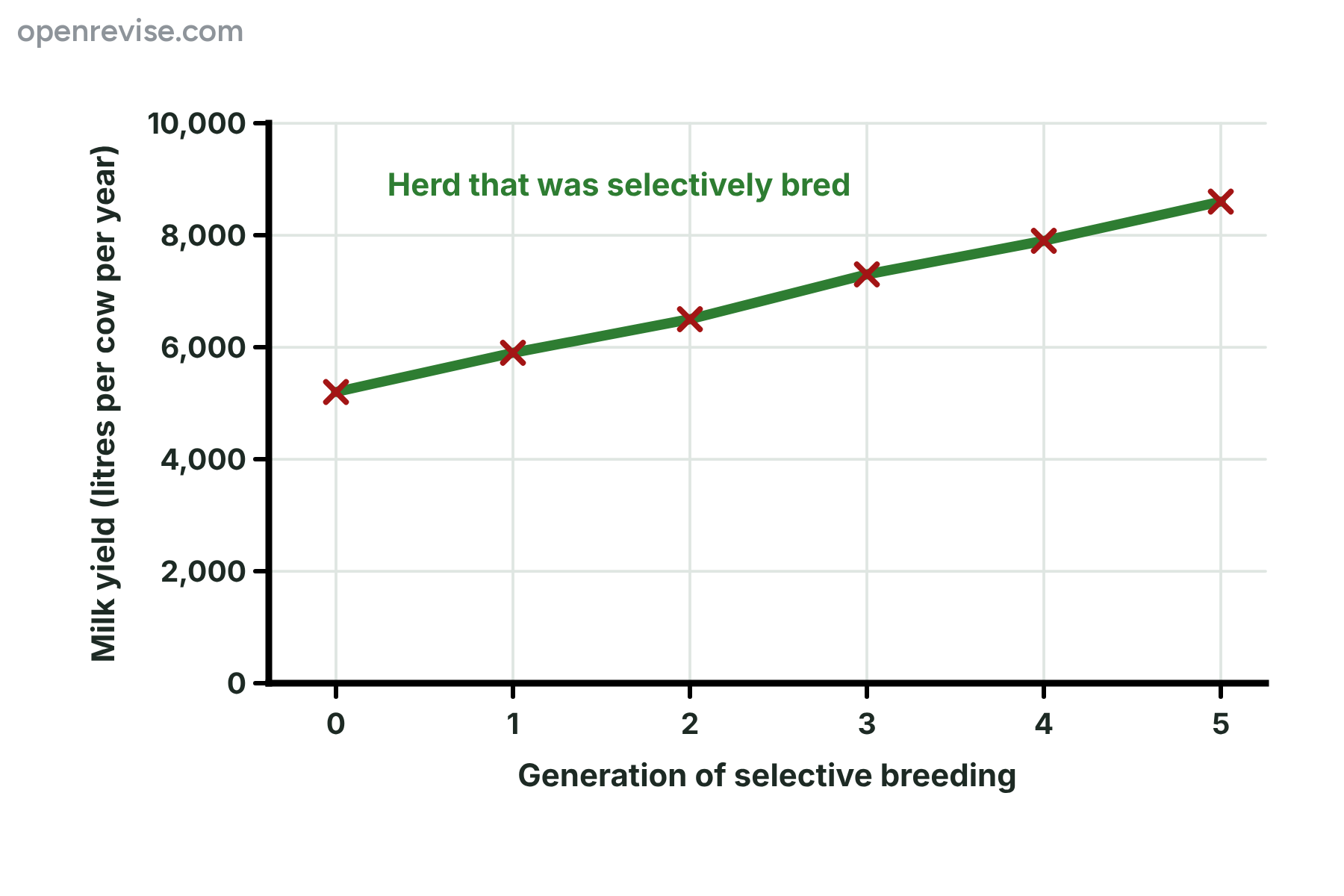 Calculate the percentage increase in milk yield from generation 0 to generation 5.
 The increase is 8 600 minus 5 200, which is 3 400 litres. Then 3 400 divided by 5 200, multiplied by 100, gives 65%.