Exam questions · Biology · Feeding the Human Race
The Steps of Genetic Engineering (Higher tier)
- 8 exam questions
- 23 marks
- 8 quick checks
-
1 Name [1 mark]
Name the type of enzyme that is used to cut a gene out of DNA.
Show answerHide answer
Model answer
A restriction enzyme.
Mark scheme
- Restriction enzyme — 1 mark
-
2 Name [3 marks]
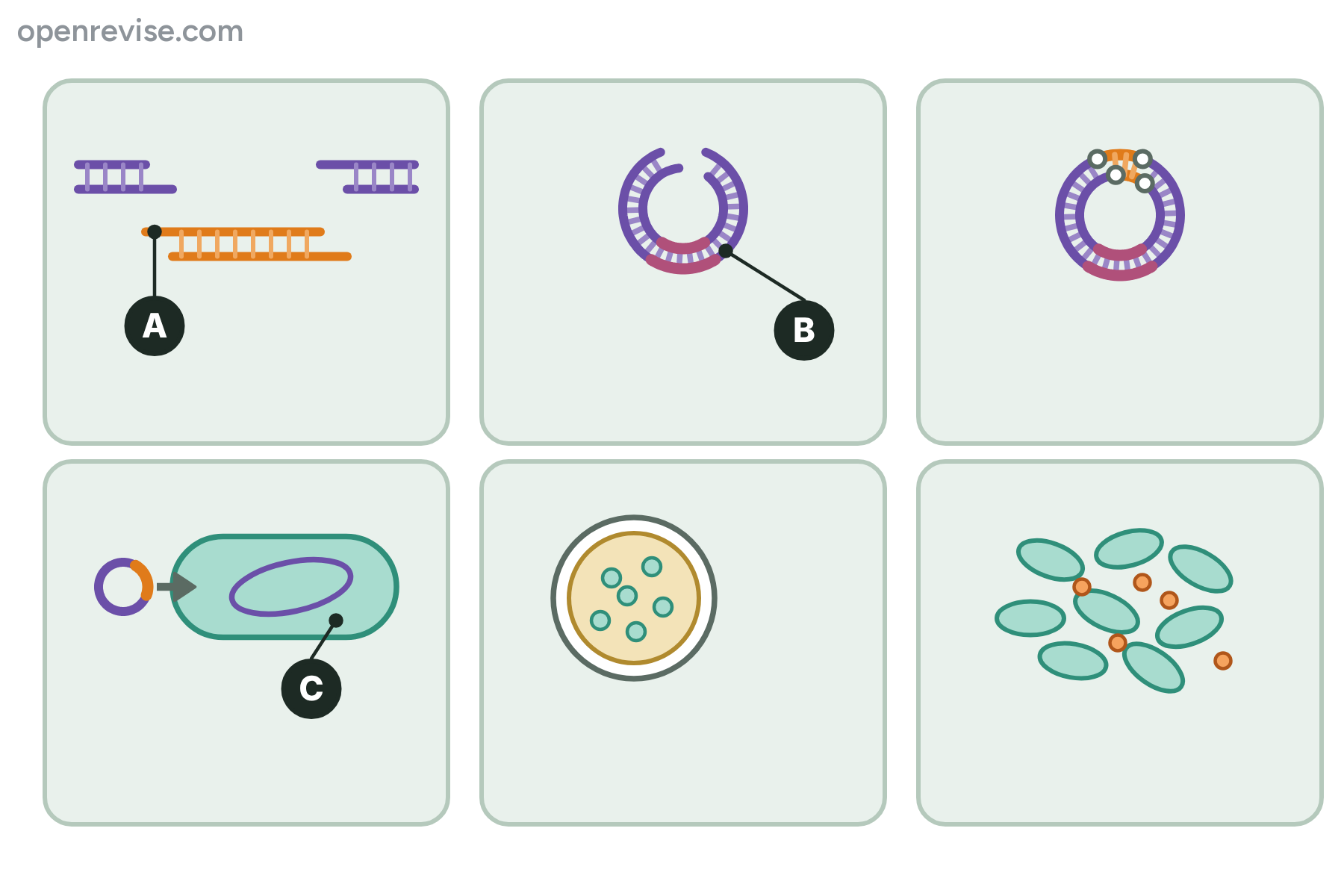
The diagram shows the steps in genetic engineering. Name the parts labelled A, B and C.
Show answerHide answer
Model answer
A is a sticky end. B is a plasmid. C is a (host) bacterium.
Mark scheme
- A: sticky end — 1 mark
- B: plasmid — 1 mark
- C: bacterium (host bacterium) — 1 mark
-
3 Describe [2 marks]
Describe what is meant by sticky ends.
Show answerHide answer
Model answer
Sticky ends are short stretches of unpaired bases at the ends of a piece of DNA cut by a restriction enzyme. They can pair up with other sticky ends that have complementary bases.
Mark scheme
- Short stretches of unpaired bases at the cut ends of DNA — 1 mark
- That can pair with complementary sticky ends — 1 mark
-
4 Explain [3 marks]
Explain why the same restriction enzyme is used to cut the gene and to cut the plasmid.
Show answerHide answer
Model answer
The restriction enzyme cuts at a particular sequence of bases, so it leaves the same sticky ends on the gene and on the plasmid. These sticky ends are complementary, so they can pair by complementary base pairing. Then the gene can be joined to the plasmid.
Mark scheme
- Cuts at the same specific sequence — 1 mark
- So that the sticky ends are complementary — 1 mark
- So the gene and the plasmid can pair up and be joined — 1 mark
-
5 Explain [2 marks]
Explain the role of DNA ligase in genetic engineering.
Show answerHide answer
Model answer
DNA ligase joins the gene to the plasmid. It seals the strands of the DNA together, to make a recombinant plasmid.
Mark scheme
- Joins the gene and the plasmid DNA together — 1 mark
- To make a recombinant plasmid (a permanent join) — 1 mark
-
6 Explain [4 marks]
After the plasmids were added, the bacteria were spread on agar containing an antibiotic. Explain how this identifies the bacteria that have taken up the plasmid.
Show answerHide answer
Model answer
The plasmid contains an antibiotic resistance marker gene. Bacteria that have taken up the plasmid are resistant to the antibiotic, so they survive and divide to form colonies. The bacteria without the plasmid are not resistant, so they are killed or cannot grow. The colonies on the agar are therefore made of bacteria that carry the plasmid.
Mark scheme
- The plasmid carries an antibiotic resistance marker — 1 mark
- Bacteria with the plasmid are resistant and survive — 1 mark
- Bacteria without the plasmid are killed or cannot grow — 1 mark
- The colonies that grow contain the plasmid — 1 mark
-
7 Calculate [2 marks]
Source: Bacteria were treated with recombinant plasmids and spread on two plates. Plate X had no antibiotic in the agar and grew 250 colonies. Plate Y had antibiotic in the agar and grew 15 colonies. Calculate the percentage of the bacteria that took up the plasmid.
Show answerHide answer
Model answer
\(\frac{15}{250} \times 100 = 6\%\)
Mark scheme
- \(15 \div 250\) — 1 mark
- 6% — 1 mark
-
8 Describe [6 marks]
Describe how bacteria can be genetically engineered to make human insulin.
Show answerHide answer
Model answer
The human insulin gene is cut out of human DNA using a restriction enzyme, which leaves sticky ends. A plasmid, which is the vector, is cut open with the same restriction enzyme, so its sticky ends are complementary to those of the gene. The gene and the plasmid are mixed, and the sticky ends pair up. DNA ligase joins the gene to the plasmid and makes a recombinant plasmid. The plasmids are put into host bacteria. The bacteria are grown on agar containing an antibiotic. The plasmid carries an antibiotic resistance marker, so only the bacteria that took up the plasmid survive. These bacteria are grown in a fermenter, where they multiply and make insulin, which is then collected and purified.
Mark scheme
- Level 3 (5 to 6 marks): all main steps described in the right order with correct terms, including how the bacteria are selected — A clear, logical sequence with accurate use of restriction enzyme, sticky ends, ligase, plasmid and marker
- Level 2 (3 to 4 marks): most of the steps are described, but one or more are missing or the order or terms are not fully correct — Some detail, but not complete
- Level 1 (1 to 2 marks): one or two steps are mentioned, with little detail — Limited description
- Possible points: restriction enzyme cuts gene; sticky ends; same enzyme cuts plasmid; ligase joins; recombinant plasmid; host bacteria; antibiotic resistance marker; selection; fermenter — Content that can earn credit at any level
Quick check
-
1
What does a restriction enzyme do?
Show answerHide answer
B: Cuts DNA at a specific base sequence
A restriction enzyme cuts DNA at a specific sequence of bases.
-
2
What is the role of DNA ligase?
Show answerHide answer
D: To join the gene into the plasmid
Ligase joins the gene and the plasmid into one molecule of recombinant DNA.
-
3
Which bases will pair with the sticky end G-G-C-C?
Show answerHide answer
A: C-C-G-G
G pairs with C and C pairs with G, so G-G-C-C pairs with C-C-G-G.
-
4
What is a plasmid used for in genetic engineering?
Show answerHide answer
C: To carry the gene into the bacterium
A plasmid is used as a vector, to carry the gene into the host bacterium.
-
5
Why is the antibiotic resistance marker needed?
Show answerHide answer
B: To show which bacteria have the plasmid
Only the bacteria that took up the plasmid are resistant, so they can be picked out on agar containing the antibiotic.
-
6
Why is the same restriction enzyme used on the gene and the plasmid?
Show answerHide answer
D: So that the sticky ends are complementary
The same enzyme leaves complementary sticky ends, which can pair and be joined.
-
7
What is recombinant DNA?
Show answerHide answer
A: DNA made by joining DNA from two sources
Recombinant DNA is made by joining DNA from two different sources.
-
8
What happens to bacteria without the plasmid on antibiotic agar?
Show answerHide answer
C: They are killed or cannot grow
They do not have the resistance marker, so they are killed or cannot grow.