Biology · Feeding the Human Race
The Steps of Genetic Engineering (Higher tier)
To move a gene from one organism to another, scientists need molecular scissors, molecular glue and a vehicle to carry the gene into a cell. This lesson is for Higher tier students only, in both Combined Science and separate Biology. It covers restriction enzymes, sticky ends, DNA ligase, vectors such as plasmids, host bacteria and selection using antibiotic resistance markers.
Learning Objectives
- 1Describe the main steps in the process of genetic engineering, in the correct order.
- 2Explain the roles of restriction enzymes, sticky ends and DNA ligase in joining a gene to a vector.
- 3Explain what a vector is, and why plasmids are used with host bacteria.
- 4Explain how antibiotic resistance markers are used to select the bacteria that have taken up the gene.
Retrieval practice
-
1
What is genetic engineering?
Show answerHide answer
Modifying the genome of an organism by inserting a gene to give it a desirable characteristic.
-
2
Which bases pair together in DNA?
Show answerHide answer
A with T, and C with G.
-
3
What is an enzyme?
Show answerHide answer
A biological catalyst, a protein that speeds up a reaction.
-
4
What is an antibiotic?
Show answerHide answer
A drug that kills bacteria or stops them growing.
The toolkit for moving a gene
Moving a gene is a molecular job: the gene has to be cut out, joined to a carrier and put into a living cell, and then the cells that have the gene have to be found. Each stage uses a different tool. Restriction enzymes cut the DNA, DNA ligase joins it, a vector such as a plasmid carries the gene into a host cell, and an antibiotic resistance marker identifies the cells that have taken it up. The most common host is a bacterium, which is why the same steps are used to make insulin.
The main steps of genetic engineering
The steps are the same whatever gene is being moved. Learn them in order.
-
1
Find the gene
The gene for the wanted characteristic, such as the human insulin gene, is identified and isolated from the donor DNA.
-
2
Cut it out
A restriction enzyme cuts the DNA on either side of the gene, leaving a fragment with sticky ends.
-
3
Cut the vector
The same restriction enzyme is used to cut open the vector, a plasmid, which has an antibiotic resistance marker gene. This leaves matching sticky ends.
-
4
Join them
The gene and the plasmid are mixed. The sticky ends pair up, and DNA ligase joins the strands to make a recombinant plasmid.
-
5
Put it into host bacteria
The recombinant plasmids are taken up by host bacteria, but only a few bacteria take them in.
-
6
Select
The bacteria are spread on agar containing an antibiotic. Only those with the resistance marker, and so the plasmid, grow into colonies.
-
7
Grow
The selected bacteria are grown in a fermenter, where they multiply and make the protein that the gene codes for.
The steps of genetic engineering
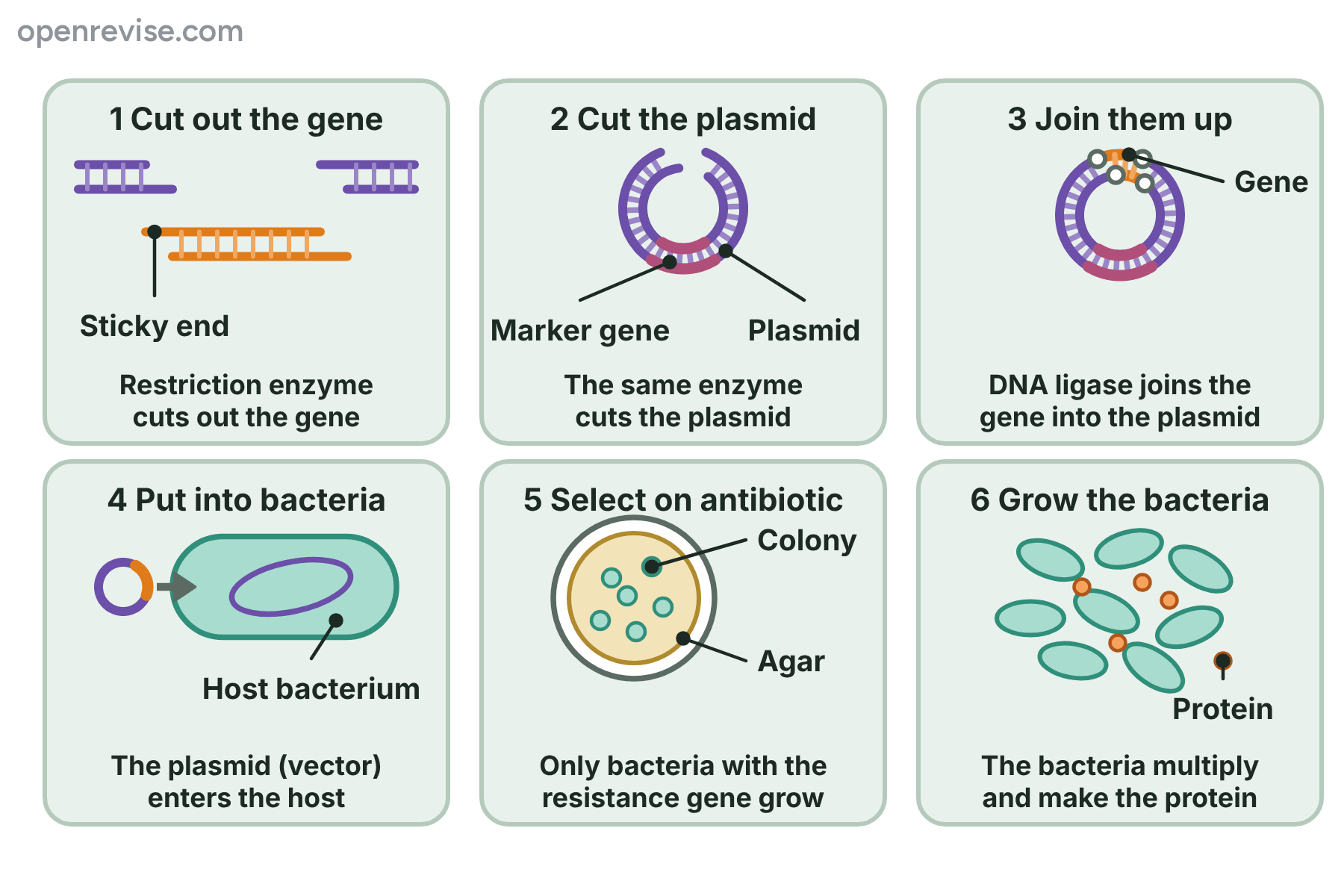
The storyboard of genetic engineering: cut, cut, join, insert, select, grow.
Cutting DNA: restriction enzymes and sticky ends
The first tool is an enzyme that cuts DNA at a particular place.
-
Restriction enzymes
These enzymes recognise a particular short sequence of bases in DNA and cut the DNA there. Many different restriction enzymes exist, and each one cuts at its own sequence, so scientists can choose one that cuts either side of a gene.
-
Sticky ends
Many restriction enzymes cut the two strands at different places, leaving short stretches of unpaired bases that stick out. These sticky ends can pair up with other sticky ends that have the matching complementary bases.
-
Matching ends
A sticky end with the bases A-A-T-T will pair with a sticky end with the bases T-T-A-A. If the gene and the plasmid are cut with the same restriction enzyme, their sticky ends match.
-
Where the enzymes come from
Bacteria make restriction enzymes naturally, to cut up the DNA of the viruses that infect them.
Joining DNA: ligase and the recombinant plasmid
Once the sticky ends have paired, the DNA still has to be joined into one molecule.
-
Pairing
When the cut gene and the cut plasmid are mixed, the sticky ends of the gene pair with the sticky ends of the plasmid by complementary base pairing.
-
DNA ligase
This is an enzyme that joins the sugar-phosphate backbones of the DNA, sealing the gaps so that the gene becomes a permanent part of the plasmid.
-
Recombinant DNA
The DNA made by joining DNA from two different sources is called recombinant DNA, and a plasmid that contains the new gene is a recombinant plasmid.
-
Why joined DNA stays
Without ligase the pairing of the sticky ends is weak and the gene could fall out again.
Vectors, plasmids and host bacteria
A gene cannot walk into a cell by itself, so it is carried in by a vector.
-
Vector
A vector is a carrier that takes the gene into the host cell. Plasmids and viruses are used as vectors.
-
Plasmids
Plasmids are small circular loops of DNA found in bacteria, in addition to the main bacterial chromosome. They are easy to cut open, and bacteria copy them every time that they divide.
-
Host bacteria
The bacteria that take in the recombinant plasmid are the hosts. They are used because they are simple, they reproduce very quickly and they can be grown cheaply in large fermenters.
-
Making them take it up
The bacteria are treated so that their cell surface lets plasmids in, for example with a heat shock, but only a small fraction of the bacteria take one up.
Selecting the bacteria with antibiotic resistance markers
Most of the bacteria do not take up the plasmid, so scientists need a way to pick out the ones that do.
-
The marker
The plasmid that is used as a vector carries a gene for resistance to an antibiotic, which is called an antibiotic resistance marker.
-
The antibiotic agar
All of the bacteria are spread on agar jelly that contains the antibiotic. Bacteria without the plasmid are killed or cannot grow.
-
Colonies
Bacteria that have taken up the plasmid are resistant, so they survive and each one multiplies to form a visible colony of identical bacteria.
-
The next stage
Cells from a colony are grown on in a fermenter, where they multiply and the gene that was inserted makes its protein.
How many bacteria took up the plasmid?
A scientist spread bacteria that had been treated with recombinant plasmids onto two plates. Plate A had agar with no antibiotic and grew 180 colonies. Plate B had agar with an antibiotic and grew 9 colonies. Calculate the percentage of the bacteria that took up the plasmid.
Show the solutionHide the solution
- 1 What does each plate show? Plate A shows the number of bacteria that survive, whether or not they have the plasmid: 180. Plate B shows only those with the resistance marker: 9.
- 2 Divide the plate B number by the plate A number \(9 \div 180 = 0.05\)
- 3 Multiply by 100 \(0.05 \times 100 = 5\%\)
Answer5% of the bacteria took up the plasmid.
Case study
Insulin from a plasmid
To make human insulin, the human insulin gene is cut out with a restriction enzyme and joined into a plasmid, cut with the same enzyme, by ligase. The plasmid also carries a gene for resistance to an antibiotic. The plasmids are put into bacteria, and the bacteria that grow on an agar plate containing the antibiotic are the ones that have the plasmid. These are grown in a fermenter, and as they multiply they make human insulin.
The big idea
Restriction enzymes cut, ligase joins, a plasmid carries, and an antibiotic resistance marker shows which bacteria have the gene.
Steps of genetic engineering
Steps of genetic engineering
-
Cut
- restriction enzymes
- same enzyme for gene and plasmid
- sticky ends
-
Join
- complementary base pairing
- DNA ligase
- recombinant plasmid
-
Vector
- plasmid
- virus
- carries the gene in
-
Host
- bacteria
- take up plasmid
- reproduce fast
-
Select
- antibiotic resistance marker
- agar with antibiotic
- colonies
-
Grow
- fermenter
- protein made
Summary and exam focus
- A restriction enzyme cuts the gene out of the DNA, leaving sticky ends of unpaired bases.
- The same enzyme cuts the plasmid vector, so that its sticky ends are complementary to those of the gene.
- DNA ligase joins the gene to the plasmid, making a recombinant plasmid.
- The plasmid is taken into host bacteria, and only a few bacteria take it up.
- The antibiotic resistance marker allows the bacteria that have the plasmid to survive on antibiotic agar and form colonies, which are then grown to make the protein.
Exam focus
Describe the main steps in the genetic engineering of bacteria to make a human protein. (6 marks) (6 marks)
Write the steps in order and name each tool: restriction enzyme to cut the gene and the plasmid, sticky ends that match, ligase to join them, the plasmid as a vector into the host bacteria, and the antibiotic resistance marker to select the bacteria. A six-mark answer is marked by level, so link each step to its purpose rather than writing a list.
Key terms
The words this lesson expects you to use. Each one is linked from the first place it appears above.
- Restriction enzyme
- An enzyme that cuts DNA at a specific sequence of bases.
- Sticky ends
- Short unpaired stretches of bases left at the cut ends of DNA, which can pair with complementary sticky ends.
- DNA ligase
- An enzyme that joins pieces of DNA together by sealing the sugar-phosphate backbone.
- Vector
- A carrier, such as a plasmid or a virus, that takes a gene into a host cell.
- Plasmid
- A small circular loop of DNA in a bacterium, separate from its main chromosome.
- Recombinant DNA
- DNA made by joining DNA from two different sources.
- Host bacterium
- A bacterium that takes in the recombinant plasmid and makes the protein from the new gene.
- Antibiotic resistance marker
- A gene on the plasmid that makes bacteria resistant to an antibiotic, which is used to select the bacteria that have taken it up.
- Complementary base pairing
- The pairing of A with T and of C with G between bases in DNA.
- Colony
- A visible group of identical bacteria on agar, grown from a single bacterium.
You've finished the notes
Check your understanding
Test yourself while it is fresh. Start with the flashcards, then try the exam questions.
Something here looks wrong?
Tell us what and we will go and look. It goes to whoever writes these pages, nobody else, and we do not ask who you are — so there is nothing to sign and nothing comes back to you.