Flashcards · Biology · Feeding the Human Race
The Steps of Genetic Engineering (Higher tier)
-
What does a restriction enzyme do?
Cuts DNA at a specific sequence of bases.
-
What are sticky ends?
Short stretches of unpaired bases left at the ends of cut DNA, which can pair with matching ends.
-
Why is the same restriction enzyme used to cut the gene and the plasmid?
So that their sticky ends are complementary and can pair.
-
Which bases would pair with the sticky end A-A-T-T?
T-T-A-A.
-
What does DNA ligase do?
It joins the DNA strands, sealing the gene into the plasmid.
-
What is recombinant DNA?
DNA made by joining DNA from two different sources.
-
What is a vector?
A carrier, such as a plasmid, that takes a gene into a host cell.
-
What is a plasmid?
A small circular loop of DNA in bacteria, separate from the main chromosome.
-
Why are bacteria used as hosts?
They are simple, they reproduce very quickly and they can be grown cheaply in fermenters.
-
Do all the bacteria take up the plasmid?
No, only a small fraction do.
-
What is an antibiotic resistance marker?
A gene on the plasmid that lets the bacteria that carry it survive an antibiotic.
-
How does the antibiotic select the right bacteria?
Bacteria without the plasmid are killed or cannot grow, while those with it survive.
-
What is a colony?
A visible group of identical bacteria grown from one cell on agar.
-
Where do restriction enzymes come from naturally?
Bacteria, which use them to cut up the DNA of viruses.
-
What is the final step after selection?
The selected bacteria are grown in a fermenter, where they multiply and make the protein.
-
Why does ligase matter?
Without it the gene could fall out of the plasmid again.
-
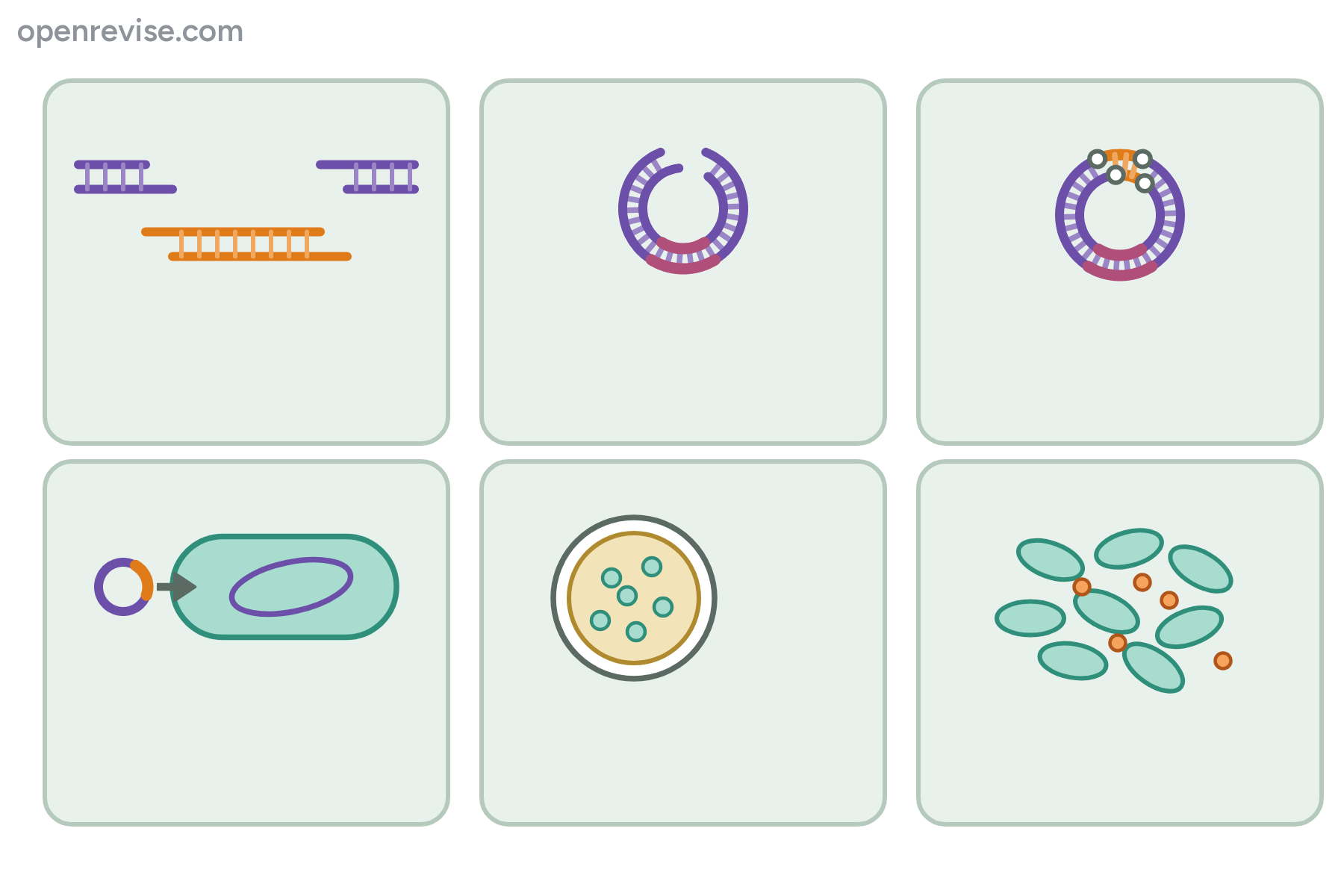 Describe what is happening in each of the six steps.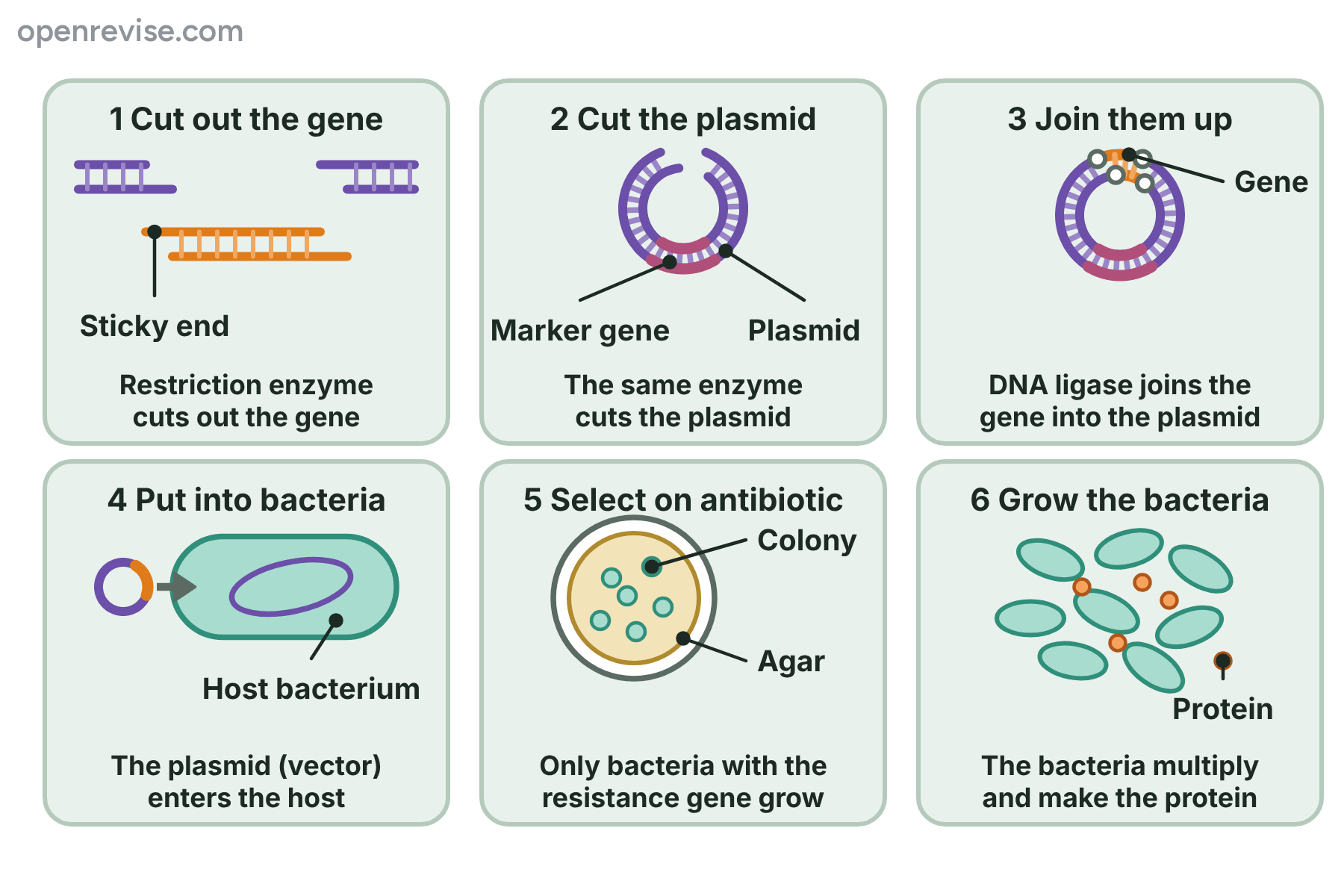
1 A restriction enzyme cuts out the gene, leaving sticky ends. 2 The same enzyme cuts the plasmid. 3 DNA ligase joins the gene into the plasmid. 4 The plasmid enters the host bacterium. 5 Only bacteria with the resistance marker grow on antibiotic agar. 6 The bacteria multiply and make the protein.
-
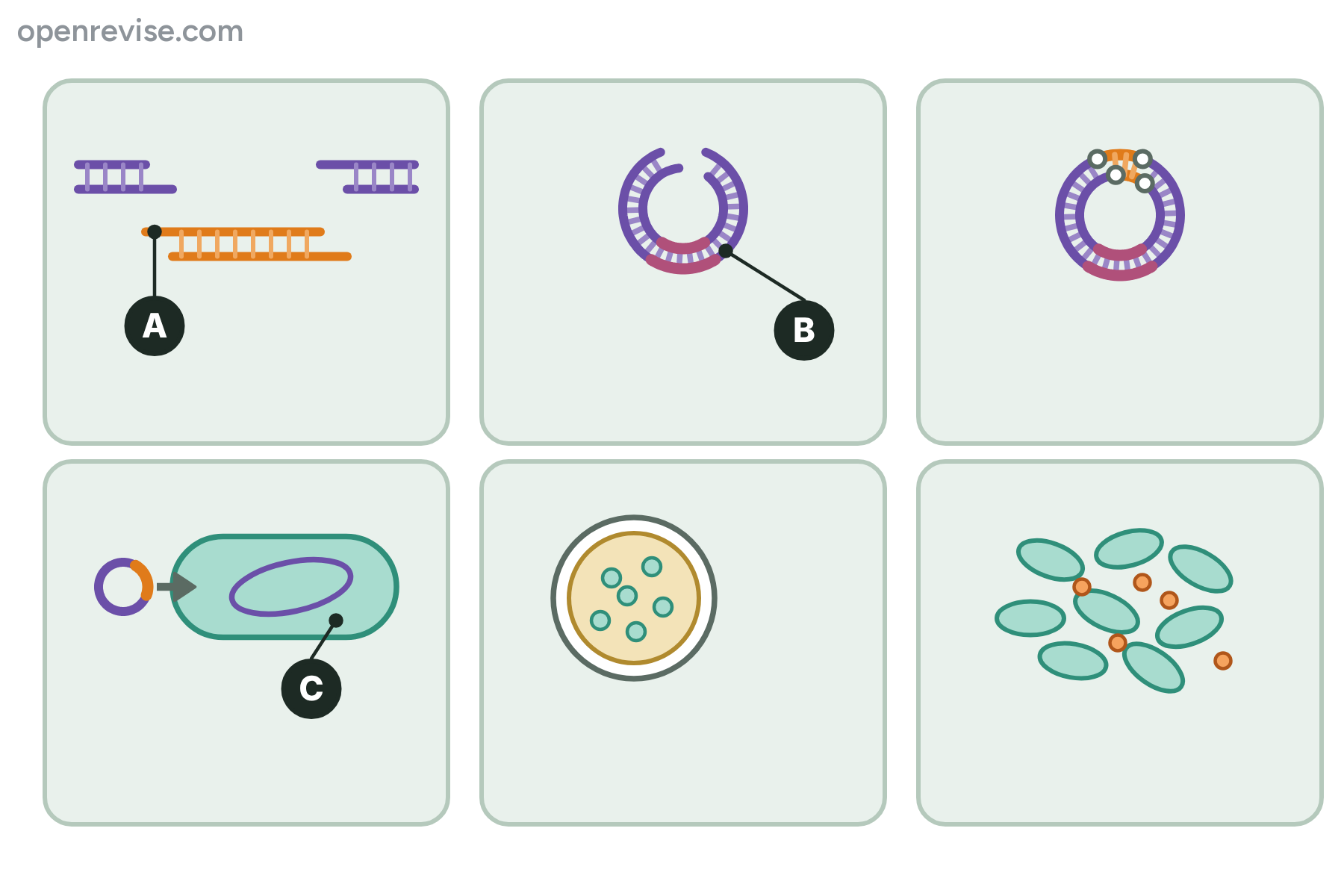 Name the parts marked A, B and C.
 A is a sticky end. B is a plasmid (the vector). C is the host bacterium.