Exam questions · Biology · Monitoring and Maintaining the Environment
Estimating Population Size
- 8 exam questions
- 26 marks
- 8 quick checks
-
1 State [2 marks]
State the equation used to estimate population size in the capture-recapture method.
Show answerHide answer
Model answer
Population size = (number in first sample × number in second sample) ÷ number of marked animals in the second sample.
Mark scheme
- Number in first sample × number in second sample — 1 mark
- Divided by the number of marked animals in the second sample — 1 mark
-
2 Calculate [3 marks]
A student placed 0.25 m\(^2\) quadrats at random in a field of area 1200 m\(^2\). The numbers of buttercups in the quadrats were 8, 12, 10, 6, 9, 11, 7, 10, 9 and 8. Estimate the number of buttercups in the field.
Show answerHide answer
Model answer
The total is 90, so the mean is \(90 \div 10 = 9.0\) per quadrat. The number of quadrats that fit in the field is \(1200 \div 0.25 = 4800\). The estimate is \(9.0 \times 4800 = 43\,200\) buttercups.
Mark scheme
- Mean = 9.0 per quadrat — 1 mark
- \(1200 \div 0.25 = 4800\) quadrats — 1 mark
- \(9.0 \times 4800 = 43\,200\) — 1 mark
-
3 Calculate [3 marks]
A scientist caught 60 frogs in a pond, marked them and released them. A week later she caught 45 frogs, and 15 of them were marked. Calculate an estimate of the number of frogs in the pond.
Show answerHide answer
Model answer
\(\frac{60 \times 45}{15} = \frac{2700}{15} = 180\) frogs.
Mark scheme
- \(60 \times 45\) — 1 mark
- Divided by 15 — 1 mark
- 180 frogs — 1 mark
-
4 Describe [4 marks]
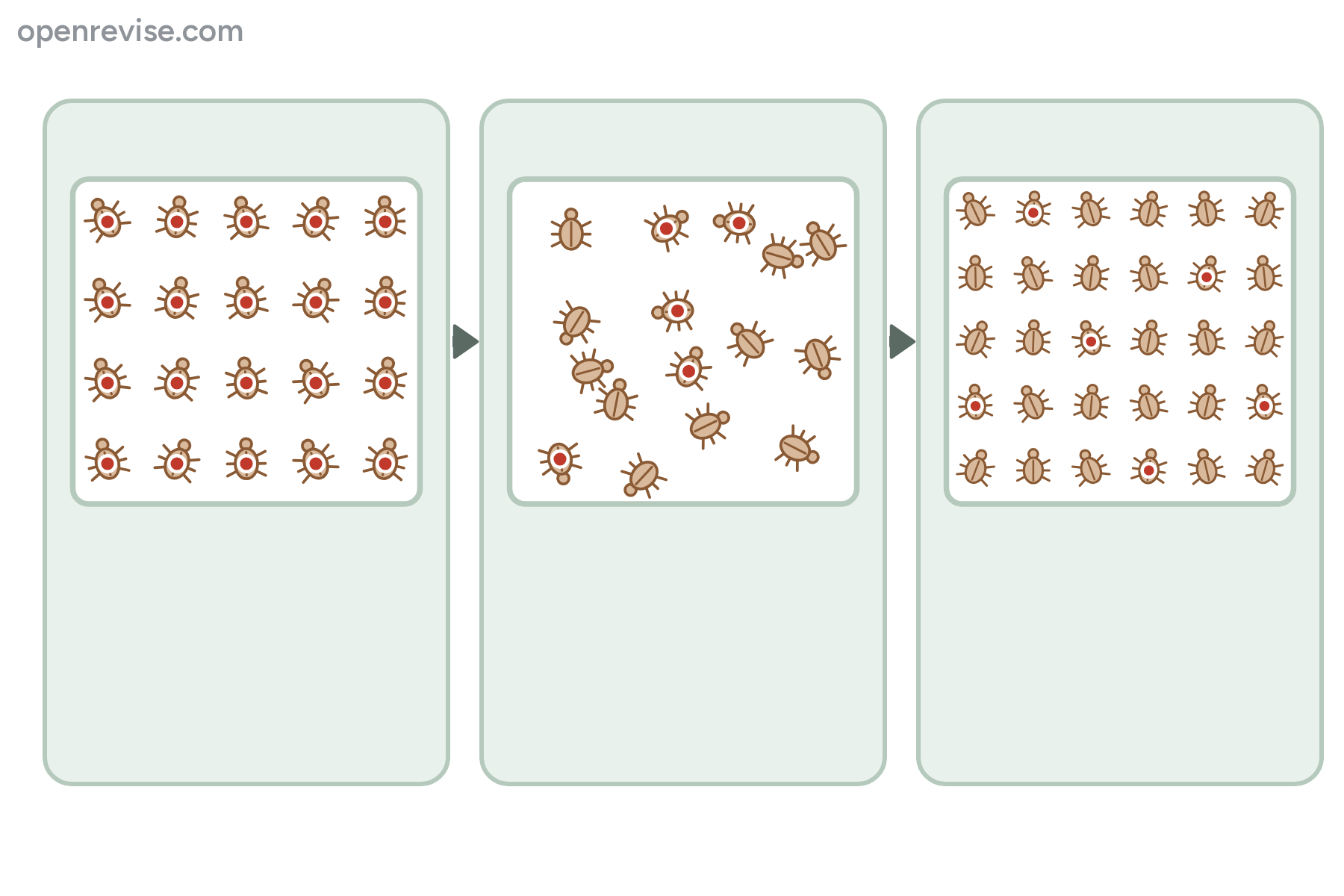
The diagram shows three stages in an investigation to estimate the size of a population of beetles. Describe what is done at each stage and how the result is used.
Show answerHide answer
Model answer
In stage 1 a sample of beetles is caught, counted, marked with a harmless spot and released. In stage 2 time is left for the marked beetles to mix with the rest of the population. In stage 3 a second sample is caught and the beetles are counted, with the number that are marked. The population is calculated as the number in the first sample times the number in the second sample divided by the number marked in the second sample.
Mark scheme
- Stage 1: caught, counted, marked and released — 1 mark
- Stage 2: time for the beetles to mix — 1 mark
- Stage 3: second sample caught, with the total and the number marked counted — 1 mark
- Population = first sample × second sample ÷ number marked — 1 mark
-
5 Explain [3 marks]
Explain two assumptions that are made when using the capture-recapture method.
Show answerHide answer
Model answer
The population does not change between the two samples, because no animals are born, die or move in or out. If they did, the fraction of marked animals would not show the population size. The marked animals mix evenly with the rest, so the second sample is representative. The marks do not harm the animals or come off.
Mark scheme
- First assumption stated, such as no births, deaths or movement — 1 mark
- Second assumption stated, such as mixing or marks not lost — 1 mark
- A reason why one of the assumptions is needed — 1 mark
-
6 Explain [3 marks]
During a capture-recapture investigation, the paint on some of the marked snails washed off in the rain. Explain how this would affect the estimated population.
Show answerHide answer
Model answer
Fewer of the marked snails would be recognised in the second sample, so the value for the number marked in the second sample would be too small. The population is calculated by dividing by this number, so the estimate would be too large. The population would be overestimated.
Mark scheme
- Fewer marked snails are found in the second sample — 1 mark
- The number marked is the divisor, so the result is larger — 1 mark
- The population is overestimated — 1 mark
-
7 Evaluate [6 marks]
A student estimated the number of woodlice under a hedge. She caught 12 woodlice, marked them and released them. The next day she caught 10 woodlice, and 2 were marked. She calculated that the population was 60. Evaluate the reliability of her estimate, and suggest how she could improve it.
Show answerHide answer
Model answer
The calculation is \(\frac{12 \times 10}{2} = 60\), which is correct for her figures. However, the samples were small, so one more or one fewer marked woodlouse in the second sample would change the estimate a lot. For example, if there had been 3 marked, the estimate would be 40. The result may also have been affected by errors in the assumptions, such as the marks rubbing off, some woodlice moving away from the hedge or dying, or the marked woodlice not having mixed after only one day. She made only one estimate, so she cannot tell how variable it is. She could improve the estimate by catching more woodlice in each sample, for example by using more traps, waiting until the marked woodlice have mixed, and by checking that the marks do not wash off. She should repeat the investigation several times and calculate a mean.
Mark scheme
- The calculation is correct, 60 — 1 mark
- The samples are small, so one animal changes the estimate a lot — 1 mark
- An assumption that may not be met, such as marks lost or movement — 1 mark
- Only one estimate, so reliability cannot be judged — 1 mark
- An improvement, such as larger samples or more traps — 1 mark
- Repeat the investigation and take the mean — 1 mark
-
8 Calculate [2 marks]
A student estimated that moss covered a mean of 15 per cent of each quadrat on a lawn with an area of 200 m\(^2\). Calculate the area of the lawn that is covered by moss.
Show answerHide answer
Model answer
\(0.15 \times 200 = 30\) m\(^2\).
Mark scheme
- \(\frac{15}{100} \times 200\) — 1 mark
- 30 m\(^2\) — 1 mark
Quick check
-
1
A mean of 6 plants was counted in 0.25 m\(^2\) quadrats. The area of the habitat is 100 m\(^2\). What is the estimated population?
Show answerHide answer
B: 2400
The number of quadrats that fit in the area is 100 divided by 0.25, which is 400, and 400 times 6 is 2400.
-
2
For which of these is capture-recapture the most suitable method?
Show answerHide answer
D: Ground beetles in a field
Capture-recapture is used for animals that move, so they cannot be counted in a quadrat.
-
3
In a capture-recapture investigation, 30 animals were marked, 40 were caught in the second sample and 10 of those were marked. What is the estimated population?
Show answerHide answer
A: 120
The population is 30 times 40 divided by 10, which is 120.
-
4
Why is there a delay between the first and second samples in capture-recapture?
Show answerHide answer
C: So that the marked animals can mix with the rest
The marked animals need time to mix evenly with the rest of the population, so the second sample is representative.
-
5
Which of these is an assumption of the capture-recapture method?
Show answerHide answer
B: No animals are born, die or move in or out
If the population changed, the fraction of marked animals would not show the size of the population.
-
6
What would happen to the estimated population if the marked animals did not mix with the others and stayed near where they were released, where the second sample was caught?
Show answerHide answer
D: It would be underestimated
More marked animals would be in the second sample than expected, so the number marked is too high and the population is underestimated.
-
7
How can the reliability of an estimate of population size from quadrats be improved?
Show answerHide answer
A: Using more quadrats placed at random
More quadrats, placed at random, make the mean less affected by unusual values.
-
8
A quadrat is 0.5 m by 0.5 m. What is its area?
Show answerHide answer
C: 0.25 square metres
Area is length times width, which is 0.5 times 0.5, which is 0.25 square metres.