Flashcards · Biology · Monitoring and Maintaining the Environment
Estimating Population Size
-
What do you multiply the mean per quadrat by to scale up?
The number of quadrats that would fit in the whole area.
-
How do you find how many quadrats fit in the area?
Total area divided by the area of one quadrat.
-
What is the area of a 0.5 m by 0.5 m quadrat?
0.25 square metres.
-
A mean of 4 per 0.25 m squared quadrat: how many per square metre?
16.
-
When is capture-recapture used?
To estimate the population of animals that move about.
-
What happens to the animals in the first sample?
They are counted, marked and released.
-
Why wait before the second sample?
So the marked animals can mix with the rest of the population.
-
What is counted in the second sample?
The total number caught, and how many of them are marked.
-
State the capture-recapture equation.
Population = (first sample × second sample) ÷ number of marked animals in the second sample.
-
Give a harmless way to mark a snail.
A small dot of non-toxic paint on the shell.
-
Name two assumptions of capture-recapture.
No births, deaths or movements between samples, and the marks stay on and are harmless (any two).
-
What is the effect if marks rub off?
Fewer marked animals are found, so the population is overestimated.
-
Why do small samples give less reliable estimates?
A small change in the number counted has a big effect on the estimate.
-
Why does a patchy habitat cause errors with quadrats?
The quadrats may land on more patches or fewer patches than average.
-
How can the estimate be made more reliable?
Use larger samples or more quadrats, and repeat and take the mean.
-
Why do fisheries use capture-recapture?
To estimate fish numbers so that they can set sustainable catches.
-
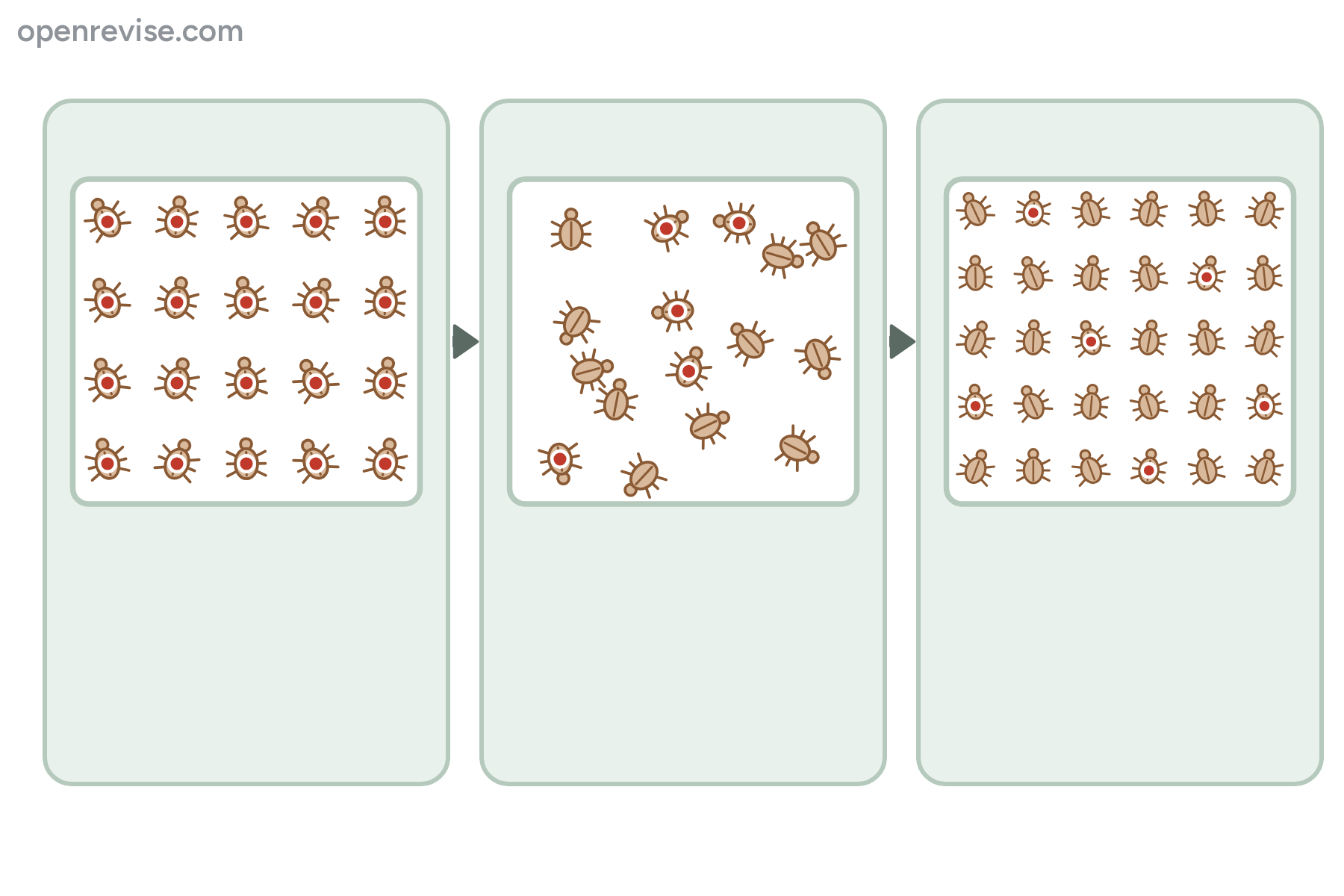 Describe what is done at each of steps 1, 2 and 3, and how the population size is found.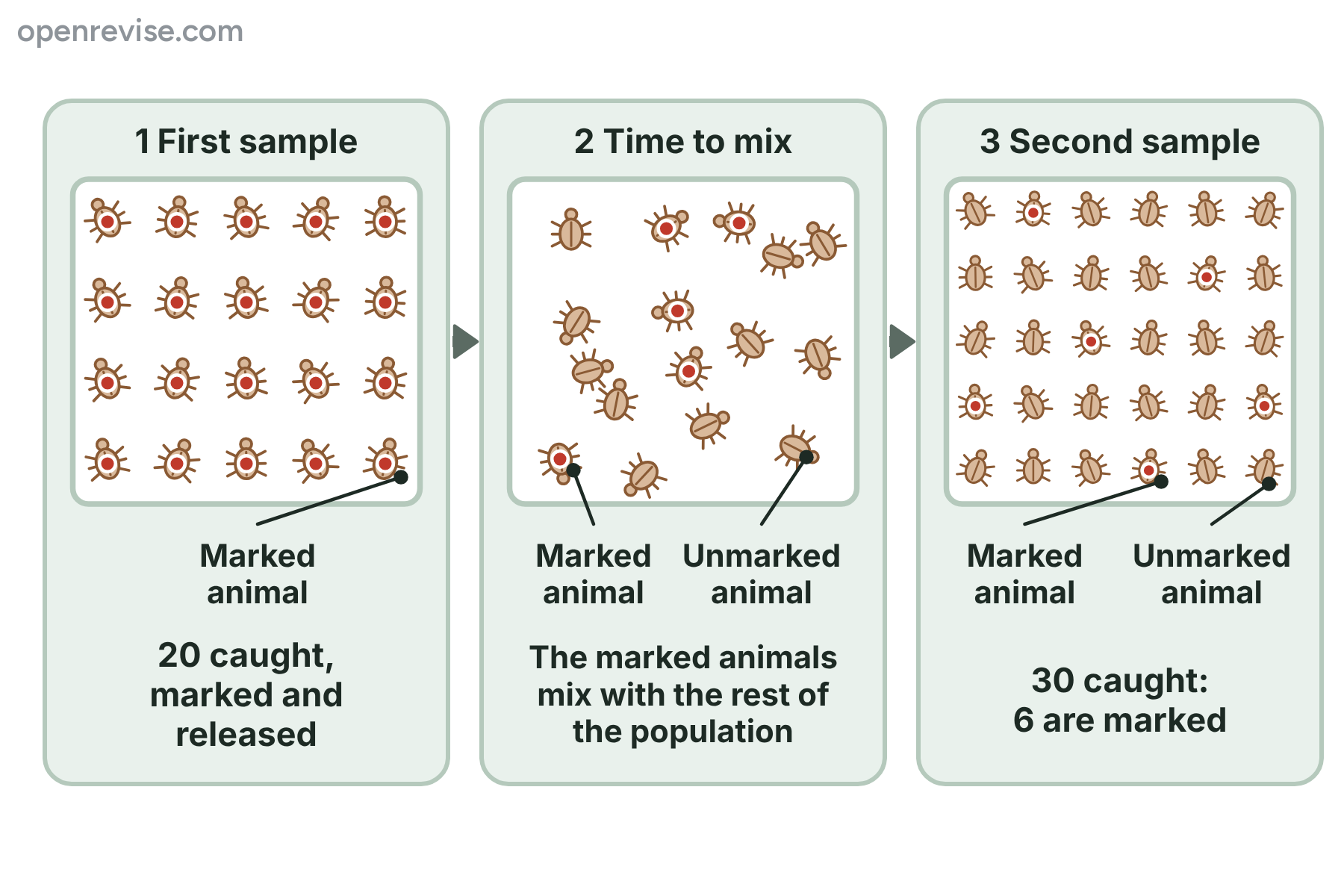
1 Catch 20 animals, mark them and release them. 2 Wait for them to mix with the population. 3 Catch another sample, of 30, and count those that are marked, which is 6. Population = 20 × 30 ÷ 6 = 100.