Exam questions · Biology · Natural Selection and Evolution
Antibiotic Resistance in Bacteria
- 8 exam questions
- 26 marks
- 8 quick checks
-
1 State [1 mark]
State why a doctor does not prescribe an antibiotic to treat influenza.
Show answerHide answer
Model answer
Influenza is caused by a virus, and antibiotics do not work on viruses.
Mark scheme
- Influenza is caused by a virus (not bacteria) — 1 mark
-
2 Describe [4 marks]
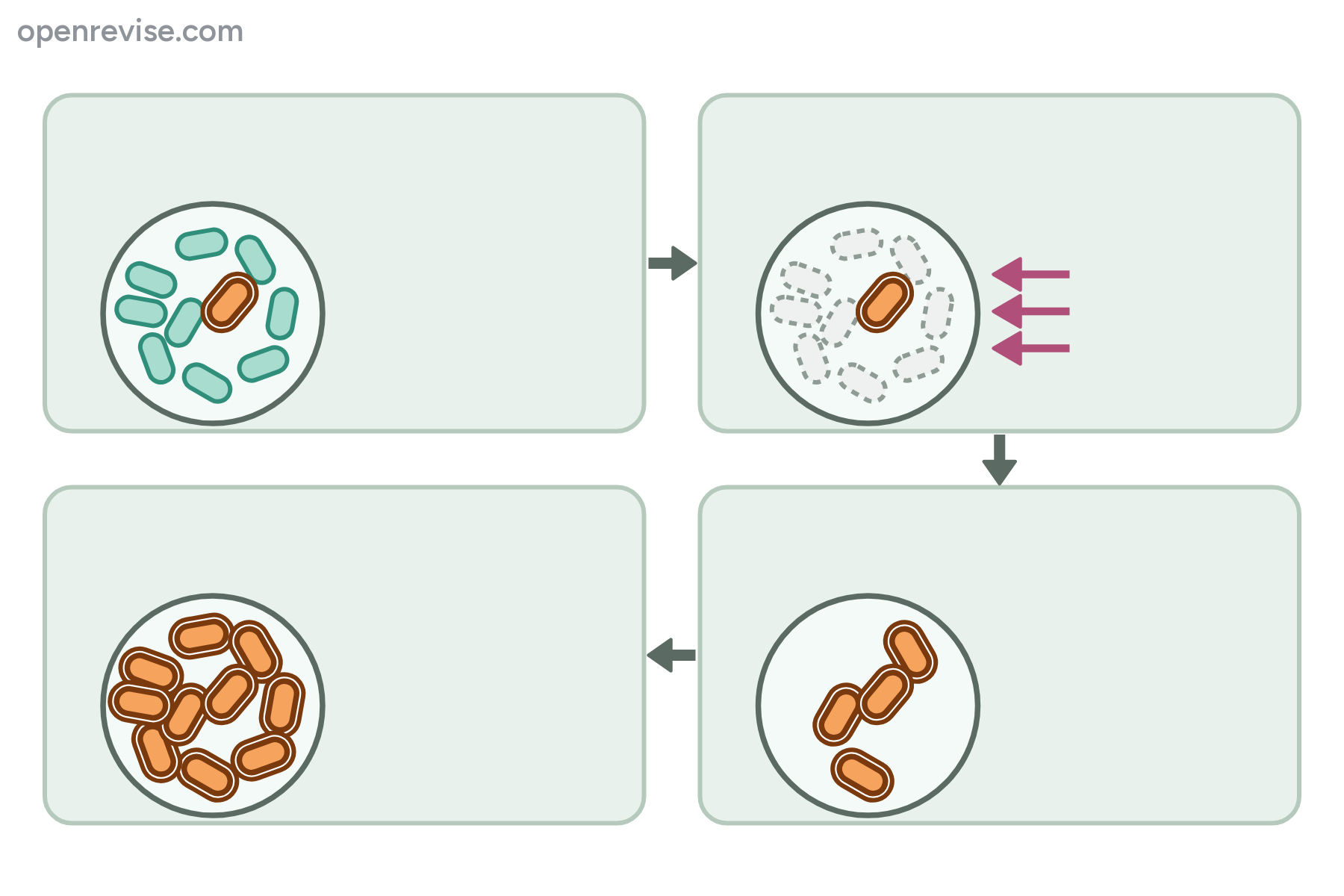
The diagram shows four stages in the evolution of resistance in a population of bacteria. The orange bacteria are resistant to an antibiotic. Describe what happens in stages 1 to 4.
Show answerHide answer
Model answer
In stage 1 a mutation has made one bacterium resistant to the antibiotic. In stage 2 the antibiotic kills the non-resistant bacteria, but the resistant bacterium survives. In stage 3 the surviving resistant bacteria reproduce and pass the allele for resistance on to their offspring. In stage 4 the whole population is made up of resistant bacteria, so the antibiotic no longer works.
Mark scheme
- Stage 1: a resistant bacterium arises (by mutation) — 1 mark
- Stage 2: non-resistant bacteria are killed, the resistant one survives — 1 mark
- Stage 3: the resistant bacteria reproduce and pass on the allele — 1 mark
- Stage 4: the population is resistant — 1 mark
-
3 Calculate [2 marks]
A resistant bacterium divides every 30 minutes. Assuming that none die, calculate the number of bacteria produced from one resistant bacterium after 4 hours.
Show answerHide answer
Model answer
4 hours is 8 divisions of 30 minutes, so the number of bacteria is \(2^8 = 256\).
Mark scheme
- \(4 \times 60 \div 30 = 8\) divisions — 1 mark
- \(2^8 = 256\) bacteria — 1 mark
-
4 Explain [4 marks]
A patient with a cold asks her doctor for antibiotics. The doctor refuses. Explain why it is better not to prescribe antibiotics for a cold.
Show answerHide answer
Model answer
A cold is caused by a virus, so an antibiotic would not cure it. Any bacteria in the patient's body would be exposed to the antibiotic, which is a selection pressure. This kills the non-resistant bacteria but not the resistant ones, which survive and reproduce, so more resistant bacteria would be present. This makes future infections harder to treat.
Mark scheme
- A cold is caused by a virus, and antibiotics do not work on viruses — 1 mark
- Bacteria in the body are exposed to the antibiotic — 1 mark
- Resistant bacteria survive and reproduce — 1 mark
- More resistant bacteria mean future infections are harder to treat — 1 mark
-
5 Describe [3 marks]
Describe three ways in which the development of antibiotic resistance can be slowed down.
Show answerHide answer
Model answer
Doctors should not prescribe antibiotics for viral infections or mild infections. Patients should finish the whole course of antibiotics, so that all of the bacteria are killed. Antibiotics should not be used routinely on healthy farm animals. Hospitals can use hygiene measures, such as hand washing, and isolate infected patients.
Mark scheme
- Do not overuse or prescribe antibiotics unnecessarily — 1 mark
- Complete the course of antibiotics — 1 mark
- Any other sensible measure, such as less use in farming or better hygiene — 1 mark
-
6 Explain [3 marks]
MRSA is a problem in hospitals. Explain why hospitals are places where resistant bacteria are selected and spread.
Show answerHide answer
Model answer
Antibiotics are used often in hospitals, so there is a strong selection pressure that favours resistant bacteria. The bacteria spread easily on hands, equipment and surfaces. Patients with wounds or weak immune systems are easily infected.
Mark scheme
- Antibiotics are used heavily, so resistant bacteria are selected — 1 mark
- The bacteria spread between patients on hands and equipment — 1 mark
- Patients have wounds or weak defences, so they are easily infected — 1 mark
-
7 Calculate [3 marks]
Source: A hospital recorded the number of cases of MRSA infection each year. In 2012 there were 120 cases, in 2013 there were 135, in 2014 there were 142, in 2015 there were 98, in 2016 there were 71 and in 2017 there were 52. A new hygiene policy and a rule on antibiotic use began on 1 January 2015. Calculate the percentage decrease in the number of cases between 2014 and 2017. Give your answer to the nearest whole number, and suggest what the data show about the new policy.
Show answerHide answer
Model answer
The decrease was \(142 - 52 = 90\) cases. As a percentage of 2014 this is \(\frac{90}{142} \times 100 = 63.4\), which is 63 per cent. The number of cases rose before 2015 and fell every year after the policy began, which suggests that the policy was successful, although the data cannot prove it caused the fall.
Mark scheme
- \(142 - 52 = 90\) — 1 mark
- \(\frac{90}{142} \times 100 = 63\) per cent — 1 mark
- The cases fell after the policy began, so the policy may have worked — 1 mark
-
8 Evaluate [6 marks]
Some farmers give antibiotics to healthy animals to make them grow faster and to stop disease spreading. Evaluate this use of antibiotics, with reference to natural selection.
Show answerHide answer
Model answer
There are benefits to the farmer, because the animals grow faster and the disease is less likely to spread, which makes meat cheaper and reduces suffering from infection. However, giving antibiotics to healthy animals exposes large numbers of bacteria to the antibiotic, which is a selection pressure. Random mutations that give resistance are selected, because the non-resistant bacteria are killed and the resistant bacteria survive and reproduce, passing on the allele. The resistant bacteria can pass from the animals to people, through meat, water or contact, and then cause infections that are difficult to treat. This makes antibiotics less useful in human medicine. It would be better to give antibiotics only to sick animals, to improve hygiene and animal welfare and to stop the routine use. The benefit to farmers is short-term, but the harm of resistant bacteria is long-term and affects everybody.
Mark scheme
- Benefits to farmers, such as faster growth or less disease — 1 mark
- The antibiotic is a selection pressure that kills non-resistant bacteria — 1 mark
- Resistant bacteria survive, reproduce and pass on the allele — 1 mark
- Resistant bacteria can spread to humans and cause infections that are hard to treat — 1 mark
- A judgement, such as that the risk outweighs the benefit — 1 mark
- A reasoned alternative, such as treating only sick animals or improving hygiene — 1 mark
Quick check
-
1
What causes a bacterium to become resistant to an antibiotic?
Show answerHide answer
C: A random mutation that gives it a resistance allele
Resistance arises by a random mutation, which happens before the antibiotic is used. The antibiotic only selects for it.
-
2
Why can bacteria evolve resistance within days?
Show answerHide answer
A: They have many generations in a short time
They reproduce very quickly, so many generations occur and natural selection works fast.
-
3
In a population of bacteria exposed to an antibiotic, which bacteria are most likely to survive and breed?
Show answerHide answer
D: The resistant bacteria
The resistant bacteria are not killed, so they survive and reproduce and pass on the allele.
-
4
What does MRSA stand for?
Show answerHide answer
B: Methicillin-resistant Staphylococcus aureus
MRSA is methicillin-resistant Staphylococcus aureus, a bacterium resistant to many antibiotics.
-
5
Why should a patient finish a course of antibiotics, even when feeling better?
Show answerHide answer
A: So that all of the bacteria are killed and none survive to breed
Surviving bacteria could breed and become a resistant population, so the whole course is needed to kill them all.
-
6
Which statement is correct?
Show answerHide answer
D: Bacteria become resistant by natural selection
It is the bacteria that become resistant, not the person, and it is by natural selection.
-
7
Why is the use of antibiotics on healthy farm animals a concern?
Show answerHide answer
C: It selects for resistant bacteria that may spread to people
It exposes many bacteria to antibiotics, selecting for resistant bacteria that can pass to humans.
-
8
Why is antibiotic resistance regarded as evidence for evolution?
Show answerHide answer
B: It shows natural selection happening in a population
It shows natural selection of a variant, in a population, happening over a short time.