Flashcards · Biology · Natural Selection and Evolution
Antibiotic Resistance in Bacteria
-
What does an antibiotic do?
It kills bacteria or stops them growing, without harming the person's cells.
-
Do antibiotics work on viruses?
No. Viruses are not cells, so antibiotics cannot affect them.
-
What is antibiotic resistance?
A bacterium not being killed by an antibiotic, because of an allele that it carries.
-
How does a resistant bacterium first arise?
By a random mutation, before the antibiotic is used.
-
What is the selection pressure in antibiotic resistance?
The antibiotic, which kills non-resistant bacteria.
-
What happens to the non-resistant bacteria?
They are killed by the antibiotic.
-
What happens to the resistant bacteria?
They survive, reproduce and pass on the resistance allele.
-
Why do bacteria evolve resistance quickly?
They reproduce very quickly, they are present in huge numbers and they clone themselves.
-
How often can some bacteria divide?
About every 20 minutes in good conditions.
-
What does MRSA stand for?
Methicillin-resistant Staphylococcus aureus.
-
Why is MRSA a problem in hospitals?
It spreads to patients with wounds and weak defences, and few antibiotics will treat it.
-
Why should a patient finish the whole course of antibiotics?
So that all of the bacteria are killed and none survive to breed.
-
Why should antibiotics not be given for a cold?
A cold is caused by a virus, and the use would only select for resistant bacteria.
-
Why is the use of antibiotics in farming a concern?
It selects for resistant bacteria that may pass to humans.
-
Name two ways to stop MRSA spreading.
Washing hands and cleaning equipment, and isolating infected patients.
-
Why is antibiotic resistance evidence for evolution?
Natural selection can be seen happening in a short time, in a population of bacteria.
-
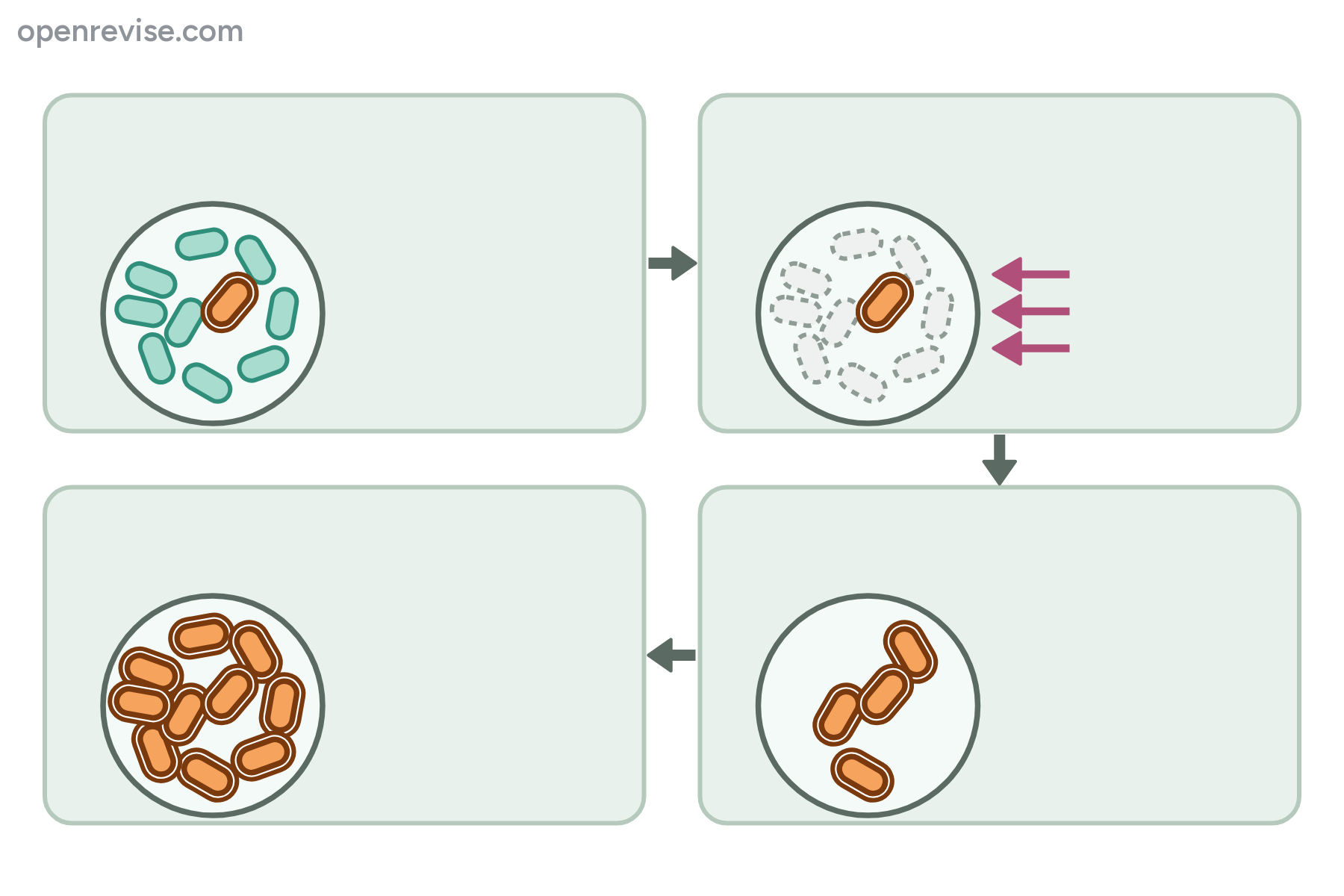 Describe what happens at each of stages 1 to 4 in the diagram.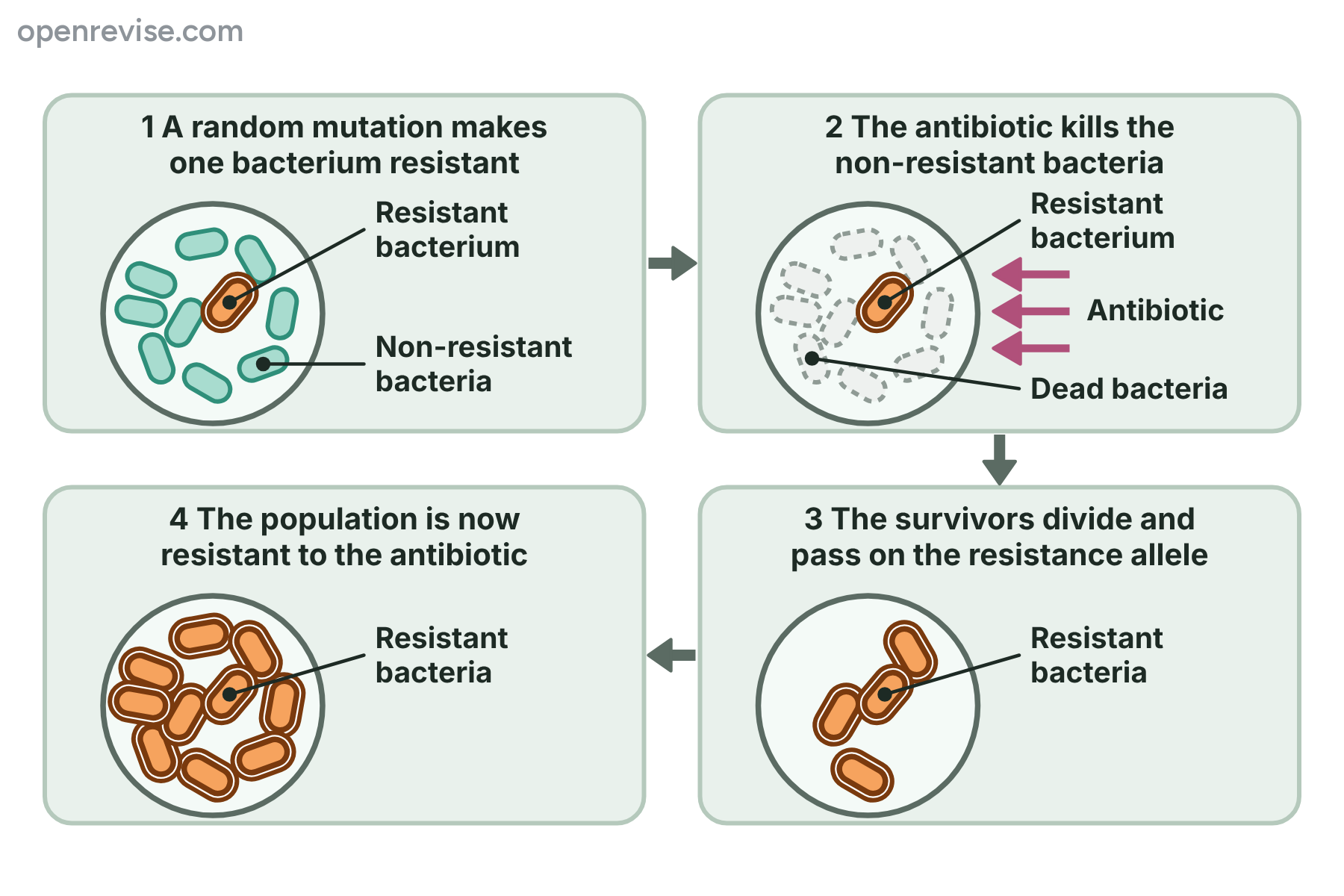
1 A mutation makes one bacterium resistant. 2 The antibiotic kills the non-resistant bacteria. 3 The resistant survivors reproduce and pass on the allele. 4 The population is now mostly resistant, so the antibiotic no longer works.