Exam questions · Biology
Natural Selection and Evolution
- 44 exam questions
- 138 marks
- 48 quick checks
Natural Selection
Just this lesson-
1 State [1 mark]
State what causes a new variant of a gene to appear.
Show answerHide answer
Model answer
A mutation.
Mark scheme
- A mutation (a change in the DNA base sequence) — 1 mark
-
2 Describe [2 marks]
Peppered moths in a wood are eaten by birds. Describe what is meant by a selection pressure.
Show answerHide answer
Model answer
A selection pressure is a factor in the environment that makes it harder for some individuals to survive and breed than others. In the wood, predation by birds is the selection pressure, because the moths that are easiest to see are eaten.
Mark scheme
- A factor in the environment that affects survival and breeding — 1 mark
- A suitable example, such as predation by birds — 1 mark
-
3 Explain [3 marks]
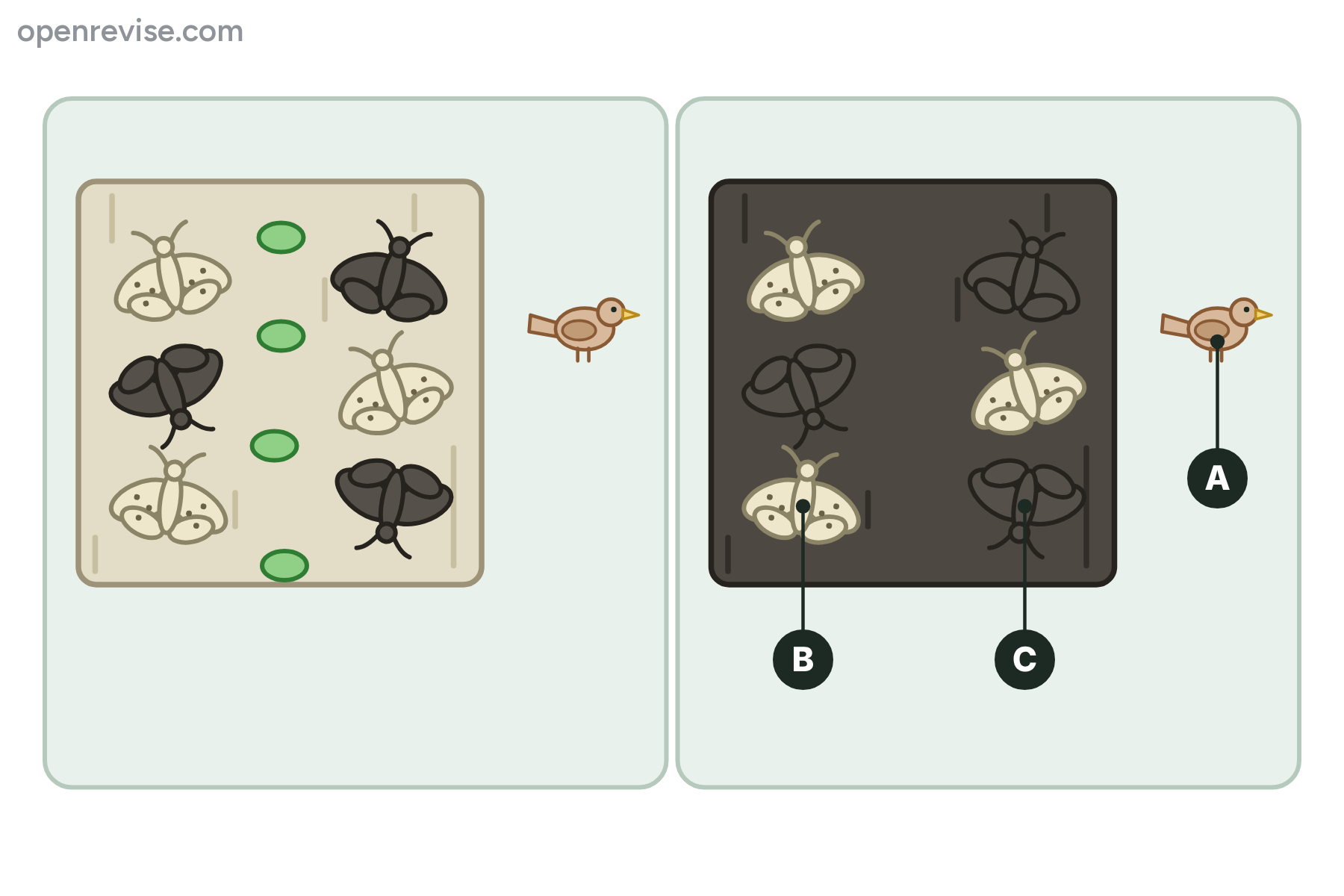
The diagram shows moths on tree bark in a clean wood and in a polluted wood. In the polluted wood, A is a bird, B is a pale moth and C is a dark moth. Explain why B is more likely to be eaten by A than C is.
Show answerHide answer
Model answer
In the polluted wood the bark is dark. The pale moth B is easy to see against the dark bark, so the bird can find it and eat it. The dark moth C is camouflaged, so it is more likely to survive.
Mark scheme
- The bark in the polluted wood is dark — 1 mark
- B is easily seen by the bird (against the dark bark) — 1 mark
- C is camouflaged, so it is less likely to be eaten — 1 mark
-
4 Calculate [2 marks]
In an experiment, 473 dark moths and 496 pale moths were released in an unpolluted wood. Later 30 dark moths and 62 pale moths were recaptured. Calculate the percentage of the pale moths that was recaptured. Give your answer to the nearest whole number.
Show answerHide answer
Model answer
\(\frac{62}{496} \times 100 = 12.5\), which is 13 per cent to the nearest whole number.
Mark scheme
- \(62 \div 496 \times 100\) — 1 mark
- 13 per cent (12.5 per cent gains 1 mark) — 1 mark
-
5 Explain [4 marks]
A student says, "The peppered moths changed colour so that they could hide from birds." Explain why this statement is wrong.
Show answerHide answer
Model answer
Individual moths do not change colour because they need to. Dark moths first appeared by a random mutation. The dark moths were better camouflaged in the sooty woods, so they survived and bred more. Their offspring inherited the allele for dark colour, so over many generations the population contained more dark moths.
Mark scheme
- Individual moths did not change colour — 1 mark
- The dark variant arose by a random mutation, not because it was needed — 1 mark
- Dark moths were camouflaged, so they survived and bred more — 1 mark
- The allele was passed on, so the population changed over generations — 1 mark
-
6 Explain [3 marks]
After the Clean Air Acts of the 1950s and 1960s, dark peppered moths became less common in Britain. Explain why.
Show answerHide answer
Model answer
Less soot was produced, so the tree bark became paler again and the lichens returned. The dark moths were now easy for birds to see, so more of them were eaten. The pale moths were camouflaged, survived and bred more, so the allele for pale colour became more common.
Mark scheme
- The bark became paler (less soot) — 1 mark
- Dark moths were easily seen and eaten — 1 mark
- Pale moths survived, bred and passed on their allele — 1 mark
-
7 Evaluate [6 marks]
Kettlewell released marked moths in two woods and recaptured some of them later. In the polluted wood near Birmingham he recaptured 53 per cent of the dark moths and 25 per cent of the pale moths. In the unpolluted wood in Dorset he recaptured 6 per cent of the dark moths and 13 per cent of the pale moths. Evaluate how far these results support the idea that birds select moths that are easily seen.
Show answerHide answer
Model answer
In the polluted wood the percentage of dark moths recaptured is about twice that of the pale moths, which suggests that more pale moths were eaten by birds. In Dorset the opposite pattern appears, with about twice as many pale moths recaptured, which suggests that birds ate more of the dark moths against the pale, lichen-covered bark. Together the results support the idea that moths that match their background survive. However, a recapture rate is not a direct measure of predation, because some moths may have flown away, died of other causes or not been found. The number of moths released was different in each case, and the experiment was done at one time in two places, so it should be repeated and the birds seen eating the moths to be sure.
Mark scheme
- Dark moths recaptured about twice as often as pale in the polluted wood — 1 mark
- Pale moths recaptured about twice as often as dark in the clean wood — 1 mark
- This supports the idea that birds eat the moths that are easy to see — 1 mark
- Recapture is not a direct measure of predation (other causes of loss) — 1 mark
- Different numbers released, one experiment, two places — 1 mark
- A suggested improvement, such as repeating it or observing the birds — 1 mark
Quick check
-
1
Which of these is the original source of a new variant of a gene?
Show answerHide answer
C: Mutation
New alleles arise only from mutations. Sexual reproduction shuffles variants that already exist.
-
2
Which statement about mutations is correct?
Show answerHide answer
A: They are random, and most have no effect on the phenotype
Mutations are random changes in the DNA, and most have no effect on the phenotype.
-
3
In a sooty wood, why were pale peppered moths eaten more often than dark ones?
Show answerHide answer
D: They were easily seen by birds against the dark bark
Birds were the selection pressure. Pale moths were easy to see against the dark bark.
-
4
What is a selection pressure?
Show answerHide answer
B: A factor in the environment that affects survival and breeding
A selection pressure is a factor in the environment, such as predation, that affects which individuals survive and breed.
-
5
Which is the best way to complete this sentence? Natural selection changes the characteristics of ...
Show answerHide answer
A: a population over many generations
Natural selection acts on a population over generations, because individuals cannot change their own alleles.
-
6
What must happen for a mutation to be passed on to offspring?
Show answerHide answer
C: It must be in a cell that makes gametes
Only a mutation in a cell that makes gametes can be inherited. The offspring then carry the new variant.
-
7
A population of beetles shows no genetic variation at all. What is the likely result of a big change in the environment?
Show answerHide answer
B: No variants are available to be selected, so the population may not adapt
Without variation there are no better-suited variants to be selected, so the whole population may be affected in the same way.
-
8
After natural selection has acted for many generations, what is true of the population?
Show answerHide answer
D: The advantageous allele is more common
The alleles that gave an advantage have been passed on and are now more common, so the population is better adapted.
Evolution and the Formation of New Species
Just this lesson-
1 Define [2 marks]
What is meant by the term species?
Show answerHide answer
Model answer
A species is a group of organisms that can interbreed to produce fertile offspring.
Mark scheme
- A group of organisms that can interbreed — 1 mark
- To produce fertile offspring — 1 mark
-
2 Explain [3 marks]
A male donkey and a female horse can mate and have a mule. Mules cannot have offspring of their own. Explain why horses and donkeys are classed as different species.
Show answerHide answer
Model answer
A species is a group of organisms that can interbreed to produce fertile offspring. Although a horse and a donkey can mate, their offspring, the mule, is infertile. So the horse and donkey cannot interbreed to produce fertile offspring, and they are different species.
Mark scheme
- A species interbreeds to produce fertile offspring — 1 mark
- The mule is infertile — 1 mark
- So horses and donkeys do not interbreed to give fertile offspring, so they are different species — 1 mark
-
3 Describe [2 marks]
Describe what is meant by evolution.
Show answerHide answer
Model answer
Evolution is a change in the inherited characteristics of a population over time. It happens through the process of natural selection.
Mark scheme
- A change in the inherited characteristics of a population — 1 mark
- Over time, through natural selection — 1 mark
-
4 Explain [4 marks]
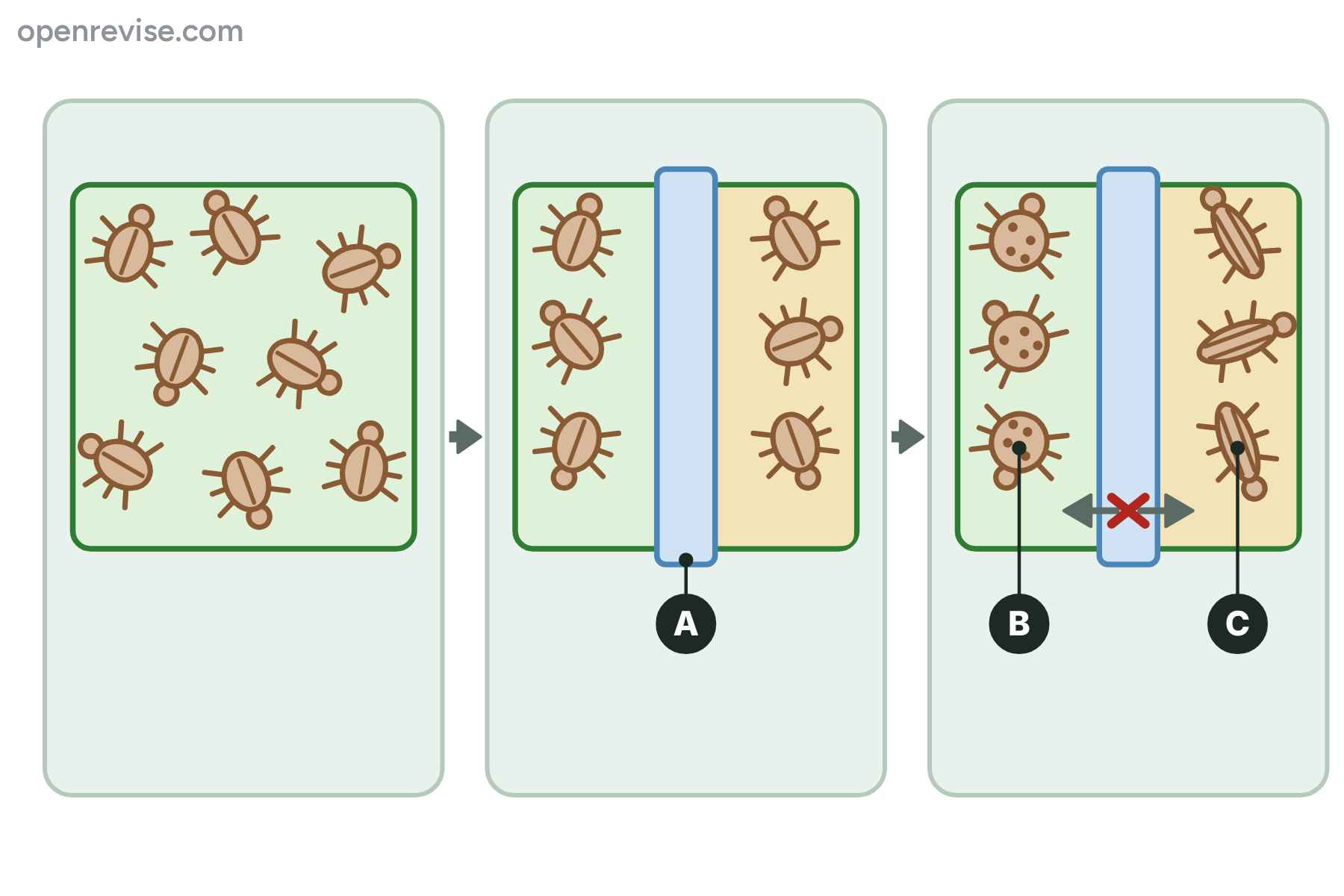
The diagram shows a population of beetles that was split in two by a river, A. Many generations later the beetles at B and C are different species. Explain how the river led to B and C becoming different species.
Show answerHide answer
Model answer
The river A is a barrier that isolated the two populations, so the beetles could not interbreed and the alleles were not shared. The environment on each side was different, so the selection pressures were different, and different variants survived and bred. Random mutations also occurred separately on each side. Over many generations the populations became so different that B and C can no longer interbreed to produce fertile offspring, so they are different species.
Mark scheme
- The river isolated the two populations so they could not interbreed — 1 mark
- Different environments, so different selection pressures — 1 mark
- Different variants selected and different mutations, so different alleles passed on — 1 mark
- After many generations they cannot interbreed to produce fertile offspring — 1 mark
-
5 Explain [3 marks]
A student says that giraffes evolved long necks because they stretched to reach the leaves at the top of trees. Explain why this is not a correct explanation.
Show answerHide answer
Model answer
A giraffe that stretches its neck does not change the DNA in its gametes, so the change cannot be passed on to its offspring. Long necks arose because some giraffes inherited an allele, produced by mutation, for a longer neck. These giraffes could reach more food, survived and bred more, so the allele became more common in the population.
Mark scheme
- A stretched neck is not inherited — 1 mark
- A mutation produced a variant for a longer neck — 1 mark
- Long-necked giraffes survived and bred more, passing the allele on — 1 mark
-
6 State [2 marks]
State two ways in which two populations of a species can become isolated from each other.
Show answerHide answer
Model answer
Any two from: a geographical barrier such as a river or mountain range; living on islands separated by the sea; breeding at different times of the year; females choosing mates by different songs, displays or colours.
Mark scheme
- First way of isolation — 1 mark
- Second way of isolation — 1 mark
-
7 Explain [6 marks]
Lake Victoria contains over 500 species of cichlid fish, which evolved from a few ancestors in about 15 000 years. The females of many species choose mates by the colour of the male. Explain how one species of fish could evolve into hundreds of species.
Show answerHide answer
Model answer
A few fish arrived in the lake and spread into different parts of it, living in different habitats and eating different foods. Groups that were separated could not interbreed, so they did not share alleles. Each group faced different selection pressures, so different variants survived, bred and passed on their alleles, and random mutations produced new variants in each group. The females in each group chose males of a certain colour, so the groups stopped breeding with each other, even when they lived together. Over many generations the groups became so different that they could no longer interbreed to produce fertile offspring, so they became separate species. This happened many times, so the number of species increased.
Mark scheme
- Groups of fish isolated in different parts of the lake or in different habitats — 1 mark
- They cannot interbreed, so alleles are not shared — 1 mark
- Different selection pressures, for example different food — 1 mark
- Different variants selected, mutations occur separately, alleles passed on — 1 mark
- Mate choice by colour keeps the groups separate — 1 mark
- Over many generations they can no longer interbreed to produce fertile offspring, so they are different species — 1 mark
Quick check
-
1
Which of these best describes a species?
Show answerHide answer
B: Organisms that interbreed to produce fertile offspring
A species is a group of organisms that can interbreed to produce fertile offspring.
-
2
A mule is the infertile offspring of a horse and a donkey. What does this show?
Show answerHide answer
D: That horses and donkeys are different species
Because the offspring is infertile, the horse and donkey cannot interbreed to produce fertile offspring, so they are different species.
-
3
What is evolution?
Show answerHide answer
A: A change in the inherited characteristics of a population over time
Evolution is a change in the inherited characteristics of a population over time, through natural selection.
-
4
What is the first step in the formation of a new species by isolation?
Show answerHide answer
C: A barrier separates the populations
The groups must first be separated, so that they cannot interbreed. The other changes follow over many generations.
-
5
Why do two populations separated by a mountain range often evolve in different ways?
Show answerHide answer
B: They have different selection pressures and different mutations
The environments are different, so different variants are best suited and selected on each side.
-
6
Which statement about evolution is correct?
Show answerHide answer
D: It happens to populations over many generations
Populations evolve over many generations. An individual does not change its alleles by natural selection.
-
7
Two populations of a plant that were isolated now flower at the same time and can pollinate each other, but the seeds they make do not grow. What does this suggest?
Show answerHide answer
A: They may have become different species
If the offspring are not fertile or viable, the two groups can no longer interbreed to produce fertile offspring, so they may now be separate species.
-
8
Which of these increases biodiversity?
Show answerHide answer
C: The evolution of a new species
When one species splits into two, there are more species, so biodiversity increases. Extinction decreases it.
Fossils and Extinction
Just this lesson-
1 State [1 mark]
State what is meant by a fossil.
Show answerHide answer
Model answer
The remains or traces of an organism from many years ago that are found in rock.
Mark scheme
- The remains or traces of an organism from many years ago, found in rock — 1 mark
-
2 Describe [3 marks]
Describe how a fossil of a shell is formed.
Show answerHide answer
Model answer
The shell is covered by layers of sediment after the animal dies. The shell is a hard part and does not decay easily, so it remains, and minerals replace it as it slowly decays, forming a copy in stone. The sediment turns to rock around it.
Mark scheme
- The shell is buried in sediment — 1 mark
- It does not decay easily, or it is replaced by minerals — 1 mark
- The sediment turns to rock, preserving the fossil — 1 mark
-
3 Give [2 marks]
Give two reasons why the fossil record is incomplete.
Show answerHide answer
Model answer
Any two from: many early organisms had soft bodies that decayed, so they left no fossils; fossils form only in rare conditions; many fossils have been destroyed by movements of the Earth, such as folding and heating of rocks; many fossils have not yet been found.
Mark scheme
- First reason — 1 mark
- Second reason — 1 mark
-
4 Describe [3 marks]
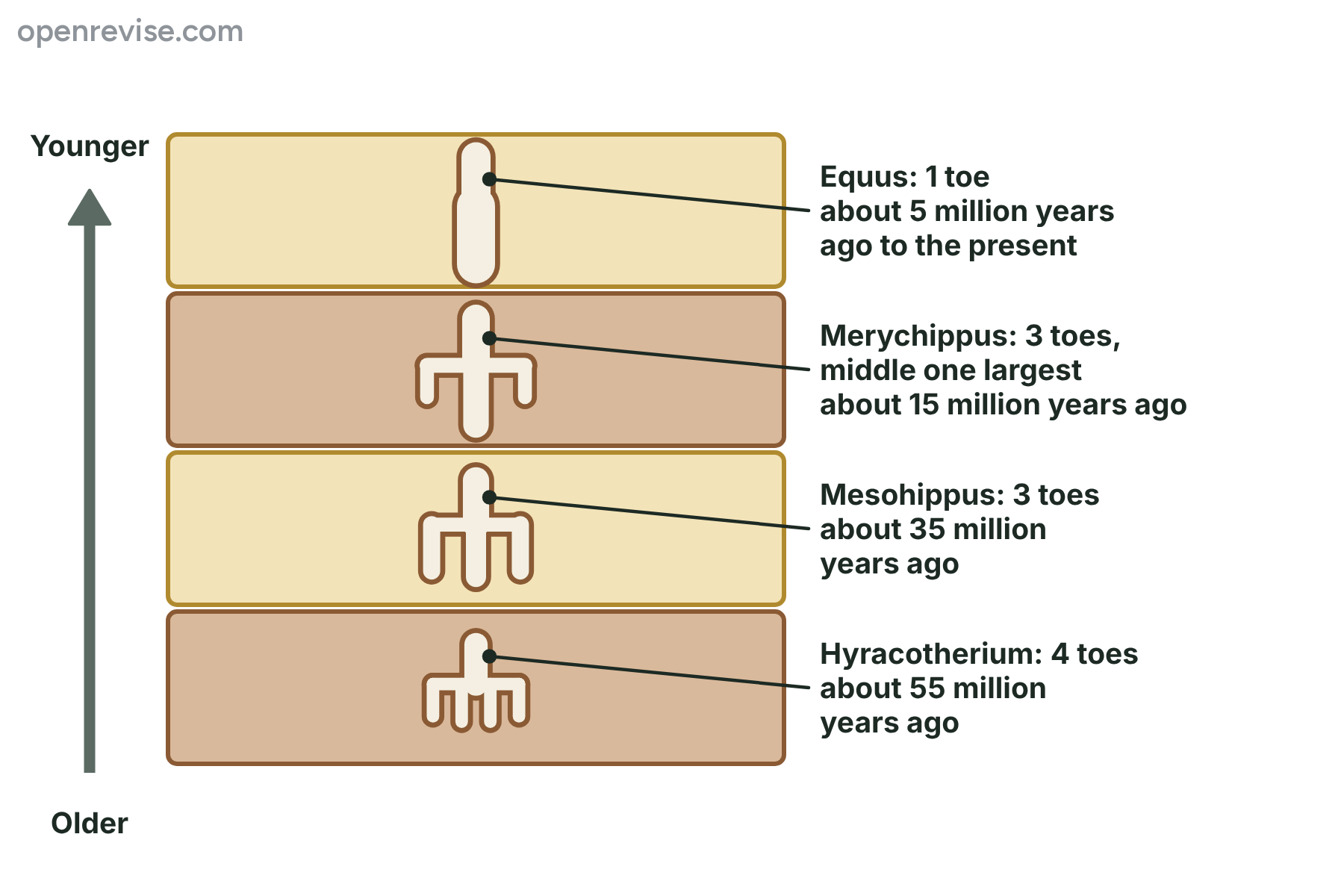
The diagram shows fossils of the front foot bones of four animals in the horse family, found in different layers of rock. Describe how the foot changed from the oldest to the youngest fossil.
Show answerHide answer
Model answer
The number of toes fell from four in the oldest fossil, Hyracotherium, to three in Mesohippus and Merychippus, and to one in the youngest, Equus. The middle toe became larger as the side toes became smaller, until only the large middle toe was left as a single hoof.
Mark scheme
- The number of toes decreased from four to one — 1 mark
- Quoting the data, such as four, three, three and one — 1 mark
- The middle toe became larger and the side toes smaller — 1 mark
-
5 Explain [3 marks]
A scientist finds the fossil of a trilobite in a deep layer of undisturbed rock and the fossil of a fish in a layer above it. Explain what this suggests about the ages of the fossils.
Show answerHide answer
Model answer
Sediment is laid down in layers, with the youngest on top. In undisturbed rock the deeper layer is older. So the trilobite is older than the fish, which lived later.
Mark scheme
- Sediment forms in layers, with new layers on top — 1 mark
- The deeper layer is older — 1 mark
- So the trilobite is older than the fish — 1 mark
-
6 Explain [4 marks]
A species of bird lived on a small island and ate only one kind of fruit. A disease killed all of the trees that made the fruit. Explain why the species of bird became extinct.
Show answerHide answer
Model answer
The food supply was lost, so the birds could not find enough to eat and could not compete for other foods. Because the species was a specialist, it could not use another food. The population was small, so it had little variation, and there may have been no variants able to eat a different food. The birds died or could not reproduce, so no individuals were left and the species was extinct.
Mark scheme
- The loss of its only food, so the birds starved or failed to breed — 1 mark
- It could not compete for or use any other food — 1 mark
- Little genetic variation in a small population, so no variants could cope — 1 mark
- No individuals were left, so the species is extinct — 1 mark
-
7 Evaluate [6 marks]
Fossils of the horse's ancestors are used as evidence that the horse evolved over millions of years. Using the diagram and your own knowledge, evaluate how well the fossil record supports the theory of evolution.
Show answerHide answer
Model answer
The diagram shows a clear pattern: the number of toes falls from four to three to one as the rocks get younger, so the foot changed gradually over 55 million years. This is what would be expected if each species evolved from the one before, and it shows how organisms are related. Other fossils support the idea, such as Archaeopteryx, which has features of reptiles and birds. However, the fossil record is incomplete, because soft parts rarely become fossils, conditions for fossilisation are rare and many fossils are destroyed or not yet found. The diagram shows only four animals and there are gaps of 10 to 20 million years between them, so it does not show every step. A fossil cannot show how the change happened. Overall the fossils strongly support evolution, because the changes are in a sequence in layers of different ages, but the record is better evidence when it is combined with other evidence, such as antibiotic resistance and DNA.
Mark scheme
- Describes the pattern: toes decrease from four to one in younger layers — 1 mark
- Uses figures from the diagram, such as ages or numbers of toes — 1 mark
- Says that the sequence fits gradual change, which supports evolution — 1 mark
- Gives another example of fossil evidence, such as Archaeopteryx — 1 mark
- Gives a limitation, such as an incomplete record or gaps in the sequence — 1 mark
- A judgement that fossils support evolution but are stronger with other evidence — 1 mark
Quick check
-
1
Which of these parts of an animal is most likely to form a fossil?
Show answerHide answer
C: The teeth
Hard parts, such as shells, teeth and bones, do not decay easily and are the parts most often preserved.
-
2
How can an insect be preserved almost whole for millions of years?
Show answerHide answer
B: By being trapped in amber
Trapped in amber (tree resin), the insect is cut off from oxygen and microorganisms, so it does not decay.
-
3
In a series of undisturbed layers of sedimentary rock, where are the oldest fossils found?
Show answerHide answer
A: In the lowest layer
New sediment is laid down on top of older sediment, so the deepest layers are the oldest.
-
4
Why is the fossil record incomplete?
Show answerHide answer
D: Many organisms have soft bodies that decay and leave no fossils
Most organisms do not become fossils, and many fossils have been destroyed or not yet found.
-
5
What do the fossils of the horse's ancestors show?
Show answerHide answer
B: That the horse changed gradually over millions of years
The fossils show a gradual change, for example in the number of toes, which is evidence for evolution.
-
6
Which of these is a cause of extinction?
Show answerHide answer
C: A new disease that has no cure in that species
A new disease, a new predator or a change in climate can leave a species unable to survive and reproduce.
-
7
Why is a small population more at risk of extinction when the environment changes?
Show answerHide answer
D: It has little genetic variation
Little genetic variation means there may be no individuals with a variant that can cope with the change.
-
8
Archaeopteryx had feathers and also teeth, claws and a long bony tail. Why is this fossil important?
Show answerHide answer
A: It shows features of both reptiles and birds
It has features of both reptiles and birds, which suggests that birds evolved from reptile-like ancestors.
Antibiotic Resistance in Bacteria
Just this lesson-
1 State [1 mark]
State why a doctor does not prescribe an antibiotic to treat influenza.
Show answerHide answer
Model answer
Influenza is caused by a virus, and antibiotics do not work on viruses.
Mark scheme
- Influenza is caused by a virus (not bacteria) — 1 mark
-
2 Describe [4 marks]
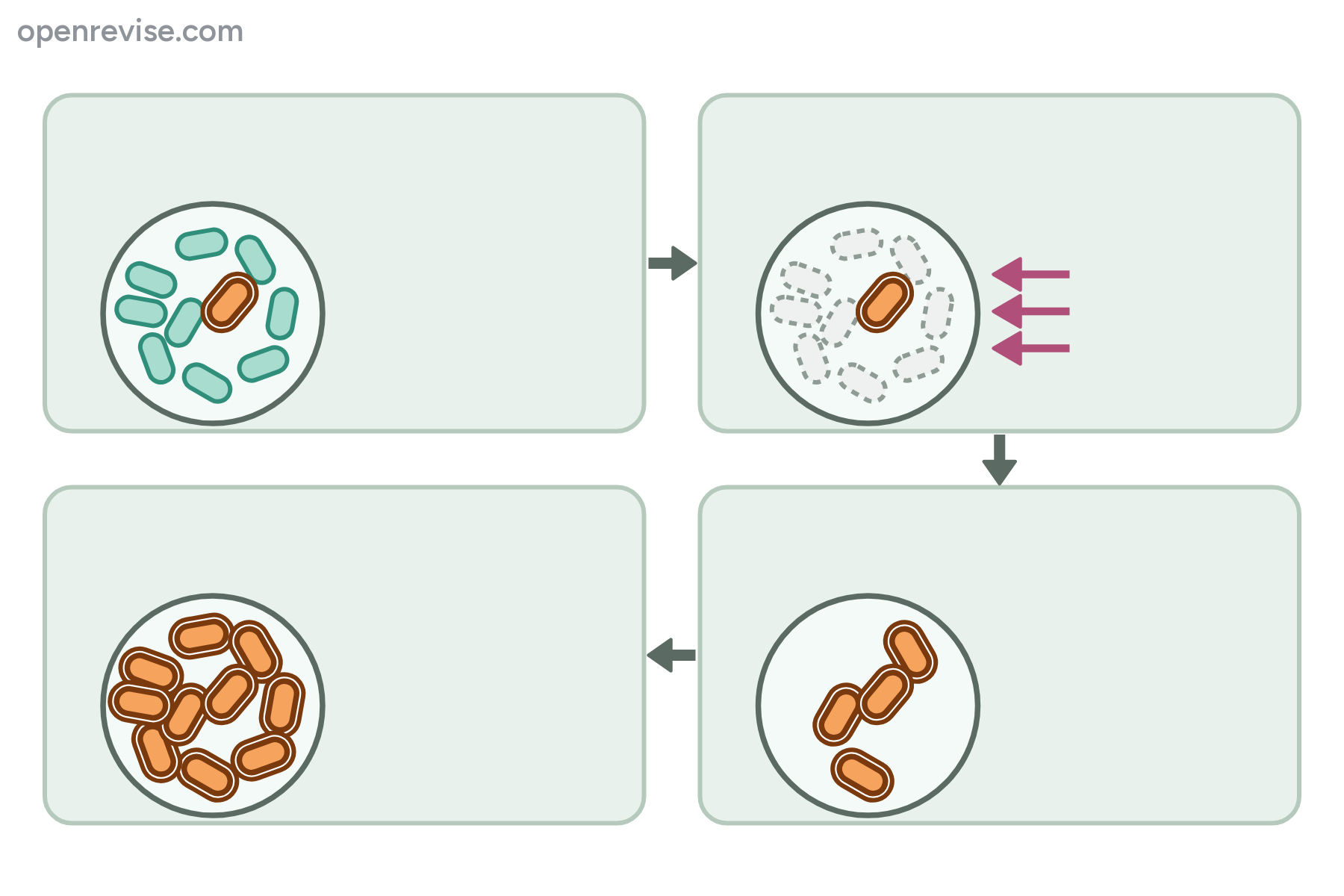
The diagram shows four stages in the evolution of resistance in a population of bacteria. The orange bacteria are resistant to an antibiotic. Describe what happens in stages 1 to 4.
Show answerHide answer
Model answer
In stage 1 a mutation has made one bacterium resistant to the antibiotic. In stage 2 the antibiotic kills the non-resistant bacteria, but the resistant bacterium survives. In stage 3 the surviving resistant bacteria reproduce and pass the allele for resistance on to their offspring. In stage 4 the whole population is made up of resistant bacteria, so the antibiotic no longer works.
Mark scheme
- Stage 1: a resistant bacterium arises (by mutation) — 1 mark
- Stage 2: non-resistant bacteria are killed, the resistant one survives — 1 mark
- Stage 3: the resistant bacteria reproduce and pass on the allele — 1 mark
- Stage 4: the population is resistant — 1 mark
-
3 Calculate [2 marks]
A resistant bacterium divides every 30 minutes. Assuming that none die, calculate the number of bacteria produced from one resistant bacterium after 4 hours.
Show answerHide answer
Model answer
4 hours is 8 divisions of 30 minutes, so the number of bacteria is \(2^8 = 256\).
Mark scheme
- \(4 \times 60 \div 30 = 8\) divisions — 1 mark
- \(2^8 = 256\) bacteria — 1 mark
-
4 Explain [4 marks]
A patient with a cold asks her doctor for antibiotics. The doctor refuses. Explain why it is better not to prescribe antibiotics for a cold.
Show answerHide answer
Model answer
A cold is caused by a virus, so an antibiotic would not cure it. Any bacteria in the patient's body would be exposed to the antibiotic, which is a selection pressure. This kills the non-resistant bacteria but not the resistant ones, which survive and reproduce, so more resistant bacteria would be present. This makes future infections harder to treat.
Mark scheme
- A cold is caused by a virus, and antibiotics do not work on viruses — 1 mark
- Bacteria in the body are exposed to the antibiotic — 1 mark
- Resistant bacteria survive and reproduce — 1 mark
- More resistant bacteria mean future infections are harder to treat — 1 mark
-
5 Describe [3 marks]
Describe three ways in which the development of antibiotic resistance can be slowed down.
Show answerHide answer
Model answer
Doctors should not prescribe antibiotics for viral infections or mild infections. Patients should finish the whole course of antibiotics, so that all of the bacteria are killed. Antibiotics should not be used routinely on healthy farm animals. Hospitals can use hygiene measures, such as hand washing, and isolate infected patients.
Mark scheme
- Do not overuse or prescribe antibiotics unnecessarily — 1 mark
- Complete the course of antibiotics — 1 mark
- Any other sensible measure, such as less use in farming or better hygiene — 1 mark
-
6 Explain [3 marks]
MRSA is a problem in hospitals. Explain why hospitals are places where resistant bacteria are selected and spread.
Show answerHide answer
Model answer
Antibiotics are used often in hospitals, so there is a strong selection pressure that favours resistant bacteria. The bacteria spread easily on hands, equipment and surfaces. Patients with wounds or weak immune systems are easily infected.
Mark scheme
- Antibiotics are used heavily, so resistant bacteria are selected — 1 mark
- The bacteria spread between patients on hands and equipment — 1 mark
- Patients have wounds or weak defences, so they are easily infected — 1 mark
-
7 Calculate [3 marks]
Source: A hospital recorded the number of cases of MRSA infection each year. In 2012 there were 120 cases, in 2013 there were 135, in 2014 there were 142, in 2015 there were 98, in 2016 there were 71 and in 2017 there were 52. A new hygiene policy and a rule on antibiotic use began on 1 January 2015. Calculate the percentage decrease in the number of cases between 2014 and 2017. Give your answer to the nearest whole number, and suggest what the data show about the new policy.
Show answerHide answer
Model answer
The decrease was \(142 - 52 = 90\) cases. As a percentage of 2014 this is \(\frac{90}{142} \times 100 = 63.4\), which is 63 per cent. The number of cases rose before 2015 and fell every year after the policy began, which suggests that the policy was successful, although the data cannot prove it caused the fall.
Mark scheme
- \(142 - 52 = 90\) — 1 mark
- \(\frac{90}{142} \times 100 = 63\) per cent — 1 mark
- The cases fell after the policy began, so the policy may have worked — 1 mark
-
8 Evaluate [6 marks]
Some farmers give antibiotics to healthy animals to make them grow faster and to stop disease spreading. Evaluate this use of antibiotics, with reference to natural selection.
Show answerHide answer
Model answer
There are benefits to the farmer, because the animals grow faster and the disease is less likely to spread, which makes meat cheaper and reduces suffering from infection. However, giving antibiotics to healthy animals exposes large numbers of bacteria to the antibiotic, which is a selection pressure. Random mutations that give resistance are selected, because the non-resistant bacteria are killed and the resistant bacteria survive and reproduce, passing on the allele. The resistant bacteria can pass from the animals to people, through meat, water or contact, and then cause infections that are difficult to treat. This makes antibiotics less useful in human medicine. It would be better to give antibiotics only to sick animals, to improve hygiene and animal welfare and to stop the routine use. The benefit to farmers is short-term, but the harm of resistant bacteria is long-term and affects everybody.
Mark scheme
- Benefits to farmers, such as faster growth or less disease — 1 mark
- The antibiotic is a selection pressure that kills non-resistant bacteria — 1 mark
- Resistant bacteria survive, reproduce and pass on the allele — 1 mark
- Resistant bacteria can spread to humans and cause infections that are hard to treat — 1 mark
- A judgement, such as that the risk outweighs the benefit — 1 mark
- A reasoned alternative, such as treating only sick animals or improving hygiene — 1 mark
Quick check
-
1
What causes a bacterium to become resistant to an antibiotic?
Show answerHide answer
C: A random mutation that gives it a resistance allele
Resistance arises by a random mutation, which happens before the antibiotic is used. The antibiotic only selects for it.
-
2
Why can bacteria evolve resistance within days?
Show answerHide answer
A: They have many generations in a short time
They reproduce very quickly, so many generations occur and natural selection works fast.
-
3
In a population of bacteria exposed to an antibiotic, which bacteria are most likely to survive and breed?
Show answerHide answer
D: The resistant bacteria
The resistant bacteria are not killed, so they survive and reproduce and pass on the allele.
-
4
What does MRSA stand for?
Show answerHide answer
B: Methicillin-resistant Staphylococcus aureus
MRSA is methicillin-resistant Staphylococcus aureus, a bacterium resistant to many antibiotics.
-
5
Why should a patient finish a course of antibiotics, even when feeling better?
Show answerHide answer
A: So that all of the bacteria are killed and none survive to breed
Surviving bacteria could breed and become a resistant population, so the whole course is needed to kill them all.
-
6
Which statement is correct?
Show answerHide answer
D: Bacteria become resistant by natural selection
It is the bacteria that become resistant, not the person, and it is by natural selection.
-
7
Why is the use of antibiotics on healthy farm animals a concern?
Show answerHide answer
C: It selects for resistant bacteria that may spread to people
It exposes many bacteria to antibiotics, selecting for resistant bacteria that can pass to humans.
-
8
Why is antibiotic resistance regarded as evidence for evolution?
Show answerHide answer
B: It shows natural selection happening in a population
It shows natural selection of a variant, in a population, happening over a short time.
Classification and Molecular Phylogenetics
Just this lesson-
1 State [2 marks]
The scientific name of the human is Homo sapiens. State the genus and the species.
Show answerHide answer
Model answer
The genus is Homo and the species is sapiens.
Mark scheme
- Genus: Homo — 1 mark
- Species: sapiens — 1 mark
-
2 Describe [2 marks]
Describe the difference between natural classification and artificial classification.
Show answerHide answer
Model answer
Artificial classification groups organisms using only a few easily seen features. Natural classification groups them by many shared features, which come from a common ancestor, so it shows how they are related.
Mark scheme
- Artificial uses a few observable features — 1 mark
- Natural uses many shared features and shows evolutionary relationships — 1 mark
-
3 Explain [3 marks]
Scientists use binomial names, such as Panthera leo, for species rather than common names, such as lion. Explain why.
Show answerHide answer
Model answer
A binomial name is the same in every country and language, so scientists everywhere know which species is meant. Common names differ from place to place, and one common name may be used for more than one species. A binomial also gives the genus, which shows that species with the same first word, such as Panthera tigris, are close relatives.
Mark scheme
- A binomial is the same worldwide — 1 mark
- Common names vary or are used for more than one species — 1 mark
- The genus shows close relatives — 1 mark
-
4 Calculate [3 marks]
A section of a gene has 400 bases. The human sequence differs from the gorilla sequence in 6 bases and from the orangutan sequence in 12 bases. Calculate the percentage difference for each species and state which is the closest relative of the human.
Show answerHide answer
Model answer
For the gorilla, \(\frac{6}{400} \times 100 = 1.5\) per cent. For the orangutan, \(\frac{12}{400} \times 100 = 3.0\) per cent. The gorilla is the closer relative, because it has the smaller percentage difference.
Mark scheme
- \(\frac{6}{400} \times 100 = 1.5\) per cent — 1 mark
- \(\frac{12}{400} \times 100 = 3.0\) per cent — 1 mark
- The gorilla is the closest relative (fewer differences) — 1 mark
-
5 Use [4 marks]
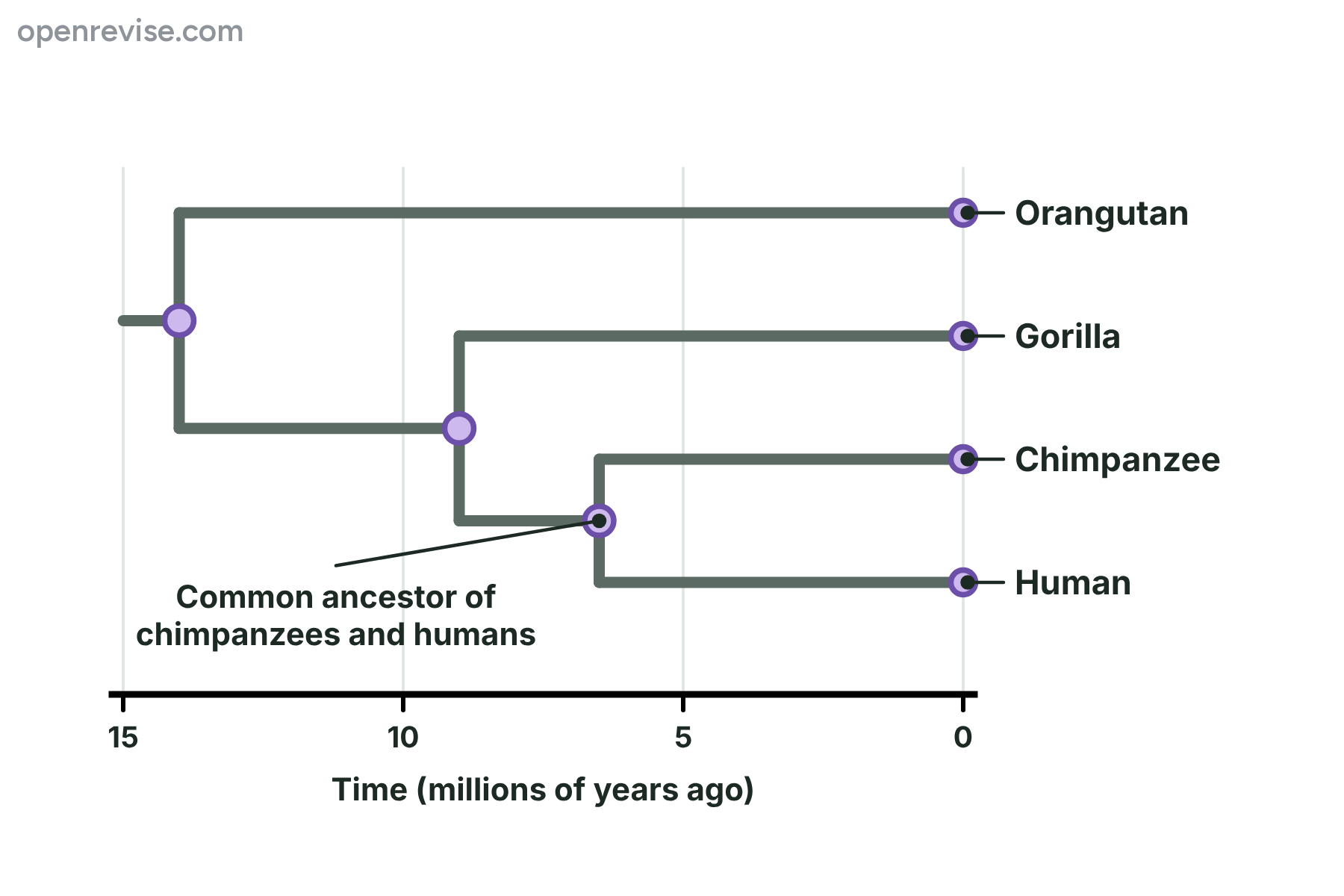
Use the evolutionary tree to answer these questions. (a) Which species is the closest relative of the human? (b) Estimate how many million years ago the gorilla lineage split from the lineage that led to the chimpanzee and the human. (c) Explain what the DNA of the orangutan would be expected to show, compared with the DNA of the gorilla and the chimpanzee.
Show answerHide answer
Model answer
(a) The chimpanzee. (b) About 9 million years ago. (c) The orangutan split from the other three longest ago, so more mutations have built up since. Its DNA would have the most differences from the human DNA, more than the gorilla or the chimpanzee.
Mark scheme
- (a) Chimpanzee — 1 mark
- (b) About 9 million years ago (8 to 10 accepted) — 1 mark
- (c) The orangutan split off longest ago, so more mutations have built up — 1 mark
- Its DNA has the most differences from the human — 1 mark
-
6 Explain [3 marks]
Explain how the work of Carl Woese on ribosomal RNA genes changed the classification of living things.
Show answerHide answer
Model answer
He compared the base sequences of a gene that all living things have. He found that the prokaryotes that were all called bacteria were really two very different groups, the Bacteria and the Archaea. This led to a new top rank of three domains: Bacteria, Archaea and Eukaryota.
Mark scheme
- Compared DNA or RNA gene sequences — 1 mark
- Found that prokaryotes are two very different groups — 1 mark
- A new system of three domains — 1 mark
-
7 Evaluate [6 marks]
Early classification was based on the features of organisms that could be seen. Today DNA sequencing is also used. Evaluate the use of DNA sequencing compared with using the appearance of organisms to classify them.
Show answerHide answer
Model answer
Appearance is quick and cheap, and it can be used on fossils and in the field, but it can be misleading. Unrelated organisms may look alike because they live in similar ways, so they can be put in the same group wrongly. Different features can also be chosen, so scientists can disagree. DNA sequencing compares the genetic material, which is inherited from ancestors, and gives a lot of data that can be counted, so that the amount of difference can be measured. It shows evolutionary relationships more reliably and it can be used to classify microorganisms that have few features to compare, which led to the discovery of the Archaea. However, DNA sequencing needs expensive equipment and fresh samples, and DNA may not survive in fossils, so appearance is still needed. Overall DNA sequencing gives better evidence of relationships, but the best classification uses both.
Mark scheme
- Appearance is quick, cheap and can be used on fossils — 1 mark
- But unrelated organisms can look alike, so it can mislead — 1 mark
- DNA gives data that can be measured and compared — 1 mark
- DNA shows evolutionary relationships more reliably, such as for microorganisms — 1 mark
- A limitation of DNA, such as cost or old DNA — 1 mark
- A judgement, such as that both are used together — 1 mark
Quick check
-
1
Which of these is an example of a binomial name?
Show answerHide answer
B: Quercus robur
A binomial is a two-part name, genus then species, such as Quercus robur.
-
2
Which is the correct order of ranks, from the largest to the smallest?
Show answerHide answer
D: Kingdom, phylum, class, order, family, genus, species
The ranks are kingdom, phylum, class, order, family, genus and species.
-
3
Why do scientists prefer natural classification to artificial classification?
Show answerHide answer
A: It shows how organisms are related
Natural classification is based on many features from a common ancestor, so the groups show evolutionary relationships.
-
4
Bats, birds and butterflies could be put in the same group of flying animals. What kind of classification would this be?
Show answerHide answer
C: Artificial classification
Grouping by one feature, flight, puts unrelated organisms together, which is artificial classification.
-
5
Which are the three domains?
Show answerHide answer
B: Bacteria, Archaea and Eukaryota
The three domains proposed by Carl Woese are Bacteria, Archaea and Eukaryota.
-
6
Two species have very few differences in their DNA. What does this suggest?
Show answerHide answer
D: They are closely related
Few differences mean that little time has passed for mutations to build up, so the species split from a common ancestor recently.
-
7
What does the branching point of an evolutionary tree show?
Show answerHide answer
A: A common ancestor of the species on the branches
Each branching point is a common ancestor, where one lineage split into two.
-
8
What does molecular phylogenetics use to work out relationships?
Show answerHide answer
C: Differences in DNA sequences
It compares the base sequences of DNA (or the sequences of proteins) between species.
Darwin, Wallace and the Theory of Evolution
Just this lesson-
1 State [1 mark]
State the name of the group of islands where Darwin observed finches with beaks that differed from island to island.
Show answerHide answer
Model answer
The Galapagos Islands.
Mark scheme
- The Galapagos Islands — 1 mark
-
2 Describe [2 marks]
Describe the contribution of Alfred Russel Wallace to the theory of evolution.
Show answerHide answer
Model answer
Wallace developed the idea of natural selection independently, from his studies of animals in South East Asia. In 1858 he sent his essay to Darwin, and the work of both men was announced together at the Linnean Society.
Mark scheme
- Developed the idea of natural selection independently — 1 mark
- Sent his essay to Darwin, leading to the joint announcement in 1858 — 1 mark
-
3 Explain [4 marks]
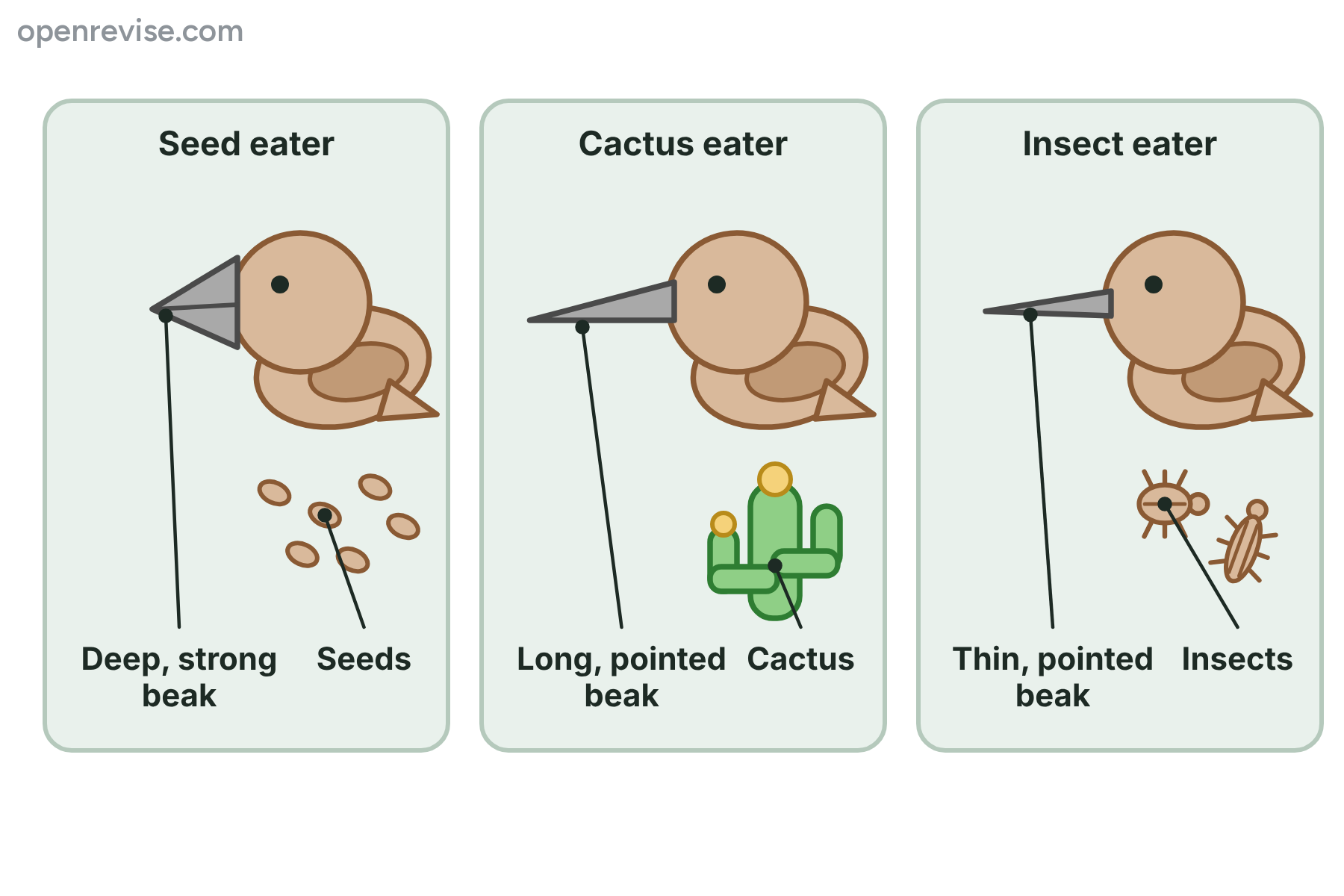
The diagram shows three species of finch from the Galapagos Islands. They are all descended from one species that reached the islands. Explain how natural selection could have produced the different beaks.
Show answerHide answer
Model answer
There was variation in beak size and shape in the original population, caused by mutations. On the different islands, the different foods were the selection pressure. The finches with beaks best suited to the food, such as a deep beak for cracking seeds, survived and bred more. They passed on the alleles for these beaks, so over many generations the beaks became more suited to the food on each island.
Mark scheme
- Variation in beaks in the original population, from mutations — 1 mark
- Different foods were the selection pressure on different islands — 1 mark
- Birds with the best-suited beak survived and bred more — 1 mark
- They passed on the alleles, so the beak type became more common over generations — 1 mark
-
4 Give [3 marks]
Darwin's theory was not accepted by everyone when it was published. Give three reasons why it was resisted.
Show answerHide answer
Model answer
Any three from: it conflicted with the religious belief that each species was created separately; it suggested that humans are related to other animals; Darwin could not explain how features were inherited, because genes were not known; the changes are too slow to be seen in a lifetime; the fossil record had gaps; some scientists preferred other ideas, such as Lamarck's.
Mark scheme
- First reason — 1 mark
- Second reason — 1 mark
- Third reason — 1 mark
-
5 Explain [3 marks]
Explain why the rediscovery of Mendel's work in 1900 helped to make the theory of evolution more widely accepted.
Show answerHide answer
Model answer
Darwin could not explain how features are inherited, which was one of the main objections to his theory. Mendel showed that features are inherited as separate units, which were later called genes. This gave a mechanism of inheritance and explained how variation can be passed on from parents to offspring, so natural selection could work.
Mark scheme
- Darwin had no explanation of inheritance — 1 mark
- Mendel showed that features are inherited as units, later called genes — 1 mark
- This explained how variation is passed on, which supports natural selection — 1 mark
-
6 Calculate [2 marks]
A seedbank sows 250 seeds from a stored sample and 205 germinate. Calculate the percentage that germinate.
Show answerHide answer
Model answer
\(\frac{205}{250} \times 100 = 82\) per cent.
Mark scheme
- \(205 \div 250 \times 100\) — 1 mark
- 82 per cent — 1 mark
-
7 Explain [3 marks]
Explain how seedbanks help to maintain biodiversity.
Show answerHide answer
Model answer
Seedbanks store seeds from many species and varieties, which preserves their genetic variation. If a species or crop variety is lost from the wild, for example through disease, climate change or the destruction of its habitat, it can be grown again from the stored seeds. The alleles that are stored, such as for resistance to disease, may be useful for breeding in the future.
Mark scheme
- Store seeds from many species and varieties, which keeps their genetic variation — 1 mark
- A species or variety that is lost can be regrown from the stored seeds — 1 mark
- Stored alleles may be needed in the future, for example for disease resistance — 1 mark
-
8 Discuss [6 marks]
Discuss the impact of the theory of evolution by natural selection on modern biology.
Show answerHide answer
Model answer
The theory explains why living things are so varied and related, and it is the central idea of biology. It underlies classification, because species are grouped by how closely they are related, and DNA sequences are used to produce evolutionary trees. In medicine it explains why bacteria evolve resistance to antibiotics, such as MRSA, so doctors avoid overusing antibiotics, and why new flu vaccines are needed each year. In agriculture it explains why pests become resistant to pesticides, so farmers change the chemicals they use. It also led to the study of how variation is inherited, which helped to develop genetics. In conservation, natural selection needs genetic variation to work, so species with little variation are at greater risk, and seedbanks store the variation of plants as insurance against loss. Overall the theory has changed biology from the description of living things to the explanation of them, and it has practical uses in medicine, agriculture and conservation.
Mark scheme
- Explains the variety and relatedness of living things — 1 mark
- Classification and evolutionary trees — 1 mark
- Medicine: antibiotic resistance or flu vaccines — 1 mark
- Agriculture: resistance to pesticides or herbicides — 1 mark
- Conservation of genetic variation, for example seedbanks — 1 mark
- A reasoned conclusion about the overall importance of the theory — 1 mark
Quick check
-
1
What did Darwin observe about the finches on the Galapagos Islands?
Show answerHide answer
B: Their beaks differed from island to island
The finches on different islands had different beaks, suited to the food that was available on each island.
-
2
Which scientist developed the idea of natural selection independently of Darwin?
Show answerHide answer
D: Alfred Russel Wallace
Alfred Russel Wallace reached the same idea and sent his essay to Darwin in 1858.
-
3
In what year was On the Origin of Species published?
Show answerHide answer
A: 1859
Darwin published the book in 1859, a year after the joint announcement with Wallace.
-
4
Why could Darwin not explain how features are passed on?
Show answerHide answer
C: Because genes were not yet known
Genes, DNA and mutations were not known at the time. Mendel's work was published in 1866 but not noticed until 1900.
-
5
Which of these was a reason why many people did not accept Darwin's theory at first?
Show answerHide answer
D: It conflicted with the belief that species were created separately
Many people believed that each species had been created separately, and the theory seemed to contradict this.
-
6
How does a seedbank store seeds so that they last for decades?
Show answerHide answer
B: Dried and kept at a low temperature
Seeds are dried and frozen, which almost stops respiration and germination, so they stay alive for a long time.
-
7
Why is genetic variation in a species important for its survival?
Show answerHide answer
C: It means some individuals may be suited to a change in the environment
With variation, some individuals may have alleles that suit a changed environment, so natural selection can act.
-
8
Which of these is an impact of the theory of evolution on modern medicine?
Show answerHide answer
A: It explains antibiotic resistance in bacteria
Natural selection explains how bacteria become resistant to antibiotics, so that doctors use them more carefully.