Biology · Natural Selection and Evolution
Antibiotic Resistance in Bacteria
Natural selection is usually too slow to watch, but in bacteria it can happen in a few days, and it is happening in hospitals now. This lesson is for both Combined Science and separate Biology. It covers antibiotic resistance as evidence for evolution, the superbug MRSA, and how the spread of resistance can be slowed.
Learning Objectives
- 1Explain how antibiotic resistance in bacteria is an example of natural selection, and why it is evidence for evolution.
- 2Explain why bacteria can evolve resistance so quickly.
- 3Describe MRSA, and explain why it is a problem in hospitals.
- 4Describe and explain ways of slowing down the development of resistance to antibiotics.
Retrieval practice
-
1
What is an antibiotic?
Show answerHide answer
A medicine that kills bacteria, or stops them from growing, without harming the human cells.
-
2
Why do antibiotics not work on colds and flu?
Show answerHide answer
Colds and flu are caused by viruses, and antibiotics affect only bacteria.
-
3
What is a mutation?
Show answerHide answer
A random change in the base sequence of DNA.
-
4
What is natural selection?
Show answerHide answer
The process in which the individuals with the variants best suited to their environment survive and breed more, and pass on their alleles.
Evolution you can watch
Evolution by natural selection usually takes thousands of years, so we cannot see it happening in an elephant or an oak tree. Bacteria are different. They reproduce so quickly that many generations occur in a few days, and so changes in a population can be seen in a laboratory or in a hospital. Antibiotic resistance is the best-known example, and it is one of the pieces of evidence for the theory of evolution that is listed in the specification, along with fossils.
Antibiotics and bacteria
Antibiotics are the medicines that doctors use to treat infections that are caused by bacteria.
-
What they do
An antibiotic kills the bacteria or stops them from growing and dividing, but does not harm the cells of the person. Penicillin, discovered by Alexander Fleming in 1928, was the first to be widely used.
-
Only for bacteria
A particular antibiotic works only on some kinds of bacteria, and none of them works on viruses, which are not cells and have no processes for an antibiotic to block.
-
A selection pressure
When bacteria are exposed to an antibiotic, the antibiotic becomes a strong selection pressure, because the bacteria that it kills cannot reproduce.
-
Resistance
A bacterium is resistant to an antibiotic if it is not killed by it. Resistance is the result of a variant, or allele, in the bacterium.
How resistance evolves
This is natural selection, in four steps, in a population of bacteria.
-
1
Mutation
By chance, a mutation in one bacterium gives it an allele that makes it resistant to the antibiotic. It happens at random, and it happens before the antibiotic is used, not because of it.
-
2
Selection
When the antibiotic is used, it kills the non-resistant bacteria. The resistant bacterium is not killed, so it survives.
-
3
Reproduction
With no competition, the survivor divides again and again, and every new bacterium inherits the resistance allele.
-
4
A resistant population
After a few generations most of the bacteria are resistant, so the antibiotic no longer works against them and the infection is hard to treat.
Natural selection in bacteria
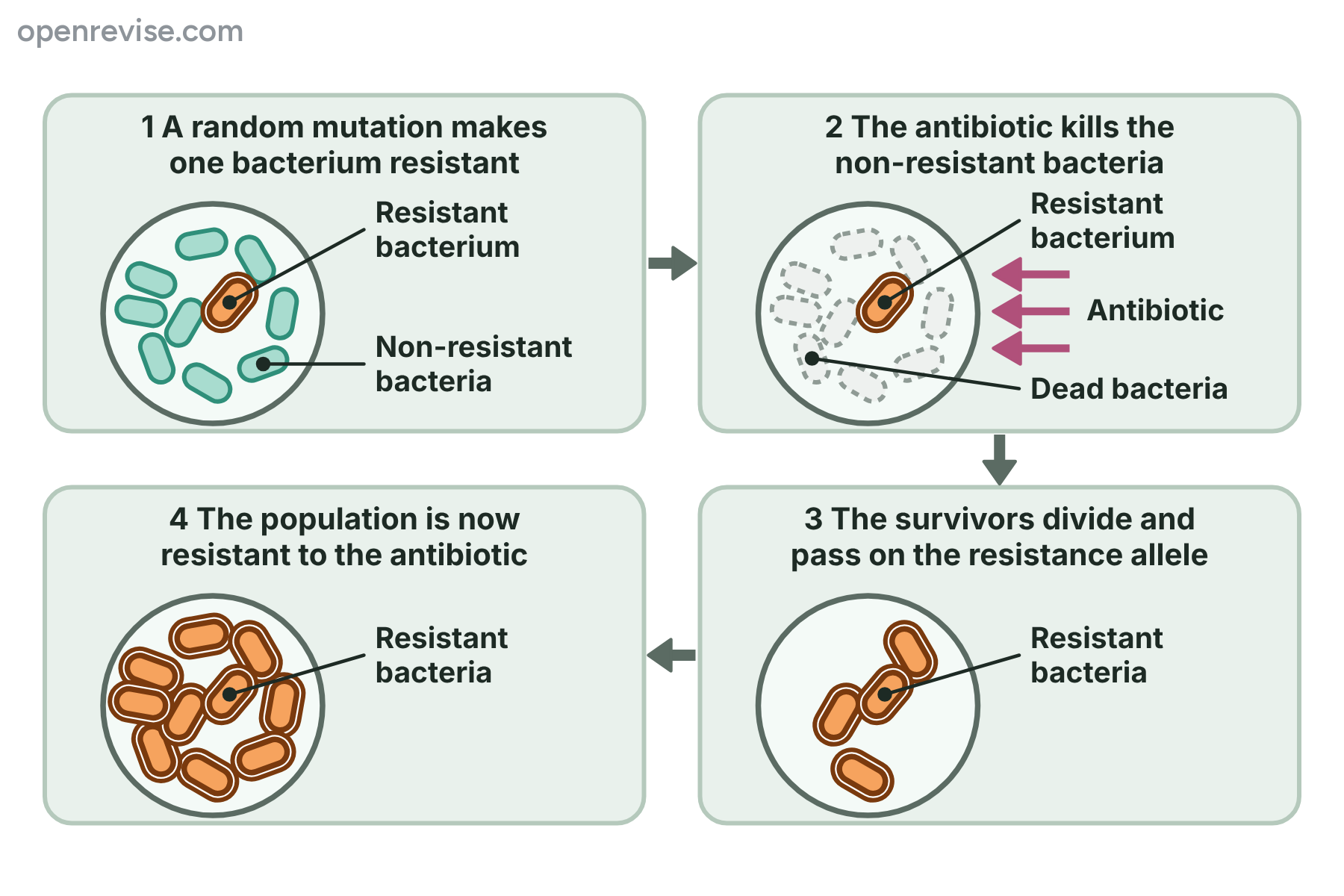
The antibiotic does not cause the mutation. It selects the bacteria that already have it.
Why bacteria evolve so fast
Several features of bacteria make natural selection quick to work on them.
-
Fast reproduction
Some bacteria can divide every 20 minutes in good conditions, so there can be more than 70 generations in a day. Each new generation is a new chance for selection.
-
Huge numbers
A single infection can contain billions of bacteria. Even if a resistance mutation is very rare, one is likely to be present somewhere in such a large population.
-
Asexual reproduction
The bacteria clone themselves, so a resistant bacterium gives rise to a whole population of resistant bacteria, all with the same allele.
-
Strong selection pressure
An antibiotic kills the non-resistant bacteria, so it gives the resistant ones an enormous advantage.
How fast do bacteria multiply?
A single resistant bacterium divides every 20 minutes. Assuming that none die, calculate how many resistant bacteria it has produced after 3 hours.
Show the solutionHide the solution
- 1 Find the time in minutes 3 hours is \(3 \times 60 = 180\) minutes
- 2 Find the number of divisions \(180 \div 20 = 9\) divisions
- 3 Each division doubles the number The number after 9 divisions is \(2^9\)
- 4 Calculate \(2^9 = 512\)
AnswerThere are 512 resistant bacteria after 3 hours.
Case study
MRSA, a hospital superbug
MRSA stands for methicillin-resistant Staphylococcus aureus. Methicillin was introduced in 1959 to treat Staphylococcus infections that had become resistant to penicillin, but resistant strains were reported in Britain by 1961. MRSA is now resistant to many antibiotics. It spreads on hands and equipment in hospitals, where patients with open wounds and weak defences are at risk, and where antibiotics are used heavily, so it is selected strongly. It can cause serious infections of wounds and the blood, and doctors have to use a small number of last-resort antibiotics, which are often expensive and have side effects.
Slowing down the development of resistance
Every use of an antibiotic selects for resistance, so the aim is to use them less, and to use them well.
-
Use only when needed
Doctors should not prescribe antibiotics for viral infections, which they cannot treat, or for mild infections that the body will clear itself.
-
Finish the course
A patient should complete the whole course of tablets, even when they feel better, so that every bacterium is killed and none survive to breed.
-
Less in farming
Antibiotics should not be given routinely to healthy farm animals, because it selects for resistant bacteria that can pass to humans.
-
Stop it spreading
Washing hands, cleaning equipment and isolating patients who carry MRSA stop resistant bacteria from spreading.
-
New antibiotics
Scientists must keep developing new antibiotics, but it can take over ten years and a great deal of money to bring one to market, and few have been found since the 1980s.
-
Keep some in reserve
Some antibiotics are kept as a last resort, so that resistance to them does not develop.
Getting the words right
Correct
- The bacteria become resistant to the antibiotic
- A mutation, by chance, makes a bacterium resistant
- The antibiotic kills the non-resistant bacteria
- The resistant bacteria survive and reproduce
Common mistakes
- The person becomes resistant to the antibiotic
- The bacteria mutate because of the antibiotic
- The bacteria get used to the antibiotic
- Each bacterium becomes resistant during the treatment
The big idea
Antibiotics do not make bacteria resistant: they kill the non-resistant ones and leave the resistant ones to survive, breed and pass on the allele.
Antibiotic resistance
Antibiotic resistance
-
Natural selection
- mutation makes a resistant variant
- antibiotic is the selection pressure
- survivors breed
-
Why so fast
- divide every 20 minutes
- billions of bacteria
- asexual cloning
-
MRSA
- methicillin-resistant Staphylococcus aureus
- spreads in hospitals
- few antibiotics work
-
Slowing resistance
- do not overuse
- finish the course
- less in farming
- hygiene
-
Evidence
- evolution seen in days
- supports the theory of natural selection
Summary and exam focus
- Antibiotic resistance is natural selection that can be watched, because bacteria reproduce quickly.
- A mutation makes a bacterium resistant, the antibiotic kills the others, and the resistant bacterium survives and passes on the allele.
- MRSA is a strain of Staphylococcus aureus that is resistant to many antibiotics, so it is a serious problem in hospitals.
- Resistance can be slowed by using antibiotics only when needed, finishing the course, using fewer on farms and stopping the spread of infection.
- Because it is seen directly, antibiotic resistance is evidence for evolution by natural selection.
Exam focus
Explain how a population of bacteria can become resistant to an antibiotic, and suggest how doctors can slow the spread of resistance. (6 marks) (6 marks)
Tell the story in order: random mutation in one bacterium, the antibiotic as a selection pressure that kills the others, survival and reproduction of the resistant bacterium and the passing on of the allele. Do not say that the bacteria changed because of the drug. Then give two or three actions with a reason for each.
Key terms
The words this lesson expects you to use. Each one is linked from the first place it appears above.
- Antibiotic
- A medicine that kills bacteria or stops them growing, without harming human cells.
- Antibiotic resistance
- The ability of a bacterium not to be killed by an antibiotic, because of a variant (allele) that it carries.
- MRSA
- Methicillin-resistant Staphylococcus aureus, a strain of bacteria that is resistant to many antibiotics.
- Pathogen
- A microorganism that causes disease.
- Selection pressure
- A factor in the environment, such as an antibiotic, that affects which individuals survive and breed.
- Mutation
- A random change in the DNA that may produce a new variant.
- Natural selection
- The survival and breeding of the individuals with the variants best suited to the environment, so their alleles become more common.
- Superbug
- A bacterium that is resistant to many antibiotics, so that it is very difficult to treat.
- Strain
- A genetic variant of a species of bacteria.
You've finished the notes
Check your understanding
Test yourself while it is fresh. Start with the flashcards, then try the exam questions.
Something here looks wrong?
Tell us what and we will go and look. It goes to whoever writes these pages, nobody else, and we do not ask who you are — so there is nothing to sign and nothing comes back to you.