Exam questions · Biology · Natural Selection and Evolution
Classification and Molecular Phylogenetics
- 7 exam questions
- 23 marks
- 8 quick checks
-
1 State [2 marks]
The scientific name of the human is Homo sapiens. State the genus and the species.
Show answerHide answer
Model answer
The genus is Homo and the species is sapiens.
Mark scheme
- Genus: Homo — 1 mark
- Species: sapiens — 1 mark
-
2 Describe [2 marks]
Describe the difference between natural classification and artificial classification.
Show answerHide answer
Model answer
Artificial classification groups organisms using only a few easily seen features. Natural classification groups them by many shared features, which come from a common ancestor, so it shows how they are related.
Mark scheme
- Artificial uses a few observable features — 1 mark
- Natural uses many shared features and shows evolutionary relationships — 1 mark
-
3 Explain [3 marks]
Scientists use binomial names, such as Panthera leo, for species rather than common names, such as lion. Explain why.
Show answerHide answer
Model answer
A binomial name is the same in every country and language, so scientists everywhere know which species is meant. Common names differ from place to place, and one common name may be used for more than one species. A binomial also gives the genus, which shows that species with the same first word, such as Panthera tigris, are close relatives.
Mark scheme
- A binomial is the same worldwide — 1 mark
- Common names vary or are used for more than one species — 1 mark
- The genus shows close relatives — 1 mark
-
4 Calculate [3 marks]
A section of a gene has 400 bases. The human sequence differs from the gorilla sequence in 6 bases and from the orangutan sequence in 12 bases. Calculate the percentage difference for each species and state which is the closest relative of the human.
Show answerHide answer
Model answer
For the gorilla, \(\frac{6}{400} \times 100 = 1.5\) per cent. For the orangutan, \(\frac{12}{400} \times 100 = 3.0\) per cent. The gorilla is the closer relative, because it has the smaller percentage difference.
Mark scheme
- \(\frac{6}{400} \times 100 = 1.5\) per cent — 1 mark
- \(\frac{12}{400} \times 100 = 3.0\) per cent — 1 mark
- The gorilla is the closest relative (fewer differences) — 1 mark
-
5 Use [4 marks]
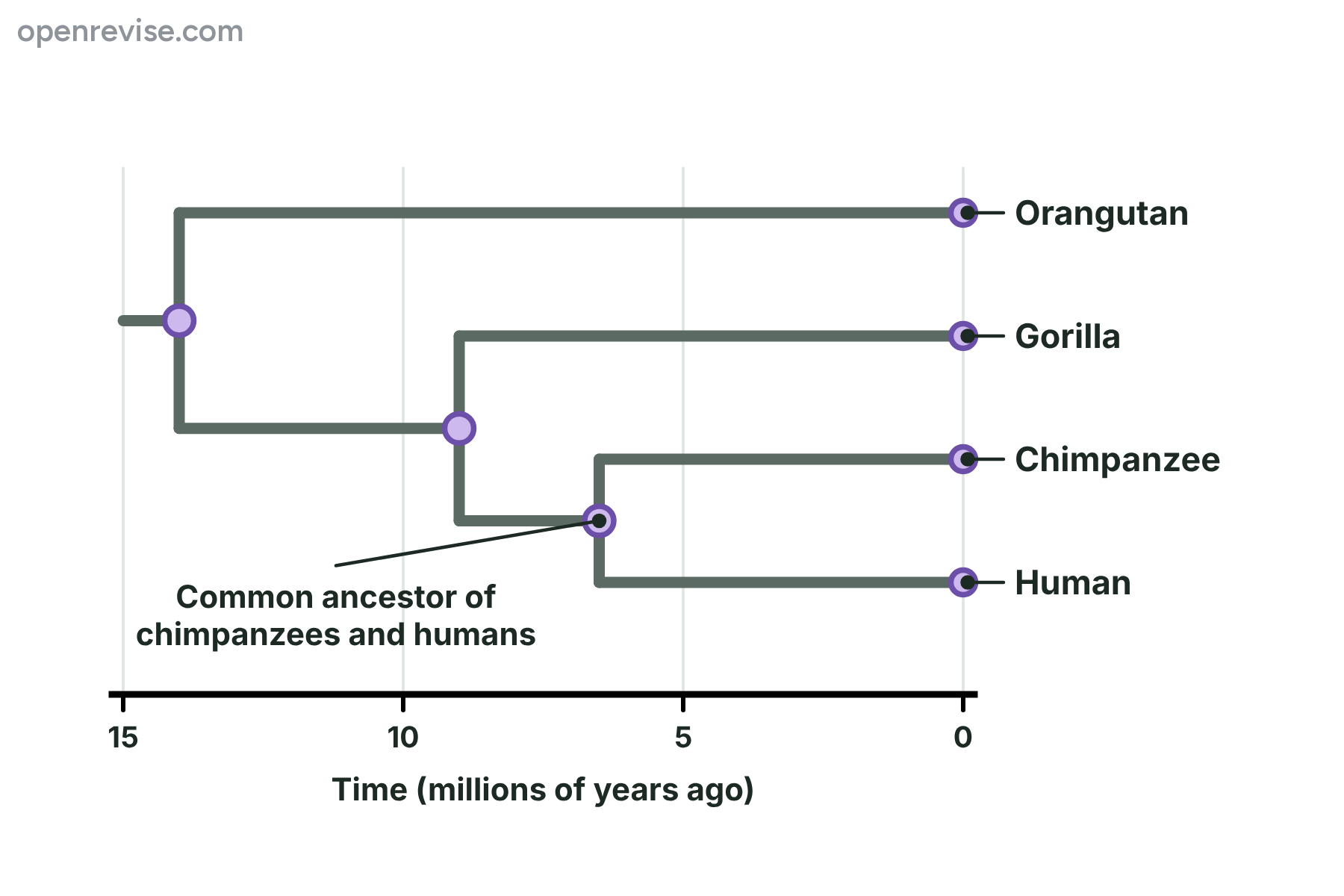
Use the evolutionary tree to answer these questions. (a) Which species is the closest relative of the human? (b) Estimate how many million years ago the gorilla lineage split from the lineage that led to the chimpanzee and the human. (c) Explain what the DNA of the orangutan would be expected to show, compared with the DNA of the gorilla and the chimpanzee.
Show answerHide answer
Model answer
(a) The chimpanzee. (b) About 9 million years ago. (c) The orangutan split from the other three longest ago, so more mutations have built up since. Its DNA would have the most differences from the human DNA, more than the gorilla or the chimpanzee.
Mark scheme
- (a) Chimpanzee — 1 mark
- (b) About 9 million years ago (8 to 10 accepted) — 1 mark
- (c) The orangutan split off longest ago, so more mutations have built up — 1 mark
- Its DNA has the most differences from the human — 1 mark
-
6 Explain [3 marks]
Explain how the work of Carl Woese on ribosomal RNA genes changed the classification of living things.
Show answerHide answer
Model answer
He compared the base sequences of a gene that all living things have. He found that the prokaryotes that were all called bacteria were really two very different groups, the Bacteria and the Archaea. This led to a new top rank of three domains: Bacteria, Archaea and Eukaryota.
Mark scheme
- Compared DNA or RNA gene sequences — 1 mark
- Found that prokaryotes are two very different groups — 1 mark
- A new system of three domains — 1 mark
-
7 Evaluate [6 marks]
Early classification was based on the features of organisms that could be seen. Today DNA sequencing is also used. Evaluate the use of DNA sequencing compared with using the appearance of organisms to classify them.
Show answerHide answer
Model answer
Appearance is quick and cheap, and it can be used on fossils and in the field, but it can be misleading. Unrelated organisms may look alike because they live in similar ways, so they can be put in the same group wrongly. Different features can also be chosen, so scientists can disagree. DNA sequencing compares the genetic material, which is inherited from ancestors, and gives a lot of data that can be counted, so that the amount of difference can be measured. It shows evolutionary relationships more reliably and it can be used to classify microorganisms that have few features to compare, which led to the discovery of the Archaea. However, DNA sequencing needs expensive equipment and fresh samples, and DNA may not survive in fossils, so appearance is still needed. Overall DNA sequencing gives better evidence of relationships, but the best classification uses both.
Mark scheme
- Appearance is quick, cheap and can be used on fossils — 1 mark
- But unrelated organisms can look alike, so it can mislead — 1 mark
- DNA gives data that can be measured and compared — 1 mark
- DNA shows evolutionary relationships more reliably, such as for microorganisms — 1 mark
- A limitation of DNA, such as cost or old DNA — 1 mark
- A judgement, such as that both are used together — 1 mark
Quick check
-
1
Which of these is an example of a binomial name?
Show answerHide answer
B: Quercus robur
A binomial is a two-part name, genus then species, such as Quercus robur.
-
2
Which is the correct order of ranks, from the largest to the smallest?
Show answerHide answer
D: Kingdom, phylum, class, order, family, genus, species
The ranks are kingdom, phylum, class, order, family, genus and species.
-
3
Why do scientists prefer natural classification to artificial classification?
Show answerHide answer
A: It shows how organisms are related
Natural classification is based on many features from a common ancestor, so the groups show evolutionary relationships.
-
4
Bats, birds and butterflies could be put in the same group of flying animals. What kind of classification would this be?
Show answerHide answer
C: Artificial classification
Grouping by one feature, flight, puts unrelated organisms together, which is artificial classification.
-
5
Which are the three domains?
Show answerHide answer
B: Bacteria, Archaea and Eukaryota
The three domains proposed by Carl Woese are Bacteria, Archaea and Eukaryota.
-
6
Two species have very few differences in their DNA. What does this suggest?
Show answerHide answer
D: They are closely related
Few differences mean that little time has passed for mutations to build up, so the species split from a common ancestor recently.
-
7
What does the branching point of an evolutionary tree show?
Show answerHide answer
A: A common ancestor of the species on the branches
Each branching point is a common ancestor, where one lineage split into two.
-
8
What does molecular phylogenetics use to work out relationships?
Show answerHide answer
C: Differences in DNA sequences
It compares the base sequences of DNA (or the sequences of proteins) between species.