Flashcards · Biology · Natural Selection and Evolution
Classification and Molecular Phylogenetics
-
What is classification?
The sorting of living things into groups.
-
What is artificial classification?
Grouping by a few features that are easy to see, which may group unrelated organisms.
-
What is natural classification?
Grouping by many shared features, which shows evolutionary relationships.
-
Why is natural classification preferred?
It shows how organisms are related and lets us predict their features.
-
Who started the modern system of classification?
Carl Linnaeus.
-
Name the seven ranks from the largest to the smallest.
Kingdom, phylum, class, order, family, genus, species.
-
What happens to the number of organisms in a group as you go down the ranks?
It falls, and the members have more in common.
-
What is a binomial name?
A two-part name of a species: the genus and then the species.
-
How is a binomial written?
Genus with a capital letter, species with a small letter, in italics or underlined.
-
Why are binomial names useful?
They are the same all over the world, so every scientist knows which species is meant.
-
What are the three domains?
Bacteria, Archaea and Eukaryota.
-
Who proposed three domains, and what did he use?
Carl Woese, using the sequence of ribosomal RNA genes.
-
What is molecular phylogenetics?
Using differences in DNA to work out how species are related.
-
What do fewer differences in the DNA of two species show?
That they split from their common ancestor more recently, so they are more closely related.
-
What does a branching point on an evolutionary tree represent?
A common ancestor, where two lineages split.
-
Why can looks be a poor guide to relationships?
Unrelated organisms may look alike because they live in a similar way.
-
 Name the seven ranks of the Linnaean system in order, starting with the largest.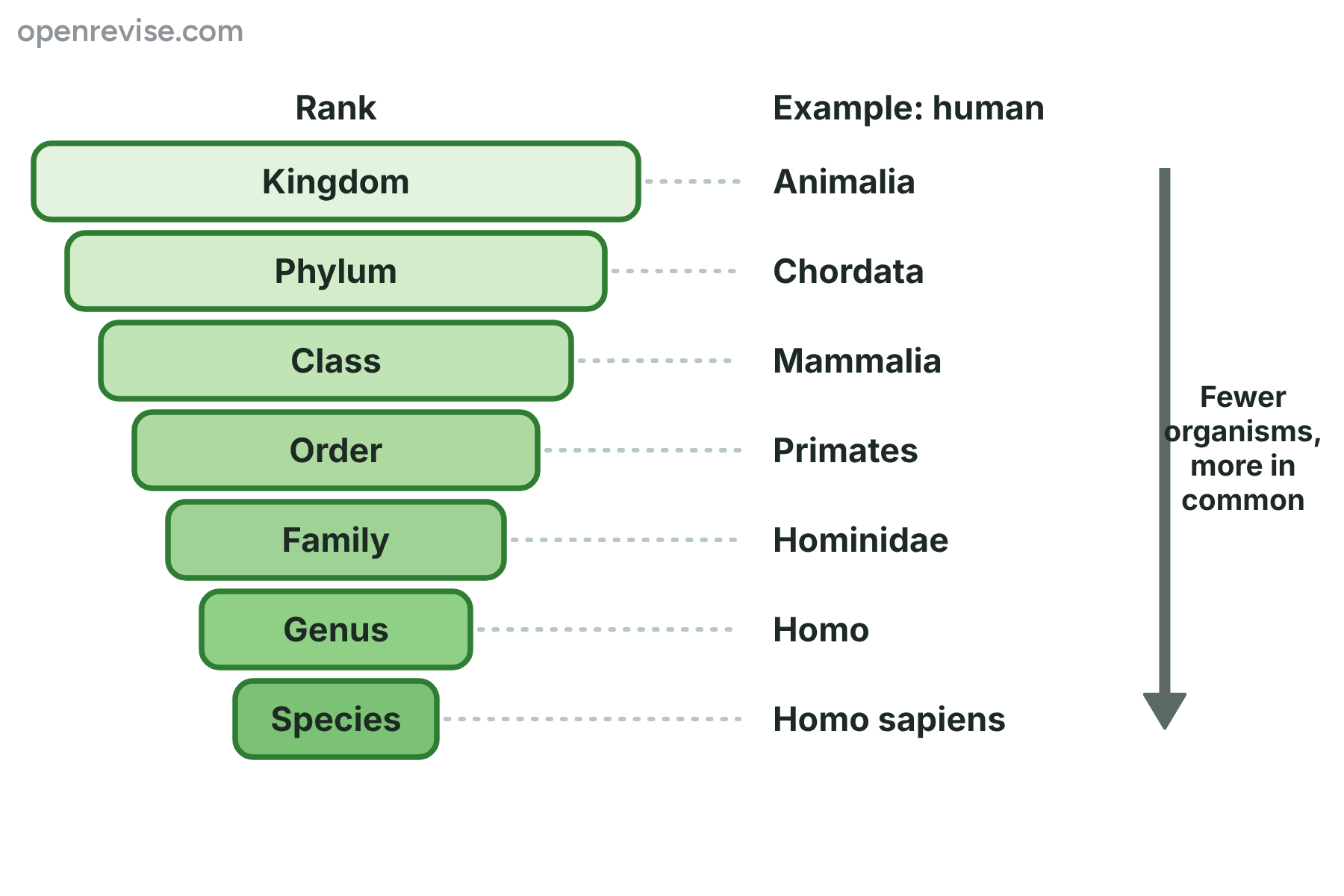
Kingdom, phylum, class, order, family, genus, species. For a human these are Animalia, Chordata, Mammalia, Primates, Hominidae, Homo, Homo sapiens.
-
 Which two species are the closest relatives in this tree, and how can you tell?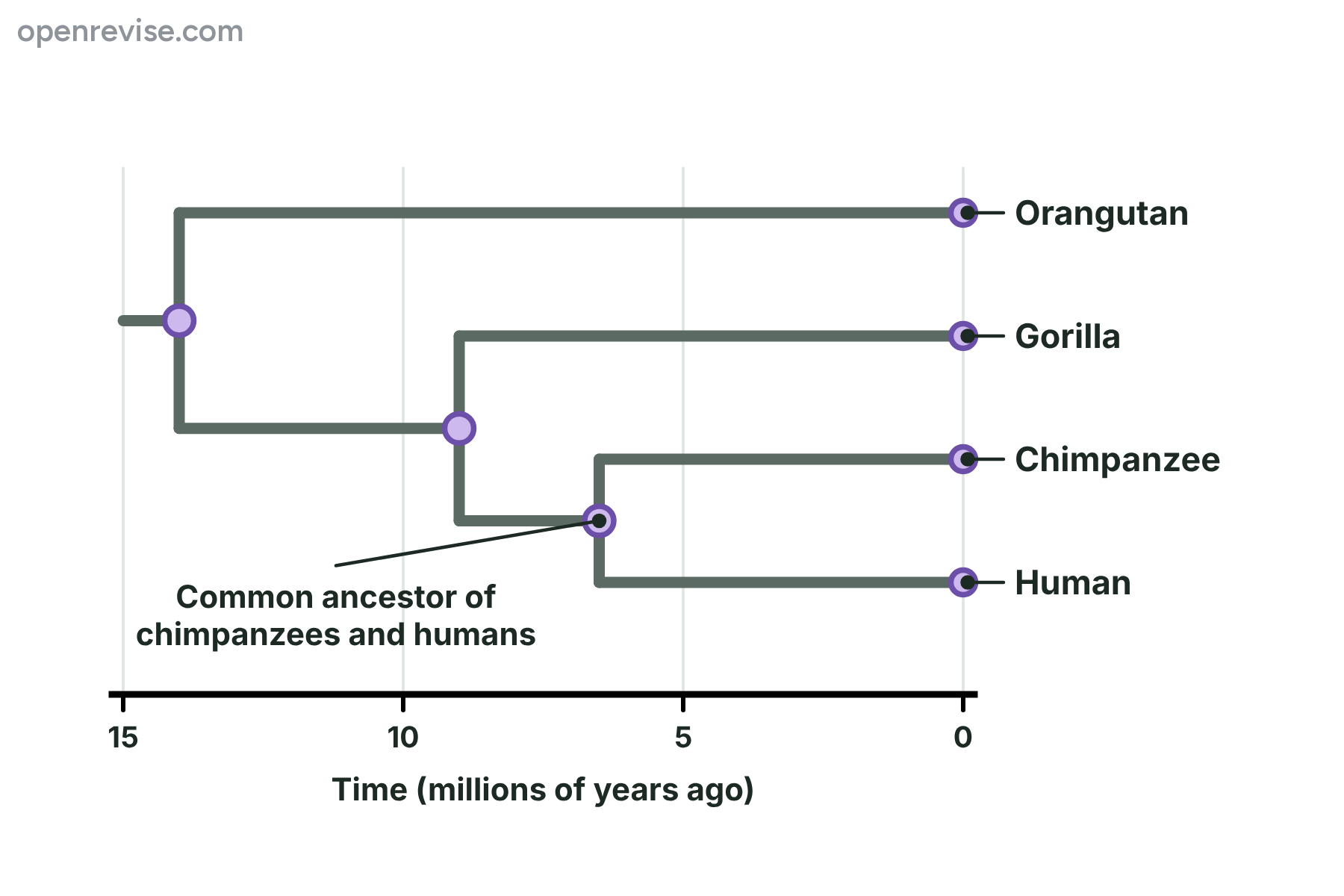
The chimpanzee and the human, because they share the most recent common ancestor, about 6.5 million years ago. The orangutan split off first, so it is the most distant relative.