Exam questions · Biology · Natural Selection and Evolution
Evolution and the Formation of New Species
- 7 exam questions
- 22 marks
- 8 quick checks
-
1 Define [2 marks]
What is meant by the term species?
Show answerHide answer
Model answer
A species is a group of organisms that can interbreed to produce fertile offspring.
Mark scheme
- A group of organisms that can interbreed — 1 mark
- To produce fertile offspring — 1 mark
-
2 Explain [3 marks]
A male donkey and a female horse can mate and have a mule. Mules cannot have offspring of their own. Explain why horses and donkeys are classed as different species.
Show answerHide answer
Model answer
A species is a group of organisms that can interbreed to produce fertile offspring. Although a horse and a donkey can mate, their offspring, the mule, is infertile. So the horse and donkey cannot interbreed to produce fertile offspring, and they are different species.
Mark scheme
- A species interbreeds to produce fertile offspring — 1 mark
- The mule is infertile — 1 mark
- So horses and donkeys do not interbreed to give fertile offspring, so they are different species — 1 mark
-
3 Describe [2 marks]
Describe what is meant by evolution.
Show answerHide answer
Model answer
Evolution is a change in the inherited characteristics of a population over time. It happens through the process of natural selection.
Mark scheme
- A change in the inherited characteristics of a population — 1 mark
- Over time, through natural selection — 1 mark
-
4 Explain [4 marks]
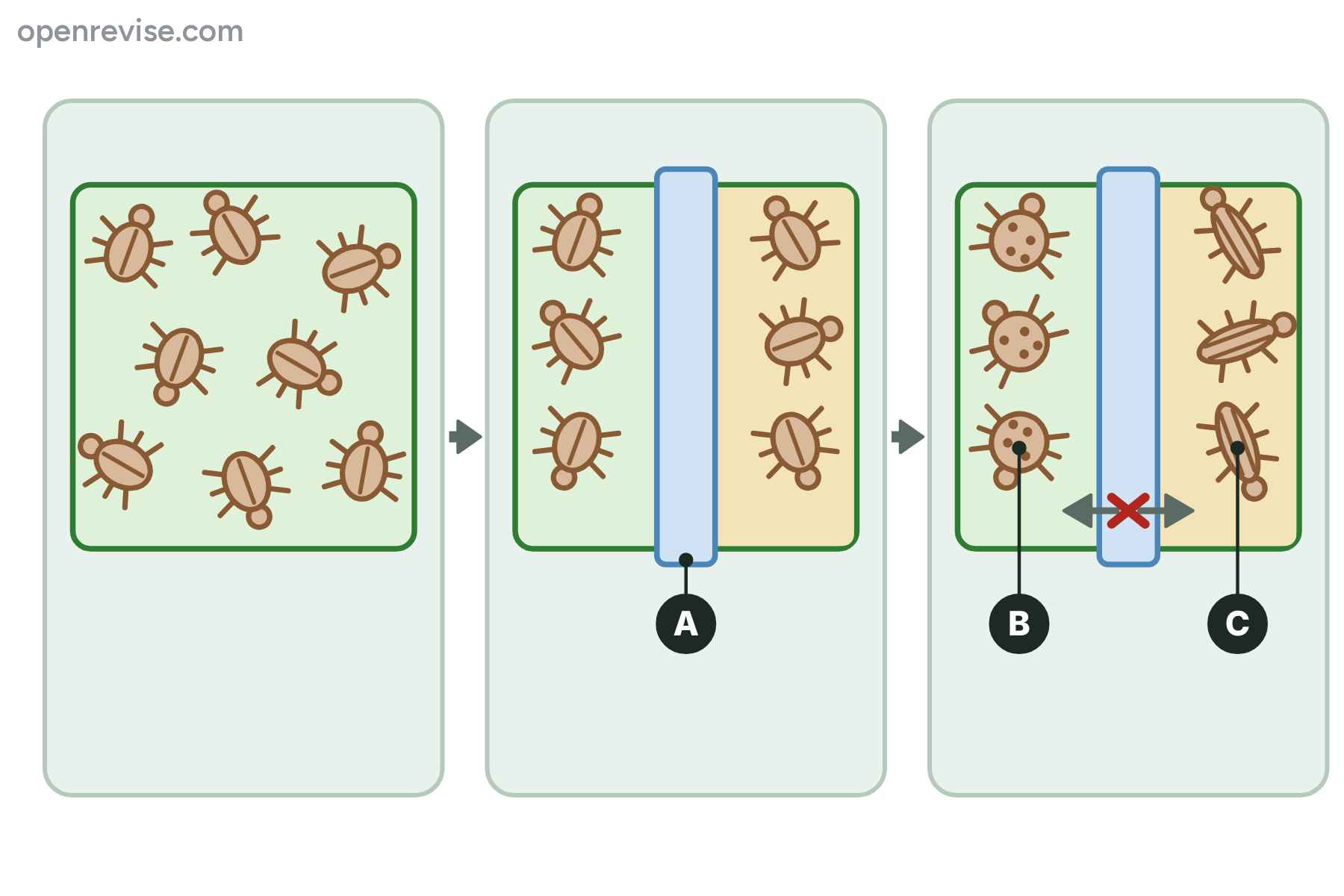
The diagram shows a population of beetles that was split in two by a river, A. Many generations later the beetles at B and C are different species. Explain how the river led to B and C becoming different species.
Show answerHide answer
Model answer
The river A is a barrier that isolated the two populations, so the beetles could not interbreed and the alleles were not shared. The environment on each side was different, so the selection pressures were different, and different variants survived and bred. Random mutations also occurred separately on each side. Over many generations the populations became so different that B and C can no longer interbreed to produce fertile offspring, so they are different species.
Mark scheme
- The river isolated the two populations so they could not interbreed — 1 mark
- Different environments, so different selection pressures — 1 mark
- Different variants selected and different mutations, so different alleles passed on — 1 mark
- After many generations they cannot interbreed to produce fertile offspring — 1 mark
-
5 Explain [3 marks]
A student says that giraffes evolved long necks because they stretched to reach the leaves at the top of trees. Explain why this is not a correct explanation.
Show answerHide answer
Model answer
A giraffe that stretches its neck does not change the DNA in its gametes, so the change cannot be passed on to its offspring. Long necks arose because some giraffes inherited an allele, produced by mutation, for a longer neck. These giraffes could reach more food, survived and bred more, so the allele became more common in the population.
Mark scheme
- A stretched neck is not inherited — 1 mark
- A mutation produced a variant for a longer neck — 1 mark
- Long-necked giraffes survived and bred more, passing the allele on — 1 mark
-
6 State [2 marks]
State two ways in which two populations of a species can become isolated from each other.
Show answerHide answer
Model answer
Any two from: a geographical barrier such as a river or mountain range; living on islands separated by the sea; breeding at different times of the year; females choosing mates by different songs, displays or colours.
Mark scheme
- First way of isolation — 1 mark
- Second way of isolation — 1 mark
-
7 Explain [6 marks]
Lake Victoria contains over 500 species of cichlid fish, which evolved from a few ancestors in about 15 000 years. The females of many species choose mates by the colour of the male. Explain how one species of fish could evolve into hundreds of species.
Show answerHide answer
Model answer
A few fish arrived in the lake and spread into different parts of it, living in different habitats and eating different foods. Groups that were separated could not interbreed, so they did not share alleles. Each group faced different selection pressures, so different variants survived, bred and passed on their alleles, and random mutations produced new variants in each group. The females in each group chose males of a certain colour, so the groups stopped breeding with each other, even when they lived together. Over many generations the groups became so different that they could no longer interbreed to produce fertile offspring, so they became separate species. This happened many times, so the number of species increased.
Mark scheme
- Groups of fish isolated in different parts of the lake or in different habitats — 1 mark
- They cannot interbreed, so alleles are not shared — 1 mark
- Different selection pressures, for example different food — 1 mark
- Different variants selected, mutations occur separately, alleles passed on — 1 mark
- Mate choice by colour keeps the groups separate — 1 mark
- Over many generations they can no longer interbreed to produce fertile offspring, so they are different species — 1 mark
Quick check
-
1
Which of these best describes a species?
Show answerHide answer
B: Organisms that interbreed to produce fertile offspring
A species is a group of organisms that can interbreed to produce fertile offspring.
-
2
A mule is the infertile offspring of a horse and a donkey. What does this show?
Show answerHide answer
D: That horses and donkeys are different species
Because the offspring is infertile, the horse and donkey cannot interbreed to produce fertile offspring, so they are different species.
-
3
What is evolution?
Show answerHide answer
A: A change in the inherited characteristics of a population over time
Evolution is a change in the inherited characteristics of a population over time, through natural selection.
-
4
What is the first step in the formation of a new species by isolation?
Show answerHide answer
C: A barrier separates the populations
The groups must first be separated, so that they cannot interbreed. The other changes follow over many generations.
-
5
Why do two populations separated by a mountain range often evolve in different ways?
Show answerHide answer
B: They have different selection pressures and different mutations
The environments are different, so different variants are best suited and selected on each side.
-
6
Which statement about evolution is correct?
Show answerHide answer
D: It happens to populations over many generations
Populations evolve over many generations. An individual does not change its alleles by natural selection.
-
7
Two populations of a plant that were isolated now flower at the same time and can pollinate each other, but the seeds they make do not grow. What does this suggest?
Show answerHide answer
A: They may have become different species
If the offspring are not fertile or viable, the two groups can no longer interbreed to produce fertile offspring, so they may now be separate species.
-
8
Which of these increases biodiversity?
Show answerHide answer
C: The evolution of a new species
When one species splits into two, there are more species, so biodiversity increases. Extinction decreases it.