Flashcards · Biology · Natural Selection and Evolution
Evolution and the Formation of New Species
-
What is evolution?
A change in the inherited characteristics of a population over time, through natural selection.
-
Does an individual evolve, or a population?
A population.
-
Why does evolution take many generations?
Each generation changes only a little, as selection acts on small differences.
-
What is a species?
A group of organisms that can interbreed to produce fertile offspring.
-
What is a mule, and why is it important to the idea of a species?
The infertile offspring of a horse and a donkey, so horses and donkeys are different species.
-
Give one limit of the definition of a species.
It cannot be tested on asexual organisms or fossils.
-
What is isolation?
Two populations of one species being kept apart so they cannot interbreed.
-
Name two geographical barriers that can isolate populations.
A river, a mountain range, the sea (any two).
-
Why are the selection pressures different on two sides of a barrier?
The two environments differ, for example in climate, food and predators.
-
What happens to the alleles of two isolated populations?
They become more and more different, as different variants are selected and different mutations occur.
-
When do two isolated populations become two species?
When they can no longer interbreed to produce fertile offspring.
-
Why can new species form on islands?
The population on an island is cut off from the mainland, so it evolves on its own.
-
What does evolution do to biodiversity?
It increases it when new species form, and it explains why all living things are related.
-
What causes a reduction in biodiversity through evolution?
Extinction of species.
-
Do giraffes evolve longer necks because they stretch?
No. A stretched neck is not inherited. Variants arise by mutation and are selected.
-
How many chromosomes does a mule have, and why is that a problem?
63, an odd number, so the chromosomes cannot pair in meiosis and it cannot make gametes.
-
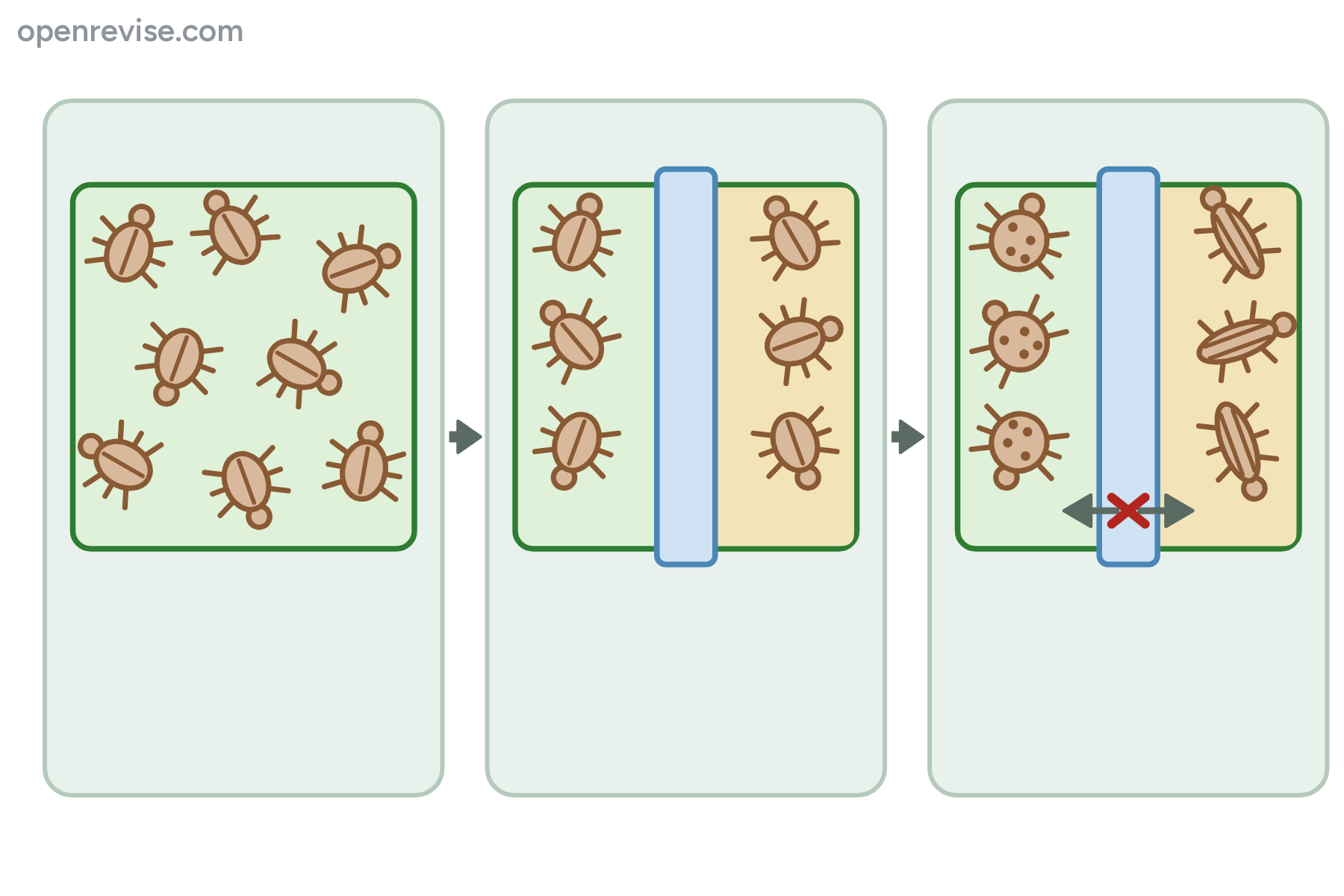 Describe the stages by which one species becomes two in this diagram.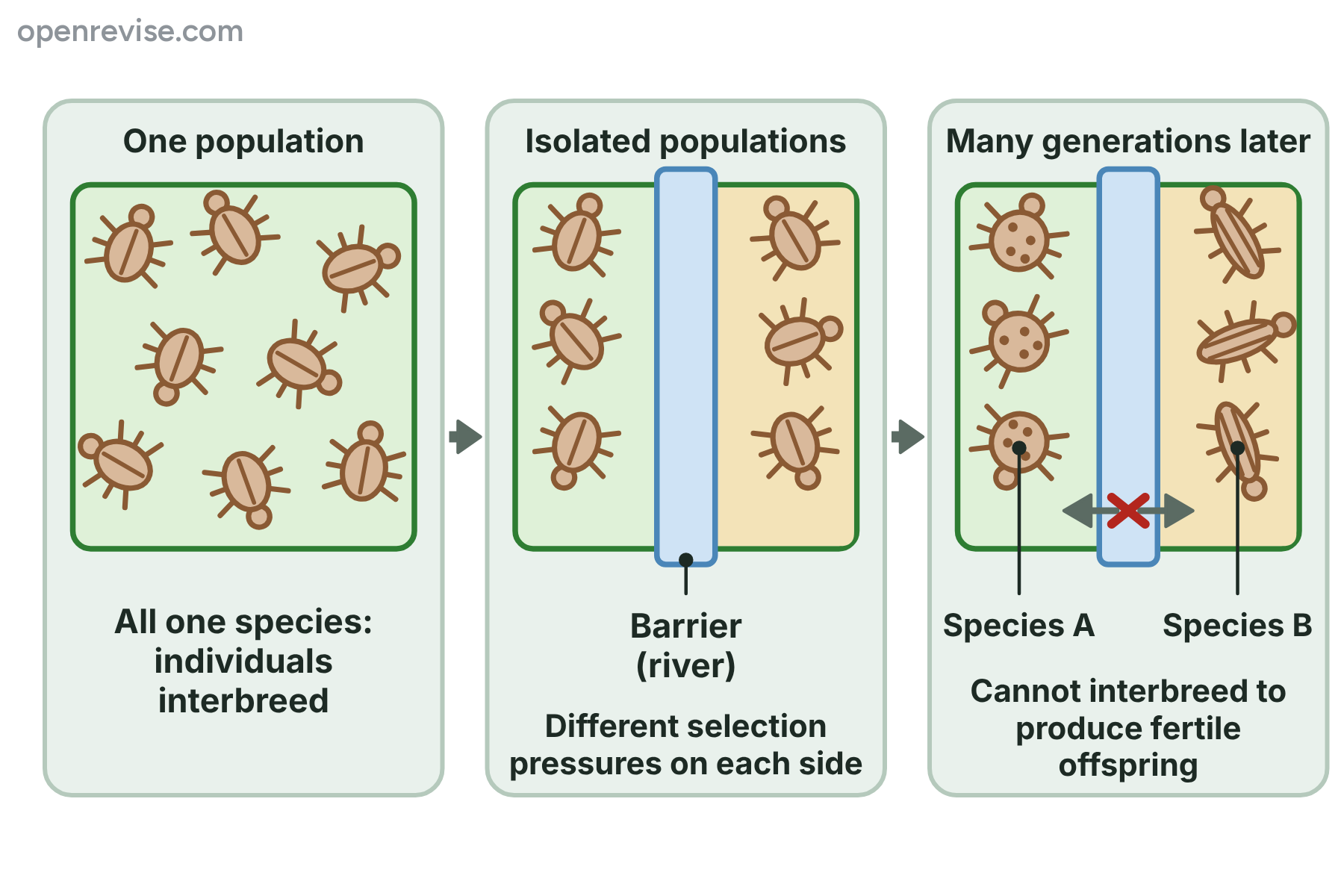
One population interbreeds. A river splits it, and each half faces different selection pressures. After many generations the beetles are so different that they cannot interbreed to produce fertile offspring, so they are two species.