Exam questions · Biology · Natural Selection and Evolution
Fossils and Extinction
- 7 exam questions
- 22 marks
- 8 quick checks
-
1 State [1 mark]
State what is meant by a fossil.
Show answerHide answer
Model answer
The remains or traces of an organism from many years ago that are found in rock.
Mark scheme
- The remains or traces of an organism from many years ago, found in rock — 1 mark
-
2 Describe [3 marks]
Describe how a fossil of a shell is formed.
Show answerHide answer
Model answer
The shell is covered by layers of sediment after the animal dies. The shell is a hard part and does not decay easily, so it remains, and minerals replace it as it slowly decays, forming a copy in stone. The sediment turns to rock around it.
Mark scheme
- The shell is buried in sediment — 1 mark
- It does not decay easily, or it is replaced by minerals — 1 mark
- The sediment turns to rock, preserving the fossil — 1 mark
-
3 Give [2 marks]
Give two reasons why the fossil record is incomplete.
Show answerHide answer
Model answer
Any two from: many early organisms had soft bodies that decayed, so they left no fossils; fossils form only in rare conditions; many fossils have been destroyed by movements of the Earth, such as folding and heating of rocks; many fossils have not yet been found.
Mark scheme
- First reason — 1 mark
- Second reason — 1 mark
-
4 Describe [3 marks]
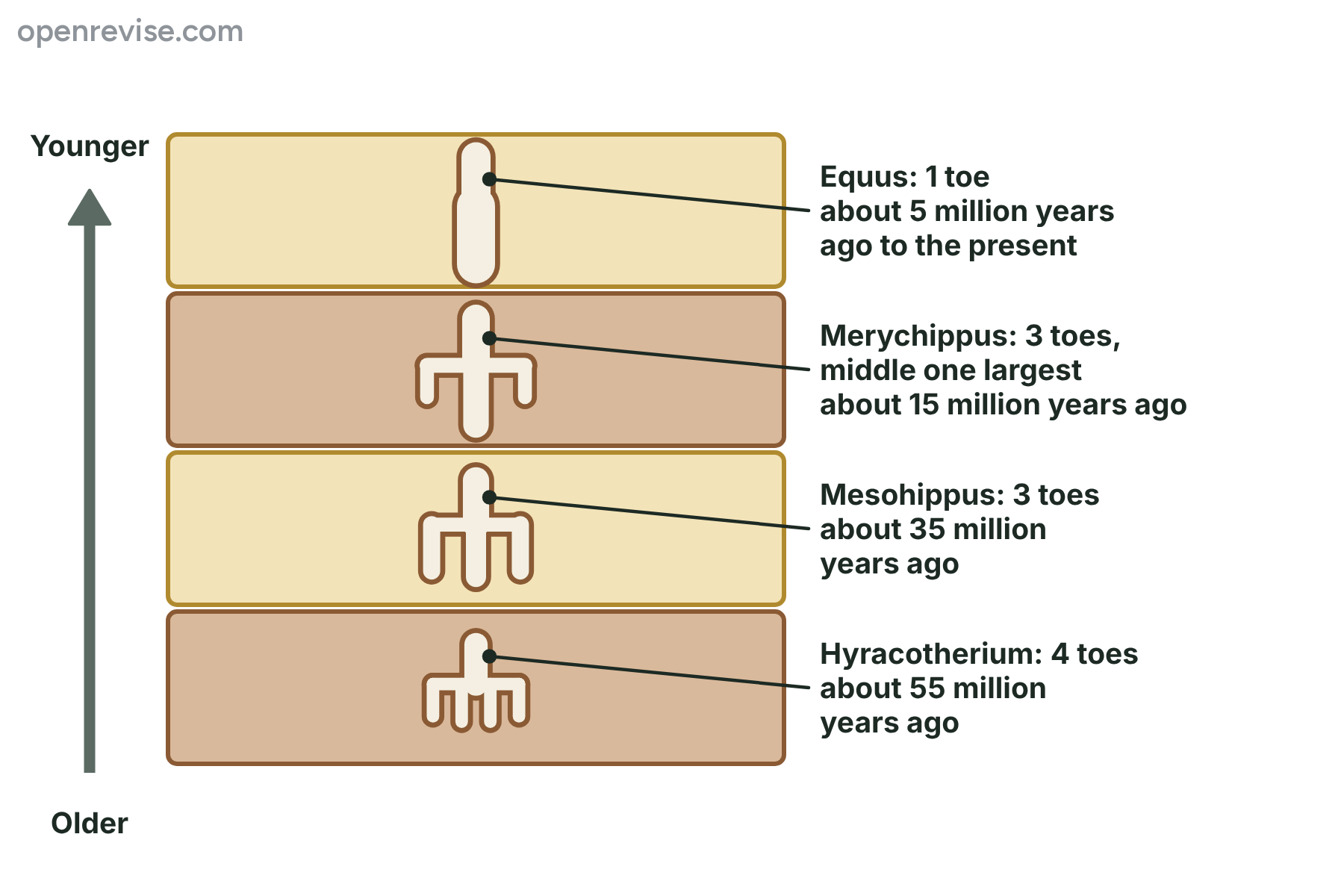
The diagram shows fossils of the front foot bones of four animals in the horse family, found in different layers of rock. Describe how the foot changed from the oldest to the youngest fossil.
Show answerHide answer
Model answer
The number of toes fell from four in the oldest fossil, Hyracotherium, to three in Mesohippus and Merychippus, and to one in the youngest, Equus. The middle toe became larger as the side toes became smaller, until only the large middle toe was left as a single hoof.
Mark scheme
- The number of toes decreased from four to one — 1 mark
- Quoting the data, such as four, three, three and one — 1 mark
- The middle toe became larger and the side toes smaller — 1 mark
-
5 Explain [3 marks]
A scientist finds the fossil of a trilobite in a deep layer of undisturbed rock and the fossil of a fish in a layer above it. Explain what this suggests about the ages of the fossils.
Show answerHide answer
Model answer
Sediment is laid down in layers, with the youngest on top. In undisturbed rock the deeper layer is older. So the trilobite is older than the fish, which lived later.
Mark scheme
- Sediment forms in layers, with new layers on top — 1 mark
- The deeper layer is older — 1 mark
- So the trilobite is older than the fish — 1 mark
-
6 Explain [4 marks]
A species of bird lived on a small island and ate only one kind of fruit. A disease killed all of the trees that made the fruit. Explain why the species of bird became extinct.
Show answerHide answer
Model answer
The food supply was lost, so the birds could not find enough to eat and could not compete for other foods. Because the species was a specialist, it could not use another food. The population was small, so it had little variation, and there may have been no variants able to eat a different food. The birds died or could not reproduce, so no individuals were left and the species was extinct.
Mark scheme
- The loss of its only food, so the birds starved or failed to breed — 1 mark
- It could not compete for or use any other food — 1 mark
- Little genetic variation in a small population, so no variants could cope — 1 mark
- No individuals were left, so the species is extinct — 1 mark
-
7 Evaluate [6 marks]
Fossils of the horse's ancestors are used as evidence that the horse evolved over millions of years. Using the diagram and your own knowledge, evaluate how well the fossil record supports the theory of evolution.
Show answerHide answer
Model answer
The diagram shows a clear pattern: the number of toes falls from four to three to one as the rocks get younger, so the foot changed gradually over 55 million years. This is what would be expected if each species evolved from the one before, and it shows how organisms are related. Other fossils support the idea, such as Archaeopteryx, which has features of reptiles and birds. However, the fossil record is incomplete, because soft parts rarely become fossils, conditions for fossilisation are rare and many fossils are destroyed or not yet found. The diagram shows only four animals and there are gaps of 10 to 20 million years between them, so it does not show every step. A fossil cannot show how the change happened. Overall the fossils strongly support evolution, because the changes are in a sequence in layers of different ages, but the record is better evidence when it is combined with other evidence, such as antibiotic resistance and DNA.
Mark scheme
- Describes the pattern: toes decrease from four to one in younger layers — 1 mark
- Uses figures from the diagram, such as ages or numbers of toes — 1 mark
- Says that the sequence fits gradual change, which supports evolution — 1 mark
- Gives another example of fossil evidence, such as Archaeopteryx — 1 mark
- Gives a limitation, such as an incomplete record or gaps in the sequence — 1 mark
- A judgement that fossils support evolution but are stronger with other evidence — 1 mark
Quick check
-
1
Which of these parts of an animal is most likely to form a fossil?
Show answerHide answer
C: The teeth
Hard parts, such as shells, teeth and bones, do not decay easily and are the parts most often preserved.
-
2
How can an insect be preserved almost whole for millions of years?
Show answerHide answer
B: By being trapped in amber
Trapped in amber (tree resin), the insect is cut off from oxygen and microorganisms, so it does not decay.
-
3
In a series of undisturbed layers of sedimentary rock, where are the oldest fossils found?
Show answerHide answer
A: In the lowest layer
New sediment is laid down on top of older sediment, so the deepest layers are the oldest.
-
4
Why is the fossil record incomplete?
Show answerHide answer
D: Many organisms have soft bodies that decay and leave no fossils
Most organisms do not become fossils, and many fossils have been destroyed or not yet found.
-
5
What do the fossils of the horse's ancestors show?
Show answerHide answer
B: That the horse changed gradually over millions of years
The fossils show a gradual change, for example in the number of toes, which is evidence for evolution.
-
6
Which of these is a cause of extinction?
Show answerHide answer
C: A new disease that has no cure in that species
A new disease, a new predator or a change in climate can leave a species unable to survive and reproduce.
-
7
Why is a small population more at risk of extinction when the environment changes?
Show answerHide answer
D: It has little genetic variation
Little genetic variation means there may be no individuals with a variant that can cope with the change.
-
8
Archaeopteryx had feathers and also teeth, claws and a long bony tail. Why is this fossil important?
Show answerHide answer
A: It shows features of both reptiles and birds
It has features of both reptiles and birds, which suggests that birds evolved from reptile-like ancestors.