Biology · Natural Selection and Evolution
Fossils and Extinction
Fossils are the nearest thing we have to a diary of life on Earth, but it is a diary with most of the pages missing. This lesson is for both Combined Science and separate Biology. It covers how fossils form, what they tell us about evolution, why the fossil record is incomplete, and why species become extinct.
Learning Objectives
- 1Describe the ways in which fossils are formed.
- 2Describe how fossils provide evidence for evolution, using an example such as the horse.
- 3Explain why the fossil record is incomplete.
- 4Explain how changes in the environment, and other causes, can lead to the extinction of a species.
Retrieval practice
-
1
What is evolution?
Show answerHide answer
A change in the inherited characteristics of a population over time, through natural selection.
-
2
What is a species?
Show answerHide answer
A group of organisms that can interbreed to produce fertile offspring.
-
3
What do we call a change that makes a species harder to survive in its habitat?
Show answerHide answer
A selection pressure, such as a new predator, disease or competitor.
-
4
What is biodiversity?
Show answerHide answer
The variety of living organisms.
Remains from the past
A fossil is the remains or traces of an organism from many years ago that are found in rock. Fossils tell us what lived on Earth in the past, what it looked like and roughly how old it is. Lined up in order of age, they show how living things have changed, which is some of the best evidence for evolution. They also tell us about the species that have disappeared, because most of the species that have ever lived are now extinct.
How fossils form
Fossils form in four main ways, and most of them need the organism to be buried before it decays.
-
Hard parts
The shells, teeth, bones and other hard parts of an organism do not decay easily. If the organism is buried in sediment, its hard parts can be preserved in the rock that forms around them.
-
Replacement by minerals
As the hard part slowly decays, minerals dissolved in water seep in and replace it, particle by particle, making a copy of the original in stone.
-
Conditions with no decay
Where there is no oxygen, no moisture or the temperature is too low, decay microbes cannot work. Insects trapped in amber, mammoths frozen in ice and a man preserved in a peat bog are preserved almost whole.
-
Traces
Footprints, burrows and the channels left by roots can be made in soft mud that later hardens, and they remain in the rock after the organism has gone.
How a hard part becomes a fossil
This usually takes millions of years.
-
1
Burial
The animal dies and is quickly covered by sediment, such as mud or sand, on a sea bed or lake bed.
-
2
Decay of soft parts
The soft parts rot away or are eaten, but the bones, teeth and shells remain.
-
3
Replacement and compaction
New layers of sediment build up and press down on the lower layers. They slowly turn to rock, and minerals replace the bone or shell.
-
4
Exposure
Movements of the Earth lift the rock, and erosion by wind, water and ice wears it away until the fossil is exposed and can be found.
How a fossil is formed
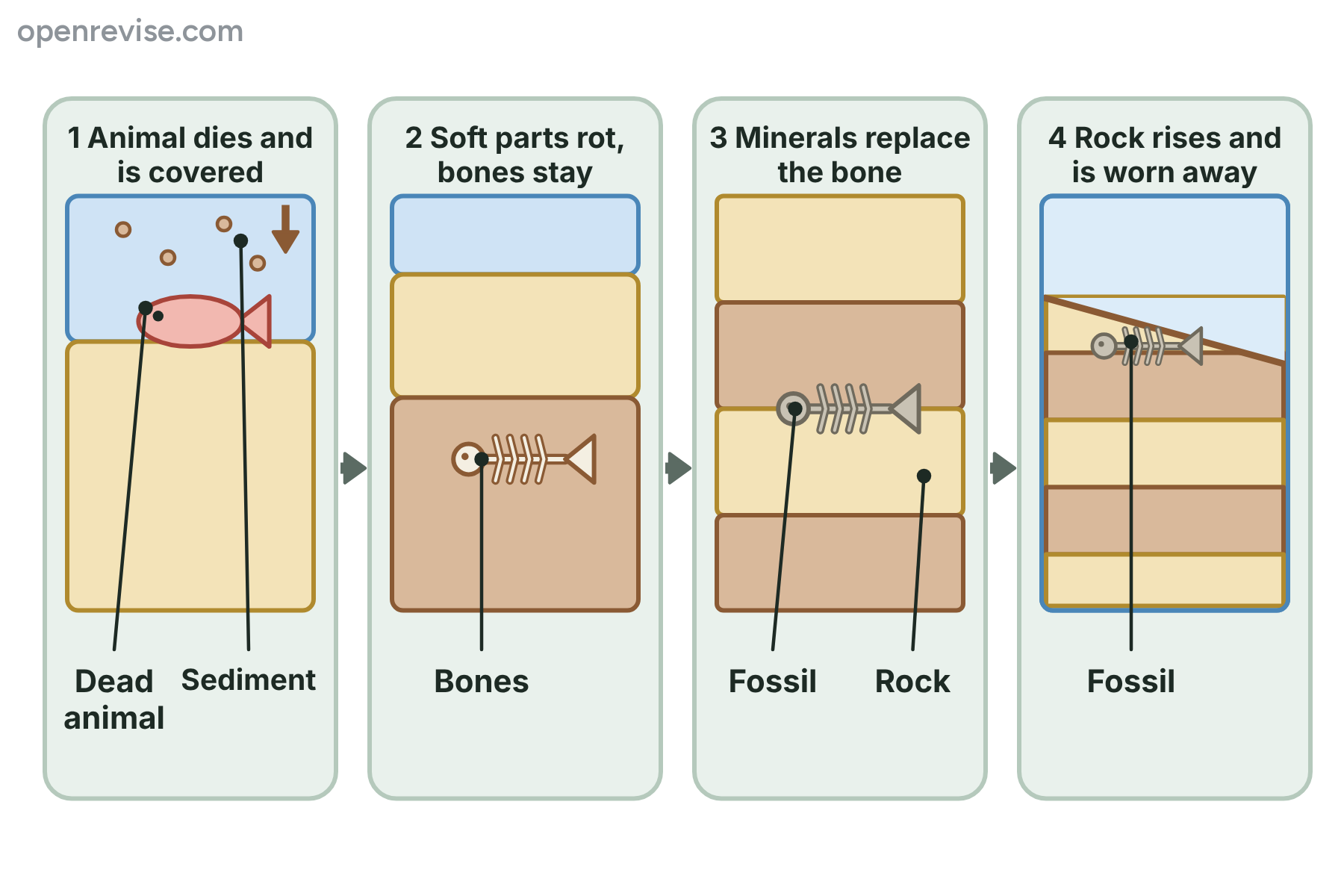
The hard parts survive and are turned to stone, and erosion eventually exposes them.
What fossils show about evolution
Fossils found in layers of rock give a record of how organisms changed over time.
-
Older layers are deeper
Sediment builds up in layers, so in rock that has not been disturbed the oldest layers and their fossils are at the bottom and the youngest are at the top.
-
Gradual change
Fossils from different layers show how a feature changed. The horse's ancestors in the oldest rocks were small with four toes on the front foot, and the horses in younger rocks are bigger, with fewer toes and one large hoof.
-
Extinct species
Fossils show species that no longer exist, such as trilobites and dinosaurs, and how the groups of living things have changed.
-
Links between groups
Archaeopteryx, about 150 million years old, had feathers and wings like a bird but also teeth, claws on its wings and a long bony tail like a reptile. It shows that birds evolved from reptile-like ancestors.
Fossils of the horse's ancestors
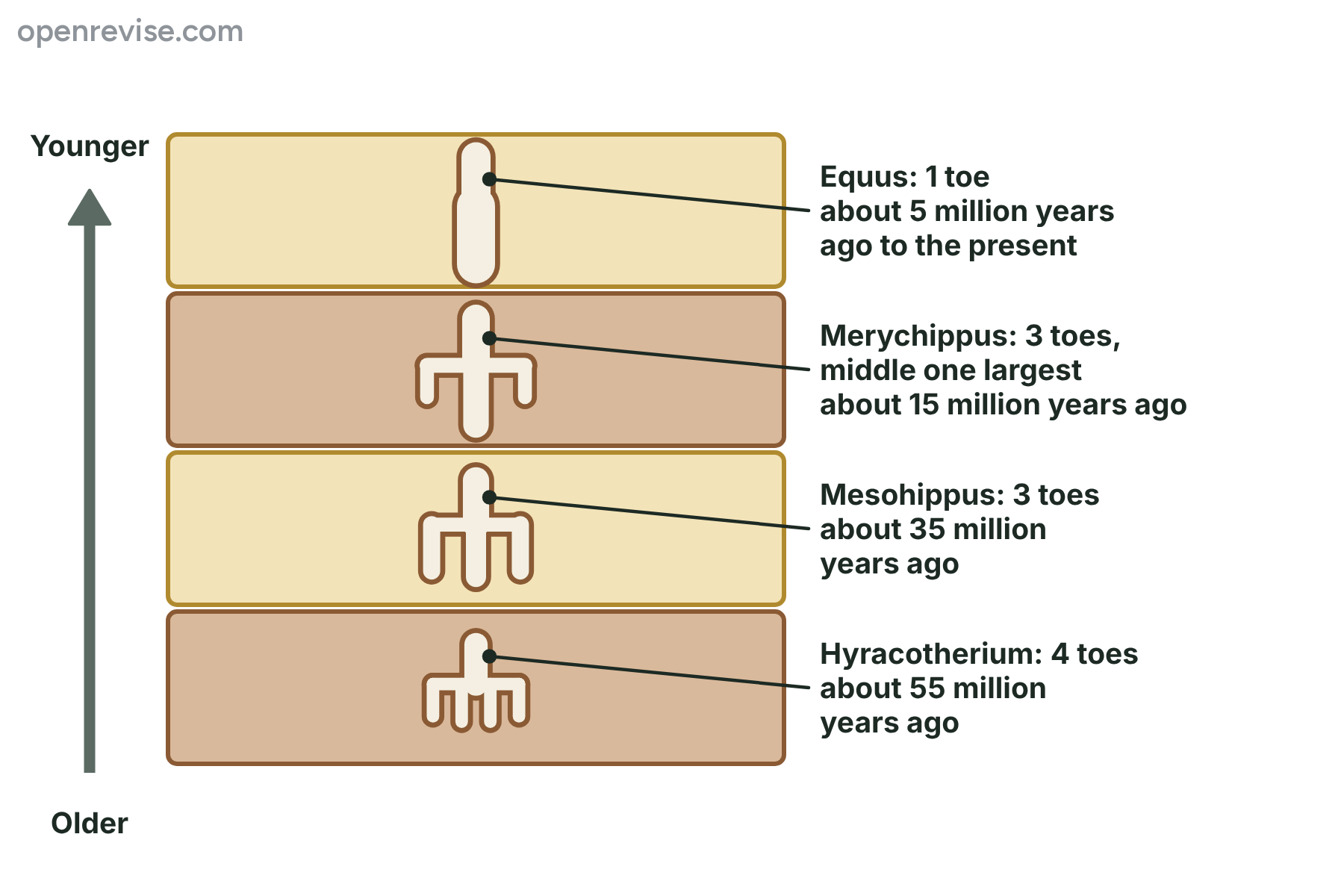
The foot of the horse changed over about 55 million years, from four toes to one hoof.
Why the fossil record is incomplete
Only a very small proportion of the organisms that have lived have become fossils, and only some of those have been found.
-
Soft bodies
Many early organisms, such as jellyfish, worms and single-celled life, were soft-bodied. They rot quickly and rarely leave a trace, so the earliest history of life is very hard to read.
-
Rare conditions
A fossil forms only if the organism is buried quickly in sediment and conditions let it be preserved. Most dead organisms are eaten by scavengers or decayed by microbes.
-
Destroyed fossils
Many fossils have been destroyed. Rocks are crushed, folded, heated and melted by movements of the Earth, and eroded away.
-
Not yet found
Many fossils are still buried, deep in the ground or under the sea, and have not been discovered.
Fossil evidence: strengths and limits
What fossils can show
- The age of the organism, from the layer of rock it is in
- What extinct organisms looked like
- Gradual change in a feature over millions of years
- Links between groups, such as Archaeopteryx
Why they cannot show everything
- Most organisms never become fossils
- Soft tissues and behaviour are rarely preserved
- Many fossils have been destroyed or not found yet
- There are gaps in the fossil record of some species
Extinction
A species is extinct when no individuals of it are left alive anywhere. Extinction happens when the environment changes in a way that a species cannot cope with.
-
Environmental change
Changes in climate, such as a long drought or an ice age, or a volcanic eruption or an asteroid strike, can leave individuals unable to compete and reproduce.
-
New predators
A new predator, often one introduced by humans, can eat a species faster than it can breed. Rats and pigs that reached Mauritius ate the eggs of the dodo.
-
New diseases
A new pathogen can spread through a population that has no resistance.
-
New competitors
A new species can take the food or the space of another, so that the first one cannot find enough to survive.
-
Human activity
Hunting and the destruction of habitats by humans have caused many recent extinctions, such as the passenger pigeon, which was hunted until the last one died in 1914.
Why some species cannot adapt
Extinction is the other side of natural selection: a species survives a change only if some of its individuals have a variant that suits the new conditions.
-
Enough variation
If the population has plenty of genetic variation, some individuals may have variants that survive the change, and the species adapts.
-
Too little variation
A small population has little variation. If none of the individuals can cope, they all die or fail to breed.
-
Too fast
Natural selection takes many generations. If the environment changes more quickly than the species can adapt, it can become extinct.
-
Specialists
Species that live in only one habitat, or eat only one kind of food, are more likely to become extinct if that habitat or food is lost.
Case study
The extinction at the end of the Cretaceous
About 66 million years ago a huge asteroid hit the Earth at Chicxulub in what is now Mexico. The dust and gases thrown into the air blocked sunlight, which cooled the planet and reduced photosynthesis, so food chains collapsed. About three quarters of all species died out, including all the dinosaurs that did not fly, and the ammonites. The fossil record shows the change clearly, because the same layer of rock has a high amount of the element iridium, which is common in asteroids, and above it the dinosaur fossils stop. The mammals and birds that survived then evolved to fill the habitats that were left.
The big idea
Fossils show that life has changed over millions of years, but the fossil record is incomplete, and most species that have ever lived are now extinct.
Fossils and extinction
Fossils and extinction
-
Formation
- hard parts
- replaced by minerals
- no decay (amber, ice, peat)
- traces
-
Evidence
- older layers deeper
- horse foot
- Archaeopteryx
- extinct species
-
Incomplete record
- soft bodies
- rare conditions
- destroyed rocks
- not found yet
-
Extinction
- environmental change
- predators
- disease
- competitors
- human activity
-
Natural selection
- needs variation
- too fast a change
- small populations
Summary and exam focus
- Fossils are the remains or traces of organisms from many years ago, found in rocks.
- Fossils form from hard parts, from parts replaced by minerals, where there is no decay, and as traces such as footprints.
- Fossils in layers of rock show how organisms have changed, for example the horse, so they are evidence for evolution.
- The fossil record is incomplete because many organisms were soft-bodied, fossilisation is rare and many fossils are destroyed or not found.
- Species become extinct when the environment changes, or because of new predators, diseases, competitors or human activity, and they cannot adapt quickly enough.
Exam focus
Describe how a fossil can form from the hard part of an animal, and explain why the fossil record is incomplete. (6 marks) (6 marks)
Put the formation in order: burial in sediment, soft parts decay, minerals replace the hard part, rock forms. Then give at least two separate reasons for gaps, such as soft bodies that decay, rare conditions for fossilisation, fossils destroyed by movements of the Earth and fossils not yet found.
Key terms
The words this lesson expects you to use. Each one is linked from the first place it appears above.
- Fossil
- The remains or traces of an organism from many years ago that are found in rock.
- Sediment
- Mud, sand or other small particles that settle in layers, usually under water.
- Fossil record
- All of the fossils that have been found, which shows how life has changed over time.
- Extinction
- The permanent loss of a species, when no individuals are left alive.
- Mass extinction
- An event in which a large proportion of the species on Earth die out in a short time.
- Transitional fossil
- A fossil with features of two groups, such as Archaeopteryx with features of reptiles and birds.
- Decay
- The breakdown of dead material by microorganisms.
- Erosion
- The wearing away of rock by wind, water and ice.
- Predator
- An animal that hunts and eats other animals.
You've finished the notes
Check your understanding
Test yourself while it is fresh. Start with the flashcards, then try the exam questions.
Something here looks wrong?
Tell us what and we will go and look. It goes to whoever writes these pages, nobody else, and we do not ask who you are — so there is nothing to sign and nothing comes back to you.