Viewing as
Teacher view: planning notes, the answers to every question, and the teacher copies of the files.
Maths · Area and volume
Perimeter and area
The area formulae for rectangles, triangles, parallelograms and trapeziums, splitting compound shapes into simple parts, and working backwards from an area to a missing length.
Teacher resources
The teacher copies: slides with the questions built in, the answers, and anything else attached to this lesson for whoever is teaching it.
- Perimeter and area - Teacher Slides.pptx Teacher The lesson slides with the teacher's notes on each slide, and every question and mark scheme built in. Built from the lesson script on 29 September 2026. View
- Perimeter and area - Teacher Notes.docx Teacher The complete notes with the teacher's notes and every model answer in full. Built from the lesson script on 29 September 2026. View
Student handouts
The same files the students see, to print or hand out.
- Perimeter and area.pptx Built from the lesson script on 29 September 2026. View
- Perimeter and area - Completed Notes.docx The full notes for the lesson, to revise from. Built from the lesson script on 29 September 2026. View
- Perimeter and area - Exam Questions.docx Built from the lesson script on 29 September 2026. View
Before We Start
Answer each one, then check.
-
1
What is the perimeter of a 7 cm by 4 cm rectangle?
Show answerHide answer
22 cm
-
2
What is the area of a 7 cm by 4 cm rectangle?
Show answerHide answer
28 cm²
-
3
Work out \(\frac{1}{2} \times 9 \times 6\).
Show answerHide answer
27
-
4
Solve \(4h = 24\).
Show answerHide answer
\(h = 6\)
Learning Objectives
- 1Find the perimeter of 2D shapes, including compound shapes.
- 2Use the area formulae for rectangles, triangles, parallelograms and trapeziums.
- 3Find the area of a compound shape.
- 4Work backwards from an area to a missing length.
The Area Formulae
A parallelogram is a rectangle with a triangle moved from one end to the other, so its area is base × height. A triangle is half a parallelogram. A trapezium's area uses the mean of its parallel sides: \(\frac{1}{2}(a + b)h\).
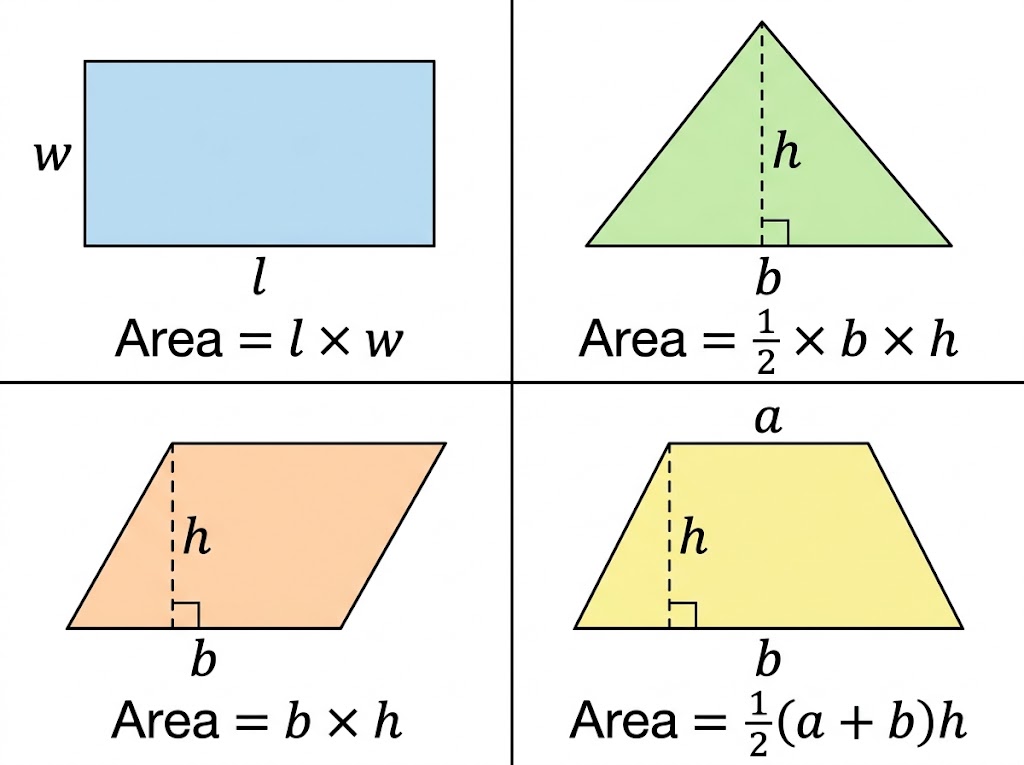
Every height is the perpendicular height - at right angles to the base.
Perimeter and Area
Perimeter is the distance round the edge; area is the space inside.
-
Perimeter
Add every side. Units: cm, m.
-
Area
Count squares or use a formula. Units: cm², m².
-
Perpendicular height
Use the height at right angles to the base, NOT the slanted side.
-
Same units
Change all the lengths into the same unit before you calculate.
Area of a Trapezium
A trapezium has parallel sides of 6 cm and 10 cm. The perpendicular distance between them is 5 cm. Work out its area.
Show the solutionHide the solution
- 1 Write the formula \(A = \frac{1}{2}(a + b)h\)
- 2 Substitute \(A = \frac{1}{2}(6 + 10) \times 5\)
- 3 Calculate \(\frac{1}{2} \times 16 \times 5 = 40\)
Answer40 cm²
A Compound Shape
An L-shape is made by cutting a 4 cm by 3 cm rectangle from one corner of a 10 cm by 8 cm rectangle. Work out its area and its perimeter.
Show the solutionHide the solution
- 1 Area: big rectangle minus the cut-out \(10 \times 8 - 4 \times 3 = 80 - 12 = 68\)
- 2 Perimeter: the sides are 10, 5, 4, 3, 6 and 8 \(10 + 5 + 4 + 3 + 6 + 8 = 36\)
- 3 Notice Cutting a corner out leaves the perimeter the same as the rectangle's: \(2(10 + 8) = 36\)
AnswerArea 68 cm², perimeter 36 cm
Working Backwards
A triangle has an area of 24 cm² and a base of 8 cm. Work out its perpendicular height.
Show the solutionHide the solution
- 1 Write the formula \(24 = \frac{1}{2} \times 8 \times h\)
- 2 Simplify \(24 = 4h\)
- 3 Solve \(h = 6\)
Answer6 cm
Common Mistakes
Wrong
- Using the slanted side as the height of a parallelogram.
- Forgetting the \(\frac{1}{2}\) for a triangle.
- Mixing cm and m in one calculation.
- Writing area in cm.
Right
- Use the perpendicular height.
- Triangle: \(\frac{1}{2} \times b \times h\).
- Convert to one unit first.
- Area is always in square units: cm², m².
Same Area, Different Shape
Draw as many different shapes as you can with an area of exactly 24 cm²: a rectangle, a triangle, a parallelogram and a trapezium. Label the dimensions of each. Which of your shapes has the smallest perimeter?
1. Choose a base.
2. Work out the height needed.
3. Compare the perimeters.
A good answer shows: For example: rectangle 6 by 4; triangle base 8, height 6; parallelogram base 6, height 4; trapezium with parallel sides 5 and 7 and height 4. Of the rectangles, the one closest to a square (about 4.9 by 4.9) has the smallest perimeter.
Can I...?
- 1Find the perimeter of a shape.
- 2Find the area of a rectangle and a triangle.
- 3Find the area of a parallelogram and a trapezium.
- 4Find missing sides of a compound shape.
- 5Find the area of a compound shape.
- 6Find a missing length from an area.
Summary & Exam Focus
- Rectangle \(lw\); triangle \(\frac{1}{2}bh\); parallelogram \(bh\); trapezium \(\frac{1}{2}(a + b)h\).
- Heights are always perpendicular.
- Compound shapes: split, or subtract a missing part.
- Area units are squared.
Exam focus
A wall is 4 m long and 2.5 m high. It has a door 0.8 m wide and 2 m high. The wall needs two coats of paint. One tin covers 5 m². How many tins are needed? (4 marks) (4 marks)
In a problem, write down what each number you calculate represents - "area of wall", "area to paint" - so the examiner can follow you and give process marks.
Key terms
The vocabulary this lesson expects you to use. Each one is linked from the first place it appears above.
- Perimeter
- The total distance around the edge of a shape.
- Area
- The amount of space inside a 2D shape, in square units.
- Perpendicular height
- The height measured at right angles to the base.
- Compound shape
- A shape made from two or more simple shapes.
- Trapezium
- A quadrilateral with one pair of parallel sides.
Questions and answers
7 questions set on this lesson, with the mark schemes and model answers open.
A trapezium has parallel sides of 7 cm and 11 cm and a perpendicular height of 6 cm. Work out the area of the trapezium.
Mark scheme — 2 marks available
- \(\frac{1}{2}(7 + 11) \times 6\) — M1
- 54 cm² — A1
Model answer
\(\frac{1}{2}(7 + 11) \times 6 = 54\) cm²
The diagram shows an L-shape. All the corners are right angles. Work out (a) the area and (b) the perimeter of the shape.
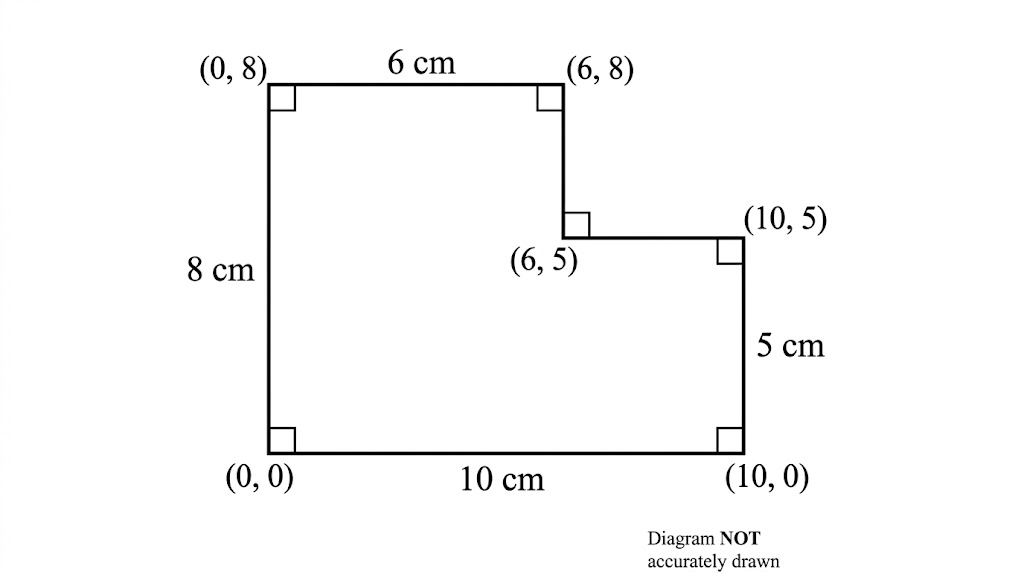
Mark scheme — 4 marks available
- Missing sides 4 and 3 found — P1
- (a) A correct method for the area, e.g. \(80 - 12\) or \(6 \times 8 + 4 \times 5\) — P1
- (a) 68 cm² — A1
- (b) 36 cm — B1
Model answer
The missing sides are \(10 - 6 = 4\) cm and \(8 - 5 = 3\) cm. (a) \(10 \times 8 - 4 \times 3 = 68\) cm² (b) \(10 + 5 + 4 + 3 + 6 + 8 = 36\) cm
A wall is 4 m long and 2.5 m high. It has a door 0.8 m wide and 2 m high. The wall, but not the door, needs two coats of paint. One tin of paint covers 5 m² and costs £12. Work out the cost of the paint needed.
Mark scheme — 4 marks available
- \(10 - 1.6 = 8.4\) — P1
- \(8.4 \times 2 = 16.8\) — P1
- 4 tins — P1
- £48 — A1
Model answer
Wall \(4 \times 2.5 = 10\) m². Door \(0.8 \times 2 = 1.6\) m². To paint \(10 - 1.6 = 8.4\) m², twice: 16.8 m². \(16.8 \div 5 = 3.36\), so 4 tins. \(4 \times 12 = £48\).
A triangle has a base of 12 cm and a perpendicular height of 9 cm. A rectangle has the same area as the triangle. The rectangle is 6 cm wide. Work out the perimeter of the rectangle.
Mark scheme — 3 marks available
- 54 — P1
- 9 cm — P1
- 30 cm — A1
Model answer
Triangle area \(\frac{1}{2} \times 12 \times 9 = 54\) cm². Rectangle length \(54 \div 6 = 9\) cm. Perimeter \(2(9 + 6) = 30\) cm.
What is the area of a parallelogram with base 9 cm and perpendicular height 4 cm?
Why: Area = base × perpendicular height = \(9 \times 4\).
What is the area of a triangle with base 10 cm and height 7 cm?
Why: \(\frac{1}{2} \times 10 \times 7 = 35\).
A trapezium has area 60 cm², height 5 cm and one parallel side 10 cm. How long is the other parallel side?
Why: \(60 = \frac{1}{2}(10 + b) \times 5\), so \(10 + b = 24\) and \(b = 14\).