Viewing as
Teacher view: planning notes, the answers to every question, and the teacher copies of the files.
Maths · Area and volume
Prisms
A prism has the same cross-section all the way through. Its volume is the area of that cross-section times its length, and its surface area is the total area of all its faces.
Teacher resources
The teacher copies: slides with the questions built in, the answers, and anything else attached to this lesson for whoever is teaching it.
- Prisms - Teacher Slides.pptx Teacher The lesson slides with the teacher's notes on each slide, and every question and mark scheme built in. Built from the lesson script on 29 September 2026. View
- Prisms - Teacher Notes.docx Teacher The complete notes with the teacher's notes and every model answer in full. Built from the lesson script on 29 September 2026. View
Student handouts
The same files the students see, to print or hand out.
Last Lesson and Before
Answer each one, then check.
-
1
Last lesson: how many cm³ are in 1 litre?
Show answerHide answer
1000
-
2
Area of a triangle with base 6 cm and height 8 cm?
Show answerHide answer
24 cm²
-
3
How many faces does a cuboid have?
Show answerHide answer
6
-
4
Work out \(2(20 + 15 + 12)\).
Show answerHide answer
94
Learning Objectives
- 1Recognise prisms and their cross-sections.
- 2Work out the volume of a cuboid and any prism.
- 3Work out the surface area of a cuboid and a prism.
- 4Solve problems involving volume and capacity.
What Makes a Prism
Slice a prism anywhere at right angles to its length and you get the same shape - the cross-section. So its volume is the area of the cross-section multiplied by the length. A cuboid is just a prism with a rectangular cross-section.
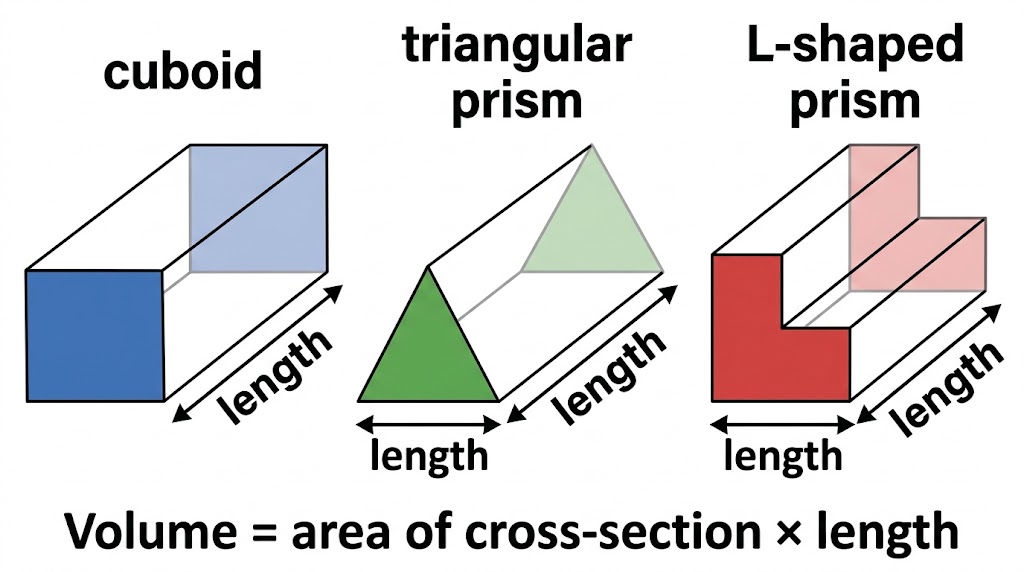
The cross-section is the same all the way along.
Volume
Volume is the space inside a 3D shape, measured in cubic units.
-
Cuboid
\(V = l \times w \times h\).
-
Any prism
\(V = \text{area of cross-section} \times \text{length}\).
-
Find the cross-section first
It may be a triangle, a trapezium or a compound shape - use last lesson's formulae.
-
Units
cm³ or m³. For capacity, 1000 cm³ = 1 litre.
Volume of a Triangular Prism
A prism has a right-angled triangle as its cross-section, with shorter sides 6 cm and 8 cm. The prism is 12 cm long. Work out its volume.
Show the solutionHide the solution
- 1 Area of the cross-section \(\frac{1}{2} \times 6 \times 8 = 24\) cm²
- 2 Multiply by the length \(24 \times 12 = 288\)
Answer288 cm³
Surface Area
The surface area is the total area of all the faces. Sketching the net helps you not miss one.
-
Cuboid
Three pairs of equal rectangles: \(SA = 2(lw + lh + wh)\).
-
Triangular prism
Two triangles plus three rectangles.
-
Rectangles round the side
Their total area is the perimeter of the cross-section times the length.
-
Units
Surface area is an area: cm² or m².
Surface Area of a Triangular Prism
Work out the surface area of the prism above. Its triangle has sides 6 cm, 8 cm and 10 cm, and it is 12 cm long.
Show the solutionHide the solution
- 1 Two triangles \(2 \times 24 = 48\)
- 2 Three rectangles: perimeter of the triangle × length \((6 + 8 + 10) \times 12 = 288\)
- 3 Add \(48 + 288 = 336\)
Answer336 cm²
How Long to Fill?
A tank is a cuboid 1.2 m long, 50 cm wide and 40 cm deep. Water flows in at 4 litres per minute. How long does it take to fill?
Show the solutionHide the solution
- 1 Same units: cm \(120 \times 50 \times 40 = 240\,000\) cm³
- 2 In litres \(240\,000 \div 1000 = 240\) litres
- 3 Time \(240 \div 4 = 60\) minutes
Answer60 minutes (1 hour)
Best Box
A box with no lid is made from a 20 cm by 20 cm square of card by cutting a square of side \(x\) cm from each corner and folding up the sides. Work out the volume for \(x = 1, 2, 3, 4, 5\) and 6. Which value of \(x\) gives the biggest box?
1. Write the length and width in terms of \(x\).
2. Work out each volume.
3. Look for the maximum.
A good answer shows: \(V = x(20 - 2x)^2\): 324, 512, 588, 576, 500, 384 cm³. The biggest of these is at \(x = 3\) (588 cm³); the true maximum is at \(x = \frac{10}{3}\), about 593 cm³.
Can I...?
- 1Recognise a prism and its cross-section.
- 2Find the volume of a cuboid.
- 3Find the volume of any prism.
- 4Find the surface area of a cuboid.
- 5Find the surface area of a prism.
- 6Solve problems with volume and capacity.
Summary & Exam Focus
- Volume of a prism = area of cross-section × length.
- Surface area = total area of all the faces.
- Convert to one unit before multiplying.
Exam focus
The diagram shows a triangular prism. Work out (a) its volume and (b) its surface area. (5 marks) (5 marks)
For surface area, list the faces before you calculate - "2 triangles, rectangles 6 × 12, 8 × 12 and 10 × 12" - so you can see you have them all.
Key terms
The vocabulary this lesson expects you to use. Each one is linked from the first place it appears above.
- Prism
- A 3D shape with the same cross-section all along its length.
- Cross-section
- The shape you get when you slice through a solid at right angles to its length.
- Volume
- The space inside a 3D shape, in cubic units.
- Surface area
- The total area of all the faces of a 3D shape.
- Net
- A 2D shape that folds to make a 3D solid.
Questions and answers
7 questions set on this lesson, with the mark schemes and model answers open.
A cuboid is 5 cm long, 4 cm wide and 3 cm high. Work out (a) its volume and (b) its surface area.
Mark scheme — 2 marks available
- (a) 60 cm³ — B1
- (b) 94 cm² — B1
Model answer
(a) \(5 \times 4 \times 3 = 60\) cm³ (b) \(2(20 + 15 + 12) = 94\) cm²
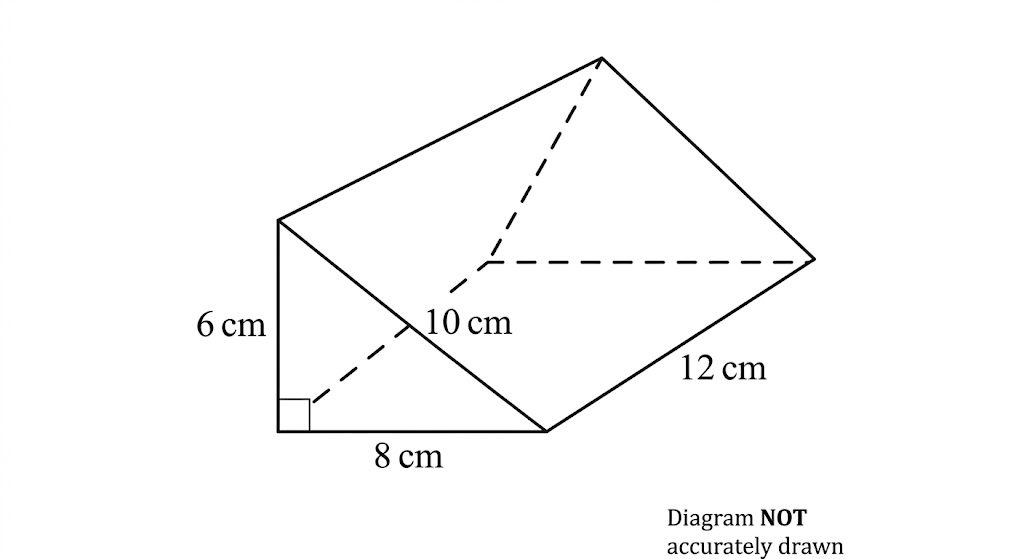
The diagram shows a triangular prism. The cross-section is a right-angled triangle with sides 6 cm, 8 cm and 10 cm. The prism is 12 cm long. Work out (a) the volume and (b) the total surface area of the prism.
Mark scheme — 5 marks available
- (a) \(\frac{1}{2} \times 6 \times 8\) — M1
- (a) 288 cm³ — A1
- (b) Area of 2 triangles, 48 — M1
- (b) At least two of 72, 96, 120 — M1
- (b) 336 cm² — A1
Model answer
(a) \(\frac{1}{2} \times 6 \times 8 \times 12 = 288\) cm³ (b) \(2 \times 24 + 6 \times 12 + 8 \times 12 + 10 \times 12 = 48 + 72 + 96 + 120 = 336\) cm²
A tank is a cuboid 1.2 m long, 50 cm wide and 40 cm deep. It is empty. Water flows in at 4 litres per minute. How long does it take to fill the tank?
Mark scheme — 3 marks available
- Volume with consistent units — P1
- 240 litres — P1
- 60 minutes — A1
Model answer
\(120 \times 50 \times 40 = 240\,000\) cm³ = 240 litres. \(240 \div 4 = 60\) minutes.
A prism has a cross-section in the shape of a trapezium, with parallel sides 4 cm and 6 cm and height 3 cm. The volume of the prism is 225 cm³. Work out the length of the prism.
Mark scheme — 3 marks available
- 15 cm² — M1
- \(225 \div 15\) — M1
- 15 cm — A1
Model answer
Area of cross-section \(\frac{1}{2}(4 + 6) \times 3 = 15\) cm². Length \(225 \div 15 = 15\) cm.
What is the volume of a cube with side 4 cm?
Why: \(4 \times 4 \times 4 = 64\).
A prism has cross-section area 18 cm² and length 10 cm. What is its volume?
Why: Volume = area of cross-section × length = \(18 \times 10\).
What is the surface area of a cube with side 5 cm?
Why: 6 square faces, each \(5 \times 5 = 25\): \(6 \times 25 = 150\).