Viewing as
Teacher view: planning notes, the answers to every question, and the teacher copies of the files.
Maths · Area and volume
Pyramids and cones
Work out the volume of pyramids and cones and the curved surface area of a cone, and at Higher tier the volume of a frustum.
Teacher resources
The teacher copies: slides with the questions built in, the answers, and anything else attached to this lesson for whoever is teaching it.
- Pyramids and cones - Teacher Slides.pptx Teacher The lesson slides with the teacher's notes on each slide, and every question and mark scheme built in. Built from the lesson script on 30 September 2026. View
- Pyramids and cones - Teacher Notes.docx Teacher The complete notes with the teacher's notes and every model answer in full. Built from the lesson script on 30 September 2026. View
Student handouts
The same files the students see, to print or hand out.
- Pyramids and cones.pptx Built from the lesson script on 30 September 2026. View
- Pyramids and cones - Completed Notes.docx The full notes for the lesson, to revise from. Built from the lesson script on 30 September 2026. View
- Pyramids and cones - Exam Questions.docx Built from the lesson script on 30 September 2026. View
Warm-up
Answer each one, then check.
-
1
What is the area of a square with side 6?
Show answerHide answer
36
-
2
State Pythagoras' theorem.
Show answerHide answer
\(a^2 + b^2 = c^2\)
-
3
What is \(\dfrac{1}{3}\) of 36 multiplied by 9?
Show answerHide answer
108
-
4
What is the area of a circle with radius 4, in terms of \(\pi\)?
Show answerHide answer
\(16\pi\)
-
5
What is the volume of a prism?
Show answerHide answer
Cross-sectional area times length
Learning Objectives
- 1Find the volume of a pyramid using \(\dfrac{1}{3} \times \text{base area} \times h\).
- 2Find the volume and curved surface area of a cone.
- 3Use Pythagoras to find a slant height.
- 4Find the volume of a frustum (Higher).
Pyramids and Cones
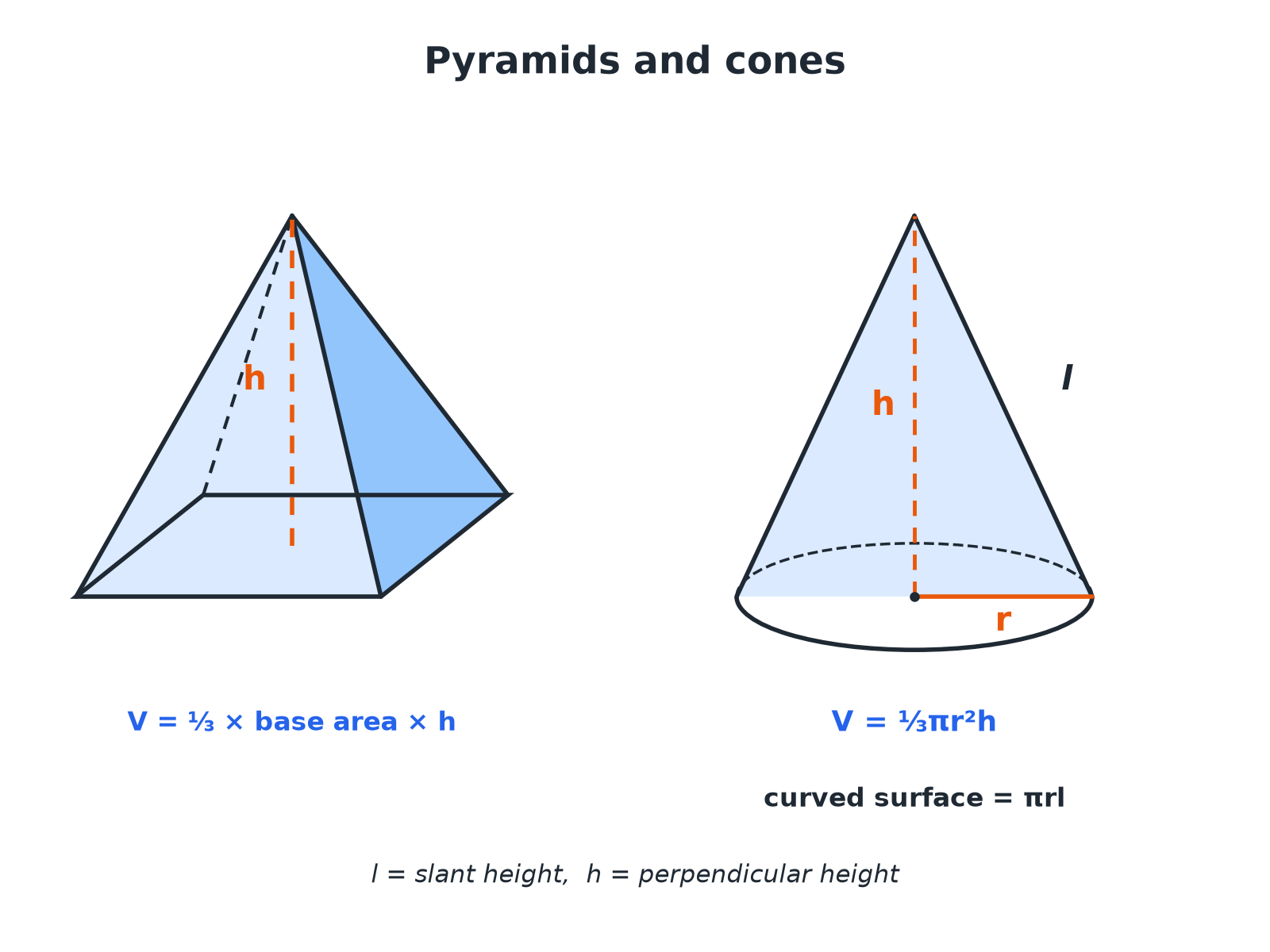
The perpendicular height is not the slant height.
THE KEY FACT
A pyramid or cone has one third of the volume of the prism or cylinder with the same base and height.
\(V = \dfrac{1}{3} \times \text{base area} \times \text{perpendicular height}\)
A Pyramid
A square-based pyramid has base side 6 cm and perpendicular height 9 cm. Find its volume.
Show the solutionHide the solution
- 1 Area of the base \(6 \times 6 = 36\)
- 2 Volume \(= \dfrac{1}{3} \times \text{base area} \times h\) \(\dfrac{1}{3} \times 36 \times 9\)
- 3 Work out \(108\)
Answer108 cm³
A Cone
A cone has base radius 4 cm and perpendicular height 9 cm. Find its volume in terms of \(\pi\) and to 1 decimal place.
Show the solutionHide the solution
- 1 Volume \(= \dfrac{1}{3}\pi r^2 h\) \(\dfrac{1}{3} \times \pi \times 16 \times 9\)
- 2 Simplify \(48\pi\)
- 3 As a decimal \(150.8\)
Answer\(48\pi = 150.8\) cm³
Slant Height and Curved Surface
A cone has base radius 5 cm and perpendicular height 12 cm. Find (a) the slant height, and (b) the curved surface area in terms of \(\pi\).
Show the solutionHide the solution
- 1 (a) The radius, height and slant height form a right-angled triangle \(l^2 = 5^2 + 12^2 = 169\)
- 2 Slant height \(l = 13\)
- 3 (b) Curved surface area \(= \pi r l\) \(\pi \times 5 \times 13 = 65\pi\)
Answer(a) 13 cm (b) \(65\pi\) cm² (204.2 cm²)
Formulae for Pyramids and Cones
The volume formula for a cone is on the formulae sheet; the curved surface area of a cone is too.
-
Pyramid
Volume: \(\dfrac{1}{3} \times \text{base area} \times h\). Surface: Add the areas of all the faces
-
Cone
Volume: \(\dfrac{1}{3}\pi r^2 h\). Surface: Curved surface \(\pi r l\); base \(\pi r^2\)
-
Slant height
Volume: \(l = \sqrt{r^2 + h^2}\). Surface: Pythagoras in the cone
Volume of a Frustum
A cone of radius 6 cm and height 12 cm has a small cone of radius 3 cm and height 6 cm cut off the top. Find the volume of the frustum that is left, in terms of \(\pi\).
Show the solutionHide the solution
- 1 Volume of the whole cone \(\dfrac{1}{3} \times \pi \times 6^2 \times 12 = 144\pi\)
- 2 Volume of the small cone \(\dfrac{1}{3} \times \pi \times 3^2 \times 6 = 18\pi\)
- 3 Subtract \(144\pi - 18\pi\)
Answer\(126\pi\) cm³ (395.8 cm³)
Ice Cream Cone
A cone has radius 3 cm and slant height 10 cm. Work out the perpendicular height, the volume of the cone, and the volume of a hemisphere of ice cream of radius 3 cm on top. Will the ice cream fit inside the cone if it melts?
1. Use Pythagoras for the height.
2. Use each volume formula.
3. Compare.
A good answer shows: Height \(= \sqrt{100 - 9} = 9.54\) cm. Cone volume \(= \dfrac{1}{3}\pi \times 9 \times 9.54 = 89.9\) cm³. Hemisphere \(= \dfrac{2}{3}\pi \times 27 = 56.5\) cm³. The ice cream volume is less than the cone volume, so it would fit.
Can I...?
- 1Find the volume of a pyramid.
- 2Find the volume of a cone.
- 3Use Pythagoras to find a slant height.
- 4Find the curved surface area of a cone.
- 5Find the total surface area of a cone.
- 6Work backwards to find a height.
- 7Find the volume of a frustum (Higher).
- 8Give answers in terms of \(\pi\).
Summary & Exam Focus
- Pyramid and cone volume: one third of base area times perpendicular height.
- Cone curved surface \(\pi r l\), with \(l = \sqrt{r^2 + h^2}\).
- Do not confuse perpendicular height with slant height.
- Frustum: whole cone minus small cone (Higher).
Exam focus
A cone has radius 5 cm and vertical height 12 cm. Work out the curved surface area of the cone. Give your answer in terms of \(\pi\). (3 marks) (3 marks)
Find the slant height with Pythagoras before you use \(\pi r l\). The vertical height goes in the volume formula; the slant height goes in the surface area formula.
Key terms
The vocabulary this lesson expects you to use. Each one is linked from the first place it appears above.
- Pyramid
- A solid with a polygon base and triangular faces meeting at a point.
- Apex
- The point at the top of a pyramid or cone.
- Cone
- A solid with a circular base and a curved surface up to an apex.
- Perpendicular height
- The height measured at right angles to the base.
- Slant height
- The distance from the apex down the side of a cone to the base edge.
- Frustum
- What is left when the top of a cone or pyramid is cut off parallel to the base.
Questions and answers
12 questions set on this lesson, with the mark schemes and model answers open.
A square-based pyramid has a base of side 6 cm and a perpendicular height of 9 cm. Work out the volume of the pyramid.
Mark scheme — 2 marks available
- \(\dfrac{1}{3} \times 6 \times 6 \times 9\) — M1
- 108 — A1
Model answer
\(\dfrac{1}{3} \times 36 \times 9 = 108\) cm³.
A cone has a base radius of 4 cm and a perpendicular height of 9 cm. Work out the volume of the cone. Give your answer correct to 3 significant figures.
Mark scheme — 2 marks available
- \(\dfrac{1}{3}\pi \times 4^2 \times 9\) — M1
- 151 — A1
Model answer
\(\dfrac{1}{3}\pi \times 4^2 \times 9 = 48\pi = 151\) cm³.
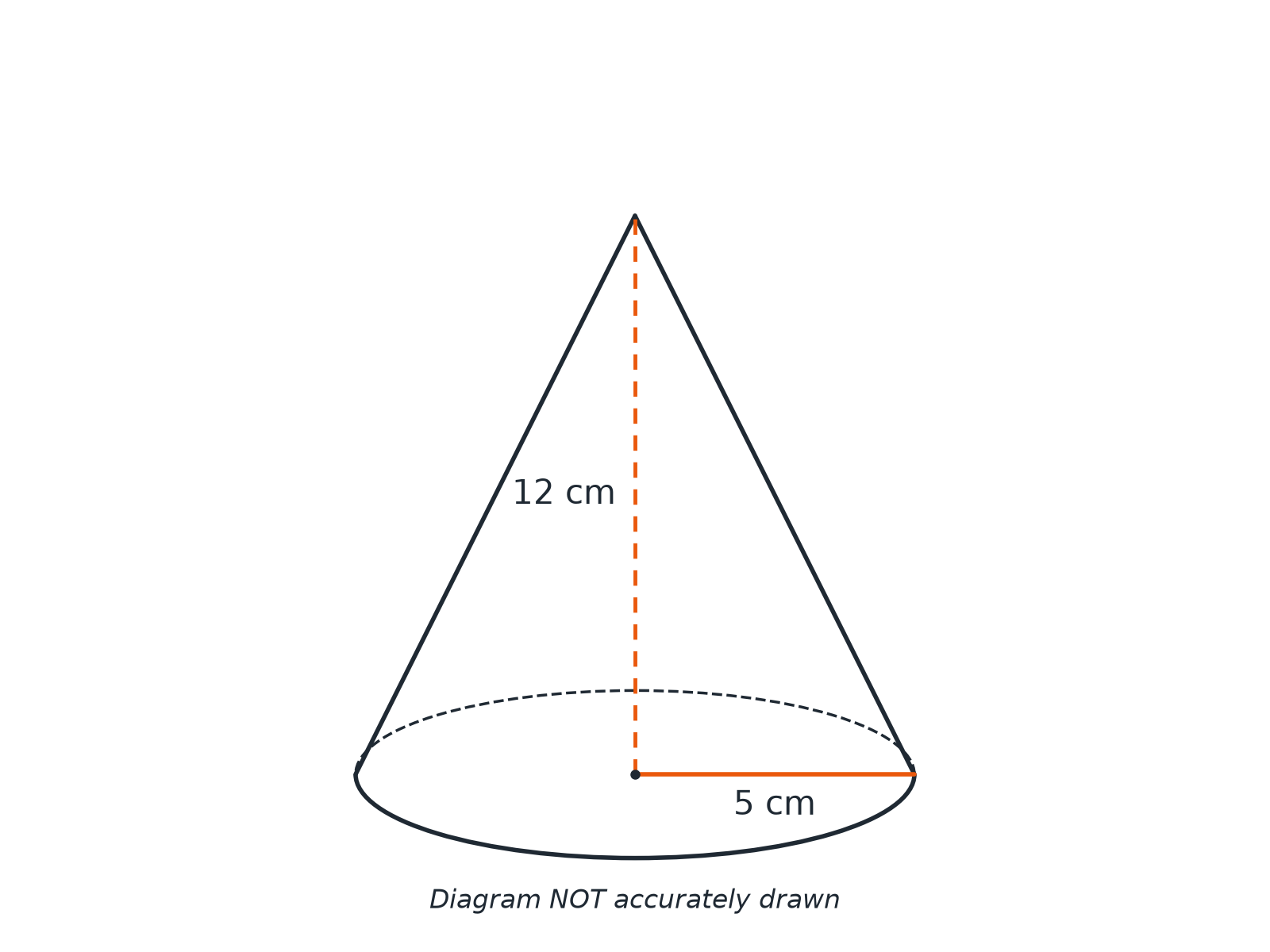
The diagram shows a cone with base radius 5 cm and vertical height 12 cm. Work out the curved surface area of the cone. Give your answer in terms of \(\pi\).
Mark scheme — 3 marks available
- \(5^2 + 12^2\) — M1
- Slant height 13 — A1
- \(65\pi\) — A1
Model answer
The slant height is \(\sqrt{5^2 + 12^2} = 13\) cm. The curved surface area is \(\pi \times 5 \times 13 = 65\pi\) cm².
Work out the volume of the cone in the last question. Give your answer correct to 3 significant figures.
Mark scheme — 2 marks available
- \(\dfrac{1}{3}\pi \times 5^2 \times 12\) — M1
- 314 — A1
Model answer
\(\dfrac{1}{3}\pi \times 5^2 \times 12 = 100\pi = 314\) cm³.
A cone has base radius 6 cm and height 12 cm. A smaller cone of base radius 3 cm and height 6 cm is cut off the top, leaving a frustum. Work out the volume of the frustum. Give your answer correct to 3 significant figures.
Mark scheme — 4 marks available
- Volume of the large cone — M1
- Volume of the small cone — M1
- Subtracting — M1
- 396 — A1
Model answer
Large cone: \(\dfrac{1}{3}\pi \times 6^2 \times 12 = 144\pi\). Small cone: \(\dfrac{1}{3}\pi \times 3^2 \times 6 = 18\pi\). Frustum: \(126\pi = 396\) cm³.
A pyramid has a rectangular base measuring 8 cm by 6 cm and a perpendicular height of 5 cm. Work out the volume of the pyramid.
Mark scheme — 2 marks available
- \(\dfrac{1}{3} \times 8 \times 6 \times 5\) — M1
- 80 — A1
Model answer
\(\dfrac{1}{3} \times 8 \times 6 \times 5 = 80\) cm³.
What fraction of a prism's volume is a pyramid with the same base and height?
Why: A pyramid has one third of the volume.
A cone has radius 3 cm and height 4 cm. What is the slant height?
Why: \(\sqrt{9 + 16} = 5\).
What is the volume of a cone with radius 3 cm and height 4 cm, in terms of \(\pi\)?
Why: \(\dfrac{1}{3}\pi \times 9 \times 4 = 12\pi\).
Which formula gives the curved surface area of a cone?
Why: Curved surface area is \(\pi r l\), where \(l\) is the slant height.
A square pyramid has base area 25 cm² and height 6 cm. What is its volume?
Why: \(\dfrac{1}{3} \times 25 \times 6 = 50\).
A frustum is made by cutting a small cone off a big cone. Its volume is...
Why: Volume of the big cone minus the volume of the small cone.