Viewing as
Teacher view: planning notes, the answers to every question, and the teacher copies of the files.
Maths · Probability
Combined events
List the outcomes of two events systematically, use sample space diagrams, and work out probabilities of combined events.
Teacher resources
The teacher copies: slides with the questions built in, the answers, and anything else attached to this lesson for whoever is teaching it.
- Combined events - Teacher Slides.pptx Teacher The lesson slides with the teacher's notes on each slide, and every question and mark scheme built in. Built from the lesson script on 30 September 2026. View
- Combined events - Teacher Notes.docx Teacher The complete notes with the teacher's notes and every model answer in full. Built from the lesson script on 30 September 2026. View
Student handouts
The same files the students see, to print or hand out.
- Combined events.pptx Built from the lesson script on 30 September 2026. View
- Combined events - Completed Notes.docx The full notes for the lesson, to revise from. Built from the lesson script on 30 September 2026. View
- Combined events - Exam Questions.docx Built from the lesson script on 30 September 2026. View
Warm-up
Answer each one, then check.
-
1
What is the probability of rolling a 3 on a fair dice?
Show answerHide answer
\(\dfrac{1}{6}\)
-
2
What is the probability of getting tails on a fair coin?
Show answerHide answer
\(\dfrac{1}{2}\)
-
3
Simplify \(\dfrac{6}{36}\).
Show answerHide answer
\(\dfrac{1}{6}\)
-
4
What do all the probabilities of an event add up to?
Show answerHide answer
1
-
5
If P(rain) = 0.3, what is P(not rain)?
Show answerHide answer
0.7
Learning Objectives
- 1Use the probability scale and the formula for equally likely outcomes.
- 2List the outcomes of two events systematically.
- 3Draw and use a sample space diagram.
- 4Work out probabilities of combined events.
THE FORMULA
For equally likely outcomes, probability is the number of successful outcomes divided by the total number of possible outcomes.
\(P(\text{event}) = \dfrac{\text{number of ways the event can happen}}{\text{total number of equally likely outcomes}}\)
Listing Outcomes
A fair coin is flipped and a fair dice is rolled. List all the possible outcomes, and find the probability of a head and a 6.
Show the solutionHide the solution
- 1 Write each coin outcome with each dice outcome H1, H2, H3, H4, H5, H6, T1, T2, T3, T4, T5, T6
- 2 Count the outcomes 12
- 3 Only one of these is a head with a 6 H6
AnswerThere are 12 outcomes, so \(P(\text{head and } 6) = \dfrac{1}{12}\).
A Sample Space Diagram
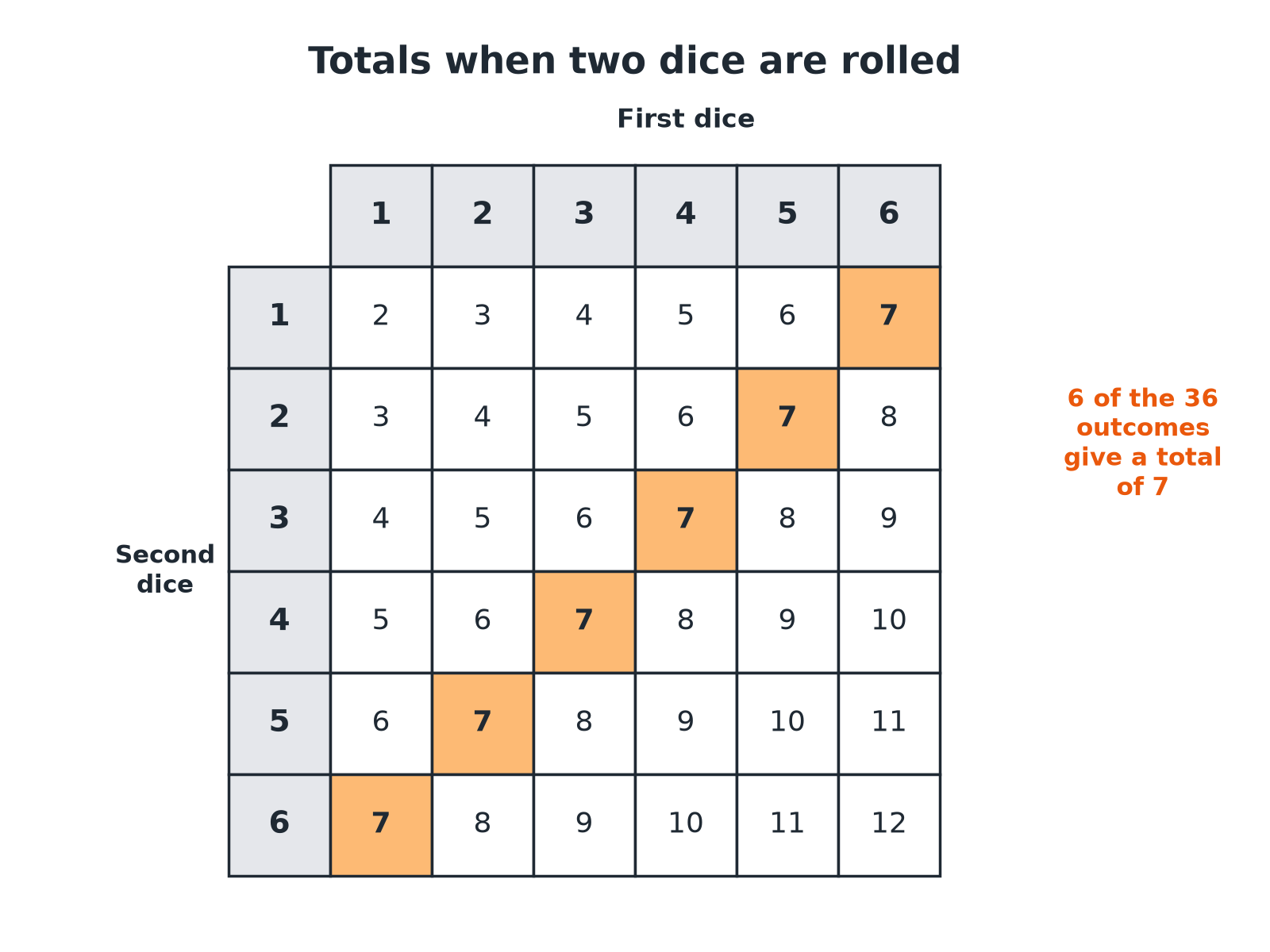
A sample space diagram shows every outcome, so nothing is missed.
Totals from Two Dice
Each cell is the sum of the two dice.
-
1
1: 2. 2: 3. 3: 4. 4: 5 | 6 | 7
-
2
1: 3. 2: 4. 3: 5. 4: 6 | 7 | 8
-
3
1: 4. 2: 5. 3: 6. 4: 7 | 8 | 9
-
4
1: 5. 2: 6. 3: 7. 4: 8 | 9 | 10
-
5
1: 6. 2: 7. 3: 8. 4: 9 | 10 | 11
-
6
1: 7. 2: 8. 3: 9. 4: 10 | 11 | 12
Using the Table
Two fair dice are rolled and the scores are added. Find (a) \(P(\text{total is } 7)\) and (b) \(P(\text{total is at least } 10)\).
Show the solutionHide the solution
- 1 (a) Count the 7s in the table 6 out of 36
- 2 (a) Simplify \(\dfrac{6}{36} = \dfrac{1}{6}\)
- 3 (b) Count the totals 10, 11 or 12 \(3 + 2 + 1 = 6\)
- 4 (b) Probability \(\dfrac{6}{36} = \dfrac{1}{6}\)
Answer(a) \(\dfrac{1}{6}\) (b) \(\dfrac{1}{6}\)
Two Spinners
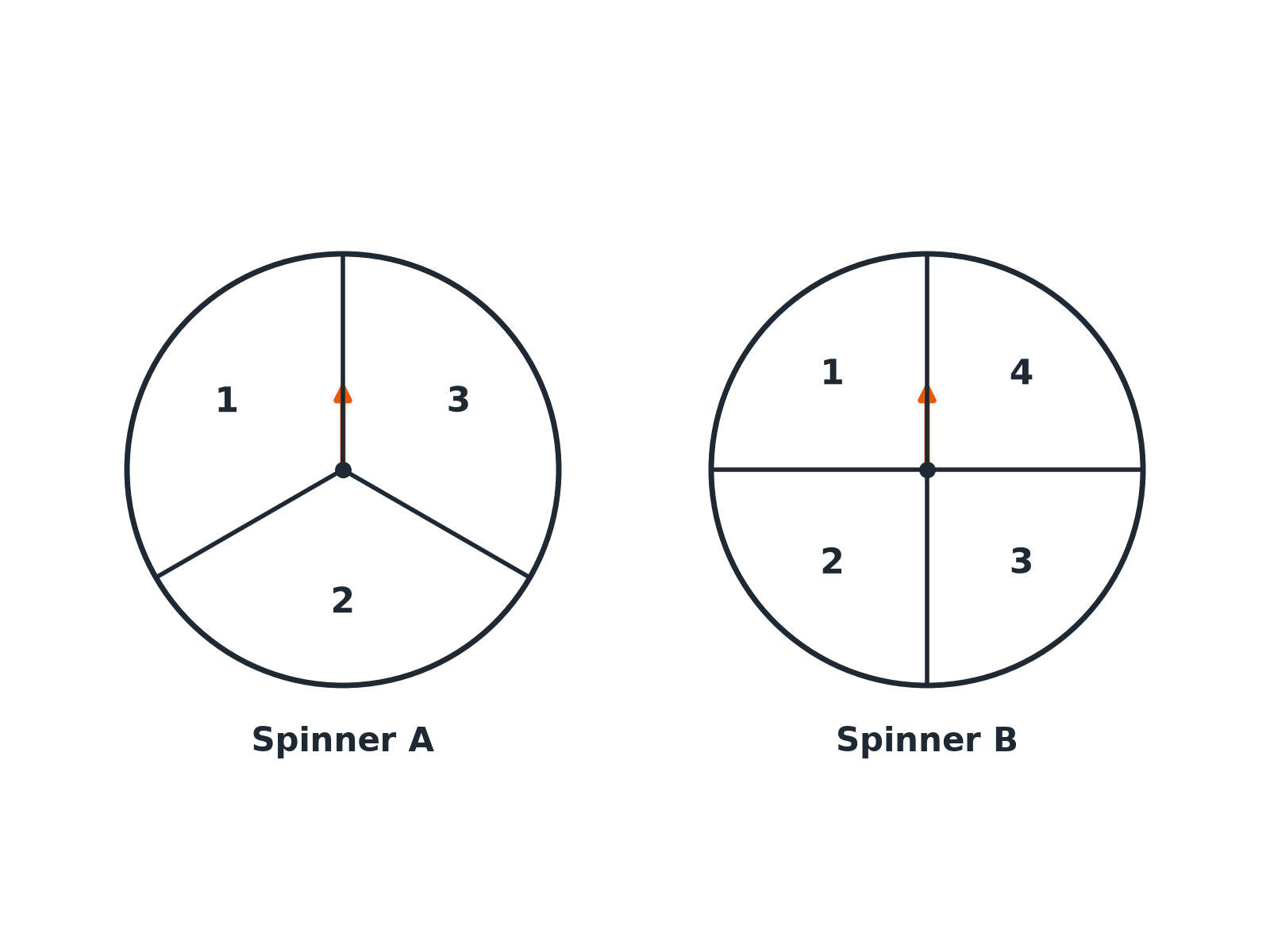
Spinner A has three equal sections numbered 1, 2, 3. Spinner B has four equal sections numbered 1, 2, 3, 4. Both are spun and the scores added. Find the probability that the total is 5, and that it is even.
Show the solutionHide the solution
- 1 Number of outcomes \(3 \times 4 = 12\)
- 2 Totals of 5 come from (1, 4), (2, 3), (3, 2)
- 3 \(P(\text{total is } 5)\) \(\dfrac{3}{12} = \dfrac{1}{4}\)
- 4 Even totals: both odd or both even (1,1), (1,3), (3,1), (3,3), (2,2), (2,4)
- 5 \(P(\text{even})\) \(\dfrac{6}{12} = \dfrac{1}{2}\)
Answer\(P(\text{total } 5) = \dfrac{1}{4}\) and \(P(\text{even}) = \dfrac{1}{2}\).
Systematic Listing
A system stops you missing outcomes or counting one twice.
-
Fix the first event
Write every second-event outcome beside it, then move to the next first-event outcome.
-
Use a table
Rows for one event, columns for the other.
-
Count
The total number of outcomes is the product of the number of outcomes of each event.
Two-Dice Game
In a game, two dice are rolled and the smaller number is subtracted from the larger (or 0 if they are equal). Complete a table of differences. Which difference is most likely, and what is its probability?
1. Fill in a 6 by 6 table.
2. Count each difference.
3. Divide by 36.
A good answer shows: The differences 0 to 5 occur 6, 10, 8, 6, 4 and 2 times out of 36. The most likely is 1, with probability \(\dfrac{10}{36} = \dfrac{5}{18}\).
Can I...?
- 1Write a probability as a fraction.
- 2List outcomes systematically.
- 3Draw a sample space diagram.
- 4Count successful outcomes.
- 5Work out probabilities from a table.
- 6Simplify probabilities.
- 7Use \(3 \times 4 = 12\) to count outcomes.
- 8Avoid double-counting.
Summary & Exam Focus
- Probability \(= \dfrac{\text{successful outcomes}}{\text{total outcomes}}\).
- Use a table or systematic list to find all outcomes.
- The total number of outcomes for two events is the product.
- Simplify your final fraction.
Exam focus
Two fair dice are rolled and their scores are added. Work out the probability that the total is 7. (3 marks) (3 marks)
Draw a 6 by 6 table. Count the 7s (there are 6) and divide by 36.
Key terms
The vocabulary this lesson expects you to use. Each one is linked from the first place it appears above.
- Outcome
- One possible result of an event.
- Event
- One or more outcomes.
- Equally likely
- Each outcome has the same chance.
- Sample space
- The set of all possible outcomes.
- Sample space diagram
- A table or list showing every outcome.
- Probability
- A number from 0 to 1 showing how likely an event is.
Questions and answers
12 questions set on this lesson, with the mark schemes and model answers open.
A fair coin is flipped and a fair dice is rolled. Write down the probability of getting a head and a 6.
Mark scheme — 2 marks available
- 12 outcomes — M1
- \(\dfrac{1}{12}\) — A1
Model answer
There are 12 equally likely outcomes and one of them is H6. The probability is \(\dfrac{1}{12}\).
Two fair dice are rolled and the scores are added. Work out the probability that the total is 7.
Mark scheme — 3 marks available
- 36 outcomes — M1
- 6 successful outcomes — M1
- \(\dfrac{1}{6}\) — A1
Model answer
There are 36 equally likely outcomes and 6 give a total of 7. The probability is \(\dfrac{6}{36} = \dfrac{1}{6}\).
Spinner A has three equal sections numbered 1, 2 and 3. Spinner B has four equal sections numbered 1, 2, 3 and 4. Both spinners are spun and the two scores are added. Work out the probability that the total is 5.
Mark scheme — 3 marks available
- 12 outcomes — M1
- Three ways to make 5 — M1
- \(\dfrac{1}{4}\) — A1
Model answer
There are \(3 \times 4 = 12\) outcomes. The totals of 5 are (1, 4), (2, 3) and (3, 2), so the probability is \(\dfrac{3}{12} = \dfrac{1}{4}\).
For the same two spinners, work out the probability that the total is even.
Mark scheme — 2 marks available
- 6 successful outcomes — M1
- \(\dfrac{1}{2}\) — A1
Model answer
The even totals come from (1,1), (1,3), (3,1), (3,3), (2,2) and (2,4): 6 of 12. The probability is \(\dfrac{1}{2}\).
Two fair dice are rolled and the scores are added. Work out the probability that the total is at least 10.
Mark scheme — 3 marks available
- 6 successful outcomes — M1
- \(\dfrac{6}{36}\) — M1
- \(\dfrac{1}{6}\) — A1
Model answer
Totals of 10, 11 and 12 occur \(3 + 2 + 1 = 6\) times out of 36. The probability is \(\dfrac{6}{36} = \dfrac{1}{6}\).
Two fair dice are rolled. Work out the probability of getting a double (the same number on both dice).
Mark scheme — 2 marks available
- 6 doubles — M1
- \(\dfrac{1}{6}\) — A1
Model answer
There are 6 doubles out of 36 outcomes, so the probability is \(\dfrac{6}{36} = \dfrac{1}{6}\).
A fair dice is rolled. What is the probability of an even number?
Why: 3 even numbers out of 6: \(\dfrac{3}{6} = \dfrac{1}{2}\).
How many outcomes are there when a coin is flipped and a dice is rolled?
Why: \(2 \times 6 = 12\).
How many outcomes are there when two dice are rolled?
Why: \(6 \times 6 = 36\).
Two fair dice are rolled. What is the probability of a total of 2?
Why: Only (1, 1): \(\dfrac{1}{36}\).
What is the best way to make sure no outcome is missed?
Why: Use a systematic list or a sample space table.
Two fair dice are rolled. Which total is most likely?
Why: 7 can be made 6 ways, more than any other total.