Viewing as
Teaching this? The teacher view adds 2 files, the mark schemes and the model answers.
Maths · Probability
Venn diagrams and set notation
Use set notation, draw and complete Venn diagrams, and use them to find probabilities, including conditional probabilities at Higher tier.
Warm-up
Answer each one, then check.
-
1
List the even numbers from 1 to 10.
Show answerHide answer
2, 4, 6, 8, 10
-
2
List the multiples of 3 from 1 to 10.
Show answerHide answer
3, 6, 9
-
3
What number is in both lists above?
Show answerHide answer
6
-
4
Work out \(40 - 29\).
Show answerHide answer
11
-
5
Simplify \(\dfrac{8}{16}\).
Show answerHide answer
\(\dfrac{1}{2}\)
Learning Objectives
- 1Use set notation: \(\in\), \(\cup\), \(\cap\), \(A'\), \(\xi\) and \(n(A)\).
- 2Draw and complete a Venn diagram.
- 3Shade the region for a set expression.
- 4Find probabilities from a Venn diagram, including conditional ones (Higher).
Set Notation
Learn these symbols.
-
\(\xi\)
Meaning: The universal set: everything being considered. Example: \(\xi = \{1, 2, ..., 10\}\)
-
\(A \cup B\)
Meaning: Union: in A or B or both. Example: \(\{2, 3, 4, 6, 8, 9, 10\}\)
-
\(A \cap B\)
Meaning: Intersection: in both A and B. Example: \(\{6\}\)
-
\(A'\)
Meaning: Complement: not in A. Example: \(\{1, 3, 5, 7, 9\}\)
-
\(n(A)\)
Meaning: The number of elements in A. Example: \(n(A) = 5\)
-
\(\in\)
Meaning: "is an element of". Example: \(4 \in A\)
Shading Set Regions
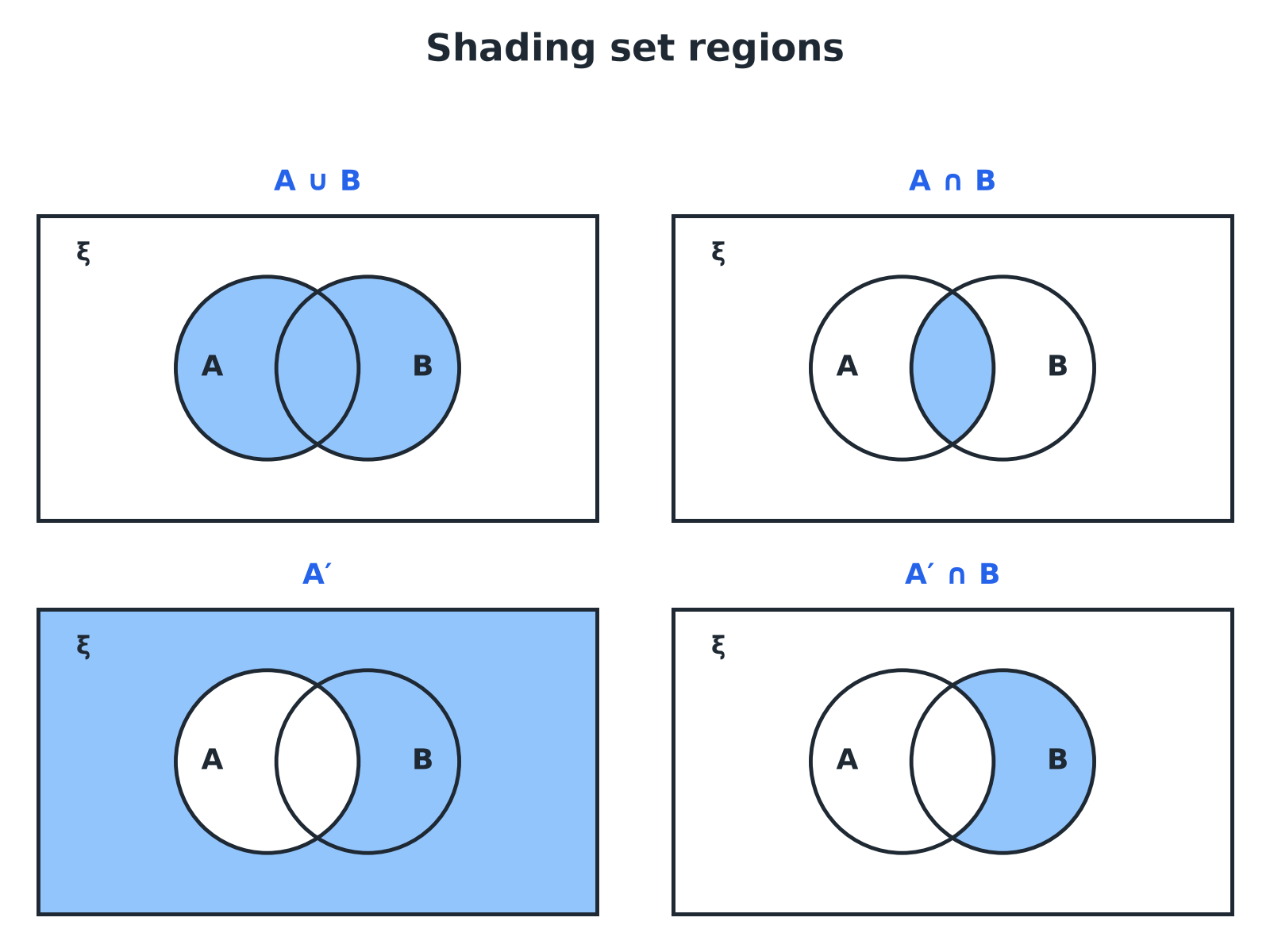
Shade the region that matches the notation.
Sets of Numbers
\(\xi = \{1, 2, 3, ..., 10\}\), \(A = \) the even numbers and \(B = \) the multiples of 3. List \(A\), \(B\), \(A \cap B\), \(A \cup B\) and \(A'\).
Show the solutionHide the solution
- 1 \(A\) \(\{2, 4, 6, 8, 10\}\)
- 2 \(B\) \(\{3, 6, 9\}\)
- 3 In both \(A \cap B = \{6\}\)
- 4 In either \(A \cup B = \{2, 3, 4, 6, 8, 9, 10\}\)
- 5 Not in A \(A' = \{1, 3, 5, 7, 9\}\)
AnswerSee the lists above; \(n(A \cup B) = 7\).
Completing a Venn Diagram
Start in the middle and work outwards.
-
1
Fill in the overlap first
The number in both sets
-
2
Work out the rest of each set
Subtract the overlap from each total
-
3
Fill the outside
Universal total minus everything inside the circles
-
4
Check
All the numbers add up to the universal total
A Survey
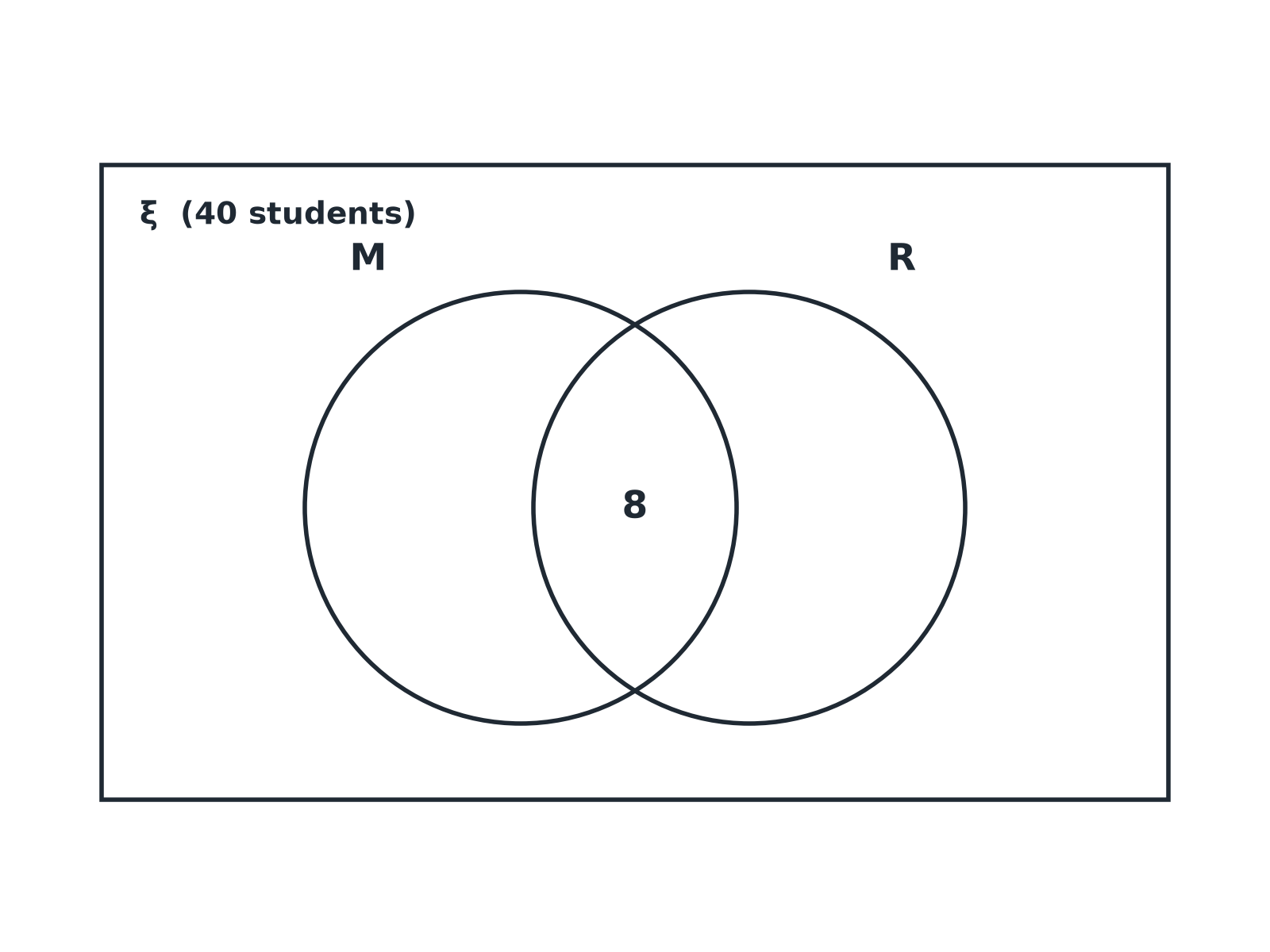
40 students were asked about music (M) and art (R). 22 take music, 15 take art and 8 take both. Complete the Venn diagram and find the number who take neither.
Show the solutionHide the solution
- 1 Both 8
- 2 Music only \(22 - 8 = 14\)
- 3 Art only \(15 - 8 = 7\)
- 4 Inside the circles \(14 + 8 + 7 = 29\)
- 5 Neither \(40 - 29 = 11\)
AnswerMusic only 14, both 8, art only 7, neither 11.
Probabilities from a Venn Diagram
For the survey, a student is chosen at random. Find (a) \(P(\text{neither})\), (b) \(P(M \cup R)\).
Show the solutionHide the solution
- 1 (a) Neither \(\dfrac{11}{40}\)
- 2 (b) Music or art (or both) \(14 + 8 + 7 = 29\), so \(\dfrac{29}{40}\)
Answer(a) \(\dfrac{11}{40}\) (b) \(\dfrac{29}{40}\)
Given That
For the survey, find \(P(M \mid R)\): the probability a student takes music, given that they take art.
Show the solutionHide the solution
- 1 "Given that they take art" restricts to the art circle 15 students
- 2 Of these, the number who also take music 8
- 3 Probability \(\dfrac{8}{15}\)
Answer\(\dfrac{8}{15}\)
Class Survey
In a class of 30 students, 18 have a dog, 12 have a cat and 5 have both. Draw a Venn diagram, and find the probability that a randomly chosen student has (a) a dog only (b) neither (c) a cat given that they have a dog.
1. Fill in the overlap first.
2. Subtract for the other regions.
3. Use the right total.
A good answer shows: Dog only \(18 - 5 = 13\), cat only \(12 - 5 = 7\), both 5, neither \(30 - 25 = 5\). (a) \(\dfrac{13}{30}\) (b) \(\dfrac{5}{30} = \dfrac{1}{6}\) (c) \(\dfrac{5}{18}\).
Can I...?
- 1Use the set notation symbols.
- 2List the elements of \(A \cap B\) and \(A \cup B\).
- 3Find \(A'\).
- 4Fill in a Venn diagram from totals.
- 5Shade the correct region.
- 6Find a probability from a Venn diagram.
- 7Find \(P(A \mid B)\) (Higher).
- 8Check the total.
Summary & Exam Focus
- \(A \cup B\): in A or B. \(A \cap B\): in both. \(A'\): not in A.
- Fill the overlap first, then each circle, then the outside.
- The numbers must add up to the universal total.
- Higher: \(P(A \mid B)\) uses B as the new total.
Exam focus
40 students were asked about music and art. 22 take music, 15 take art and 8 take both. Draw a Venn diagram to show this information. (4 marks) (4 marks)
Start with the overlap (8), then subtract it from each circle total. Finish with the number outside.
Key terms
The vocabulary this lesson expects you to use. Each one is linked from the first place it appears above.
- Set
- A collection of items.
- Element
- One item in a set.
- Universal set
- The set of everything being considered, \(\xi\).
- Union
- Items in one set or the other or both, \(\cup\).
- Intersection
- Items in both sets, \(\cap\).
- Complement
- Items not in the set, \(A'\).
Practice questions
Have a go at each one before you open its answer.
-
Question 1 Non-calculator 2 marks
\(\xi = \{1, 2, 3, 4, 5, 6, 7, 8, 9, 10\}\), \(A = \{\text{even numbers}\}\) and \(B = \{\text{multiples of } 3\}\). List the members of \(A \cap B\).
Show answerHide answer
Model answer
\(A \cap B = \{6\}\).
Mark scheme
- \(A = \{2, 4, 6, 8, 10\}\) and \(B = \{3, 6, 9\}\) — M1
- \(\{6\}\) — A1
-
Question 2 Non-calculator 2 marks
Using the same sets, list the members of \(A'\).
Show answerHide answer
Model answer
\(A' = \{1, 3, 5, 7, 9\}\).
Mark scheme
- Odd numbers seen — M1
- \(\{1, 3, 5, 7, 9\}\) — A1
-
Question 3 Non-calculator 4 marks
40 students were asked whether they take music (M) and art (R). 22 take music, 15 take art and 8 take both. Complete the Venn diagram.
Show answerHide answer
Model answer
M only 14, overlap 8, R only 7, outside the circles 11.
Mark scheme
- Overlap 8 — B1
- M only 14 — B1
- R only 7 — B1
- Outside 11 — B1
-
Question 4 Non-calculator 2 marks
One of the 40 students is chosen at random. Use your Venn diagram to work out the probability that the student takes neither music nor art.
Show answerHide answer
Model answer
\(\dfrac{11}{40}\).
Mark scheme
- 11 — M1
- \(\dfrac{11}{40}\) — A1
-
Question 5 Non-calculator 2 marks
Write down the number of students in \(M \cup R\).
Show answerHide answer
Model answer
\(14 + 8 + 7 = 29\).
Mark scheme
- Adding the three regions — M1
- 29 — A1
-
Question 6 Non-calculator 3 marks
One of the 40 students is chosen at random. Given that the student takes art, work out the probability that they also take music.
Show answerHide answer
Model answer
15 students take art, and 8 of these also take music. The probability is \(\dfrac{8}{15}\).
Mark scheme
- 15 as the total — M1
- \(\dfrac{8}{15}\) — A1
- A correct conclusion — C1
Quick check
-
What does \(A \cap B\) mean?
Show answerHide answer
C: In both A and B
The intersection: in both A and B.
-
What does \(A'\) mean?
Show answerHide answer
B: Not in A
The complement: everything in \(\xi\) that is not in A.
-
\(\xi = \{1, 2, 3, 4, 5\}\) and \(A = \{1, 2\}\). What is \(A'\)?
Show answerHide answer
D: \(\{3, 4, 5\}\)
The elements of \(\xi\) not in A: \(\{3, 4, 5\}\).
-
In a Venn diagram with total 30, 12 are in A only, 5 in both and 7 in B only. How many are in neither?
Show answerHide answer
A: 6
\(30 - (12 + 5 + 7) = 6\).
-
What does \(n(A)\) stand for?
Show answerHide answer
B: The number of elements in A
The number of elements in set A.
-
\(P(A \mid B)\) is read as...
Show answerHide answer
C: The probability of A given B
The probability of A given that B has happened.
Downloads
Free to keep, print and annotate.
- Venn diagrams and set notation.pptx Built from the lesson script on 30 September 2026. View
- Venn diagrams and set notation - Completed Notes.docx The full notes for the lesson, to revise from. Built from the lesson script on 30 September 2026. View
- Venn diagrams and set notation - Exam Questions.docx Built from the lesson script on 30 September 2026. View
Something here looks wrong?
Tell us what and we will go and look. It goes to whoever writes these pages, nobody else, and we do not ask who you are — so there is nothing to sign and nothing comes back to you.