Viewing as
Teacher view: planning notes, the answers to every question, and the teacher copies of the files.
Maths · Transformations and constructions
Translations and combinations of different transformations
Translate shapes using column vectors, describe translations, and combine transformations to find a single equivalent transformation.
Teacher resources
The teacher copies: slides with the questions built in, the answers, and anything else attached to this lesson for whoever is teaching it.
- Translations and combinations of different transformations - Teacher Slides.pptx Teacher The lesson slides with the teacher's notes on each slide, and every question and mark scheme built in. Built from the lesson script on 30 September 2026. View
- Translations and combinations of different transformations - Teacher Notes.docx Teacher The complete notes with the teacher's notes and every model answer in full. Built from the lesson script on 30 September 2026. View
Student handouts
The same files the students see, to print or hand out.
- Translations and combinations of different transformations.pptx Built from the lesson script on 30 September 2026. View
- Translations and combinations of different transformations - Completed Notes.docx The full notes for the lesson, to revise from. Built from the lesson script on 30 September 2026. View
- Translations and combinations of different transformations - Exam Questions.docx Built from the lesson script on 30 September 2026. View
Warm-up
Answer each one, then check.
-
1
What is the reflection of \((3, 1)\) in the y-axis?
Show answerHide answer
\((-3, 1)\)
-
2
What is the image of \((2, 3)\) under a \(180^\circ\) rotation about the origin?
Show answerHide answer
\((-2, -3)\)
-
3
What does congruent mean?
Show answerHide answer
Same shape and size
-
4
Work out \((5, 2) + (3, -4)\) as coordinates.
Show answerHide answer
\((8, -2)\)
-
5
What is a scale factor?
Show answerHide answer
The number lengths are multiplied by
Learning Objectives
- 1Translate a shape using a column vector.
- 2Describe a translation with a vector.
- 3Carry out and describe combinations of transformations.
- 4Find the single transformation equivalent to a combination.
THE KEY IDEA
A translation slides every point of a shape the same distance in the same direction.
It is described by a column vector: the top number is the move right (negative means left), the bottom number is the move up (negative means down).
A Translation
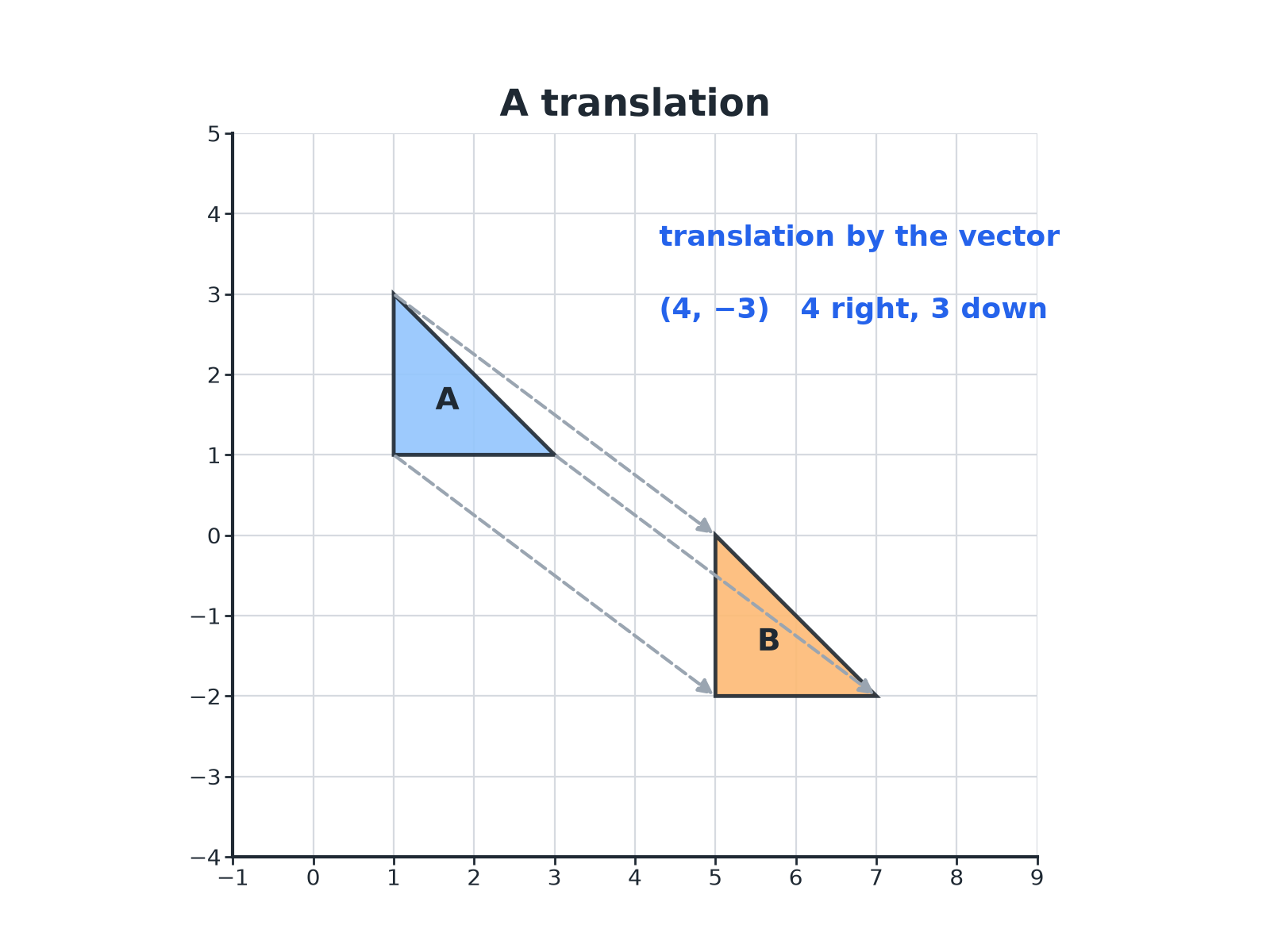
Every point moves the same way.
Translating a Shape
Triangle A has vertices \((1, 1)\), \((1, 3)\) and \((3, 1)\). Translate it by the vector \(\begin{pmatrix} 4 \\ -3 \end{pmatrix}\).
Show the solutionHide the solution
- 1 Add 4 to each x-coordinate (move right) \(1 + 4 = 5\)
- 2 Subtract 3 from each y-coordinate (move down) \(1 - 3 = -2\)
- 3 Apply it to every vertex \((1, 1) \to (5, -2)\), \((1, 3) \to (5, 0)\), \((3, 1) \to (7, -2)\)
AnswerThe image has vertices \((5, -2)\), \((5, 0)\) and \((7, -2)\).
Describing a Translation
Point P is at \((2, 5)\) and its image is at \((-1, 2)\). Describe the translation.
Show the solutionHide the solution
- 1 Change in x \(-1 - 2 = -3\): 3 to the left
- 2 Change in y \(2 - 5 = -3\): 3 down
- 3 Write as a vector \(\begin{pmatrix} -3 \\ -3 \end{pmatrix}\)
AnswerA translation by the vector \(\begin{pmatrix} -3 \\ -3 \end{pmatrix}\).
A Combination of Two Transformations
Apply the first, then the second to the image.
-
Do them in order
The order can change the answer, so work through the steps carefully.
-
Label each image
Name the shapes A, B and C to keep track.
-
Find the single equivalent
Look for the one transformation that takes the original straight to the final image.
Useful Combinations
-
Two reflections in parallel lines
Equivalent to a translation.
-
Two reflections in lines that cross
Equivalent to a rotation about the crossing point.
-
Two rotations about the same centre
Equivalent to one rotation about that centre.
-
Two translations
Equivalent to one translation: add the vectors.
Describing a Combination
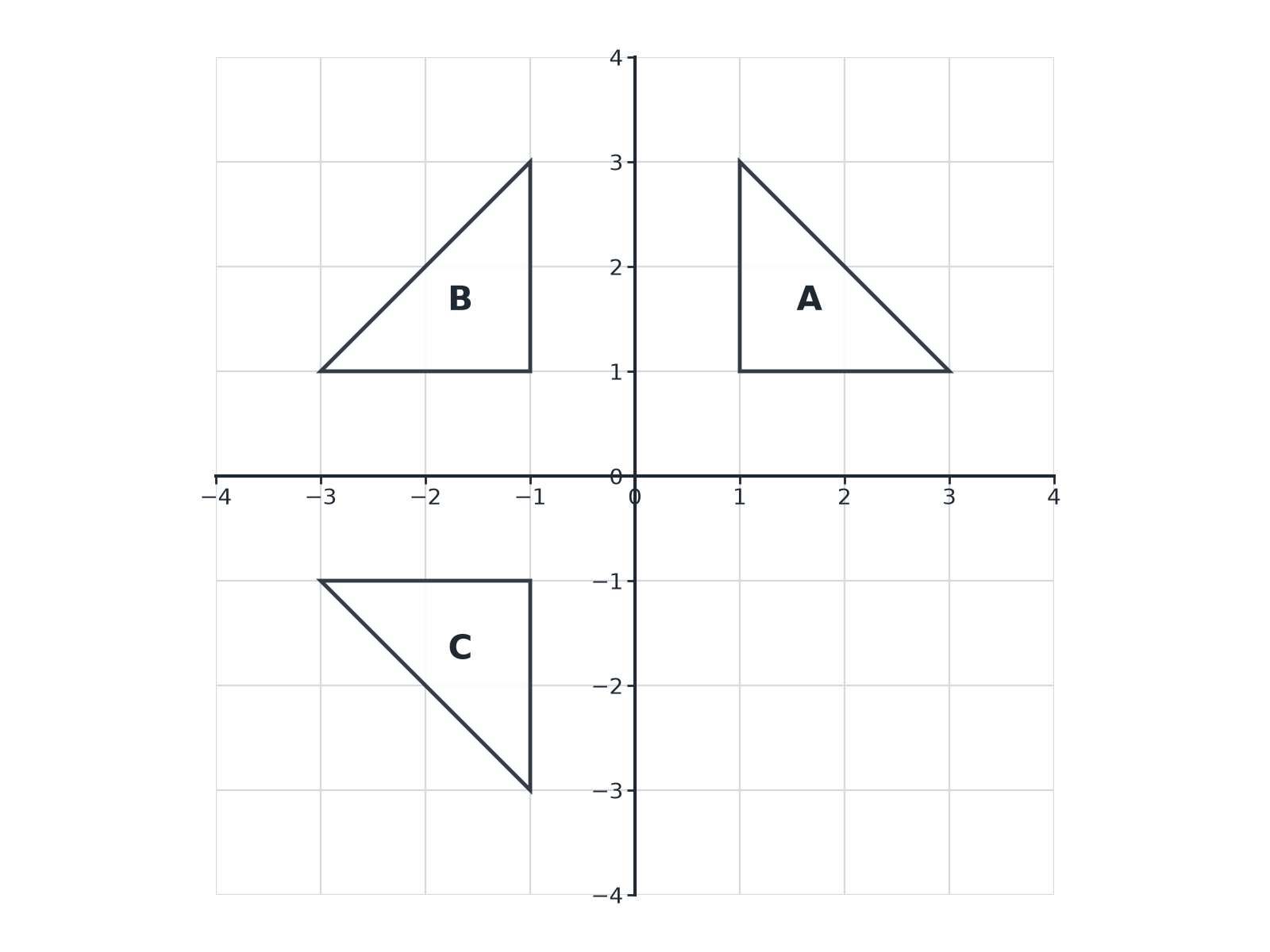
Triangle A has vertices \((1, 1)\), \((1, 3)\), \((3, 1)\). Triangle B is A reflected in the y-axis. Triangle C is B reflected in the x-axis. Describe the single transformation that maps A onto C.
Show the solutionHide the solution
- 1 B has vertices \((-1, 1)\), \((-1, 3)\), \((-3, 1)\)
- 2 C is B reflected in the x-axis \((-1, -1)\), \((-1, -3)\), \((-3, -1)\)
- 3 Compare A and C Every coordinate has changed sign
- 4 Identify A half turn about the origin
AnswerA rotation of \(180^\circ\) about \((0, 0)\).
Slide and Flip
Shape A has vertices \((1, 1)\), \((3, 1)\), \((1, 2)\). Translate A by \(\begin{pmatrix} 2 \\ 3 \end{pmatrix}\) to get B, then reflect B in the y-axis to get C. Write the vertices of B and C, and describe fully the single transformation that maps B onto C.
1. Do the translation first.
2. Reflect the image.
3. Compare with the original.
A good answer shows: B has vertices \((3, 4)\), \((5, 4)\), \((3, 5)\). C has vertices \((-3, 4)\), \((-5, 4)\), \((-3, 5)\). B maps onto C by a reflection in the y-axis (the line \(x = 0\)).
Can I...?
- 1Translate using a column vector.
- 2Describe a translation with a vector.
- 3Add vectors for two translations.
- 4Do a combination in the right order.
- 5Label images clearly.
- 6Find a single equivalent transformation.
- 7Identify invariant points.
- 8Describe every transformation fully.
Summary & Exam Focus
- Translation vector: right/left on top, up/down underneath.
- Two translations add.
- Work through combinations one step at a time.
- Always describe fully: name plus details.
Exam focus
Triangle B is the reflection of triangle A in the y-axis. Triangle C is the reflection of triangle B in the x-axis. Describe fully the single transformation that maps triangle A onto triangle C. (3 marks) (3 marks)
Find the coordinates of A and C and compare them. Every sign changing points to a half turn about the origin.
Key terms
The vocabulary this lesson expects you to use. Each one is linked from the first place it appears above.
- Translation
- A slide of every point by the same vector.
- Column vector
- A pair of numbers, one above the other, giving a move right and up.
- Combination
- Two or more transformations done one after the other.
- Single transformation
- One transformation that does the same job as a combination.
- Invariant point
- A point that does not move under a transformation.
- Image
- The shape after a transformation.
Questions and answers
12 questions set on this lesson, with the mark schemes and model answers open.
Triangle A has vertices \((1, 1)\), \((1, 3)\) and \((3, 1)\). It is translated by the vector \(\begin{pmatrix} 4 \\ -3 \end{pmatrix}\). Write down the coordinates of the vertices of the image.
Mark scheme — 2 marks available
- Two vertices correct — B1
- All three correct — B1
Model answer
\((5, -2)\), \((5, 0)\) and \((7, -2)\).
The point \(P(2, 5)\) is mapped to \(P'(-1, 2)\) by a translation. Write the translation as a column vector.
Mark scheme — 2 marks available
- One number correct — M1
- Both correct — A1
Model answer
\(\begin{pmatrix} -3 \\ -3 \end{pmatrix}\).
The diagram shows triangles A, B and C. (a) Describe fully the single transformation that maps A onto B. (b) Describe fully the single transformation that maps B onto C.
Mark scheme — 4 marks available
- (a) Reflection — B1
- (a) The y-axis, or \(x = 0\) — B1
- (b) Reflection — B1
- (b) The x-axis, or \(y = 0\) — B1
Model answer
(a) A reflection in the y-axis (the line \(x = 0\)). (b) A reflection in the x-axis (the line \(y = 0\)).
Using the diagram in the last question, describe fully the single transformation that maps triangle A onto triangle C.
Mark scheme — 3 marks available
- Rotation — B1
- \(180^\circ\) — B1
- Centre \((0, 0)\) — B1
Model answer
A rotation of \(180^\circ\) about the origin \((0, 0)\).
A shape is translated by \(\begin{pmatrix} 3 \\ 2 \end{pmatrix}\) and then by \(\begin{pmatrix} -5 \\ 4 \end{pmatrix}\). Write down the single translation that does the same job.
Mark scheme — 2 marks available
- Adding the vectors — M1
- \(\begin{pmatrix} -2 \\ 6 \end{pmatrix}\) — A1
Model answer
Add the vectors: \(\begin{pmatrix} 3 + (-5) \\ 2 + 4 \end{pmatrix} = \begin{pmatrix} -2 \\ 6 \end{pmatrix}\).
The shape P is reflected in the line \(x = 1\) and then the image is reflected in the line \(x = 4\). Describe fully the single transformation that is equivalent to these two reflections.
Mark scheme — 3 marks available
- Translation — B1
- Distance 6 (twice the gap between the lines) — M1
- \(\begin{pmatrix} 6 \\ 0 \end{pmatrix}\) — A1
Model answer
A translation by \(\begin{pmatrix} 6 \\ 0 \end{pmatrix}\): twice the distance between the mirror lines (\(2 \times 3 = 6\)) to the right.
A translation by \(\begin{pmatrix} 3 \\ -2 \end{pmatrix}\) moves a point...
Why: 3 to the right and 2 down.
What is the image of \((1, 4)\) under the translation \(\begin{pmatrix} 2 \\ 1 \end{pmatrix}\)?
Why: \((1 + 2, 4 + 1) = (3, 5)\).
Which transformation changes the size of a shape?
Why: Only an enlargement changes size.
Two translations \(\begin{pmatrix} 1 \\ 2 \end{pmatrix}\) and \(\begin{pmatrix} 3 \\ -4 \end{pmatrix}\) equal one translation of...
Why: Add the vectors: \(\begin{pmatrix} 4 \\ -2 \end{pmatrix}\).
An invariant point under a transformation is a point that...
Why: It stays in the same place.
Reflecting in the y-axis and then the x-axis is equivalent to...
Why: A half turn about the origin.