Viewing as
Teacher view: planning notes, the answers to every question, and the teacher copies of the files.
Maths · More trigonometry
Graph of the sine function
Sketch and read the graph of \(y = \sin x\), use its symmetry to find all solutions to \(\sin x = k\) between \(0^\circ\) and \(360^\circ\), and know key values.
Teacher resources
The teacher copies: slides with the questions built in, the answers, and anything else attached to this lesson for whoever is teaching it.
- Graph of the sine function - Teacher Slides.pptx Teacher The lesson slides with the teacher's notes on each slide, and every question and mark scheme built in. Built from the lesson script on 30 September 2026. View
- Graph of the sine function - Teacher Notes.docx Teacher The complete notes with the teacher's notes and every model answer in full. Built from the lesson script on 30 September 2026. View
Student handouts
The same files the students see, to print or hand out.
- Graph of the sine function.pptx Built from the lesson script on 30 September 2026. View
- Graph of the sine function - Completed Notes.docx The full notes for the lesson, to revise from. Built from the lesson script on 30 September 2026. View
- Graph of the sine function - Exam Questions.docx Built from the lesson script on 30 September 2026. View
Warm-up
Answer each one, then check.
-
1
What is \(\sin 30^\circ\)?
Show answerHide answer
\(0.5\)
-
2
What is \(\sin 90^\circ\)?
Show answerHide answer
\(1\)
-
3
What is the largest value \(\sin x\) can take?
Show answerHide answer
\(1\)
-
4
What does SOH mean?
Show answerHide answer
\(\sin = \text{opposite} \div \text{hypotenuse}\)
-
5
Which mode must a calculator be in for degrees?
Show answerHide answer
DEG
Learning Objectives
- 1Sketch the graph of \(y = \sin x\) for \(0^\circ \le x \le 360^\circ\).
- 2Recall key values of sine.
- 3Use symmetry to find a second solution of \(\sin x = k\).
- 4Read solutions from the graph.
SINE GRAPH
The graph of \(y = \sin x\) is a smooth wave that repeats every \(360^\circ\).
It starts at 0, rises to 1 at \(90^\circ\), returns to 0 at \(180^\circ\), falls to \(-1\) at \(270^\circ\) and returns to 0 at \(360^\circ\).
The Sine Graph
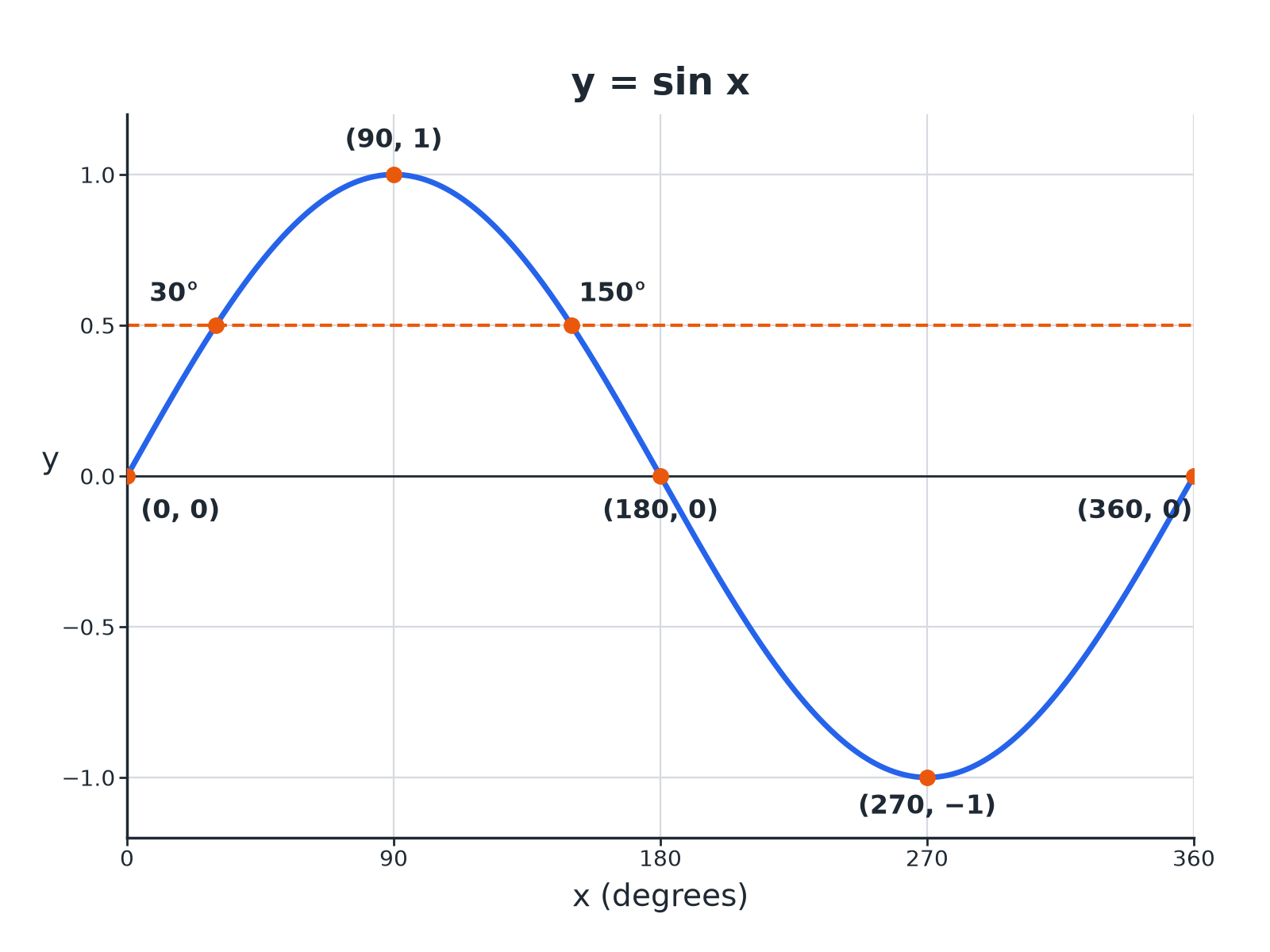
Sine x equals 0.5 has two solutions: 30 degrees and 150 degrees.
Key Values of Sine
These are worth learning.
-
\(\sin x\)
\(0^\circ\): \(0\). \(30^\circ\): \(0.5\). \(90^\circ\): \(1\). \(150^\circ\): \(0.5\) | \(0\) | \(-1\) | \(0\)
Features of the Graph
-
Period
Repeats every \(360^\circ\).
-
Maximum
\(1\) at \(x = 90^\circ\).
-
Minimum
\(-1\) at \(x = 270^\circ\).
-
Roots
\(x = 0^\circ,\ 180^\circ,\ 360^\circ\).
-
Symmetry
Symmetrical about \(x = 90^\circ\) and \(x = 270^\circ\).
Finding Two Solutions
Use symmetry about \(x = 90^\circ\).
-
1
Use the calculator
Find \(x = \sin^{-1}(k)\); this is the first solution
-
2
Reflect about 90
Second solution \(= 180^\circ - x\)
-
3
Check the range
Both must be between \(0^\circ\) and \(360^\circ\)
-
4
Negative values
If \(k < 0\), the solutions are between \(180^\circ\) and \(360^\circ\)
Solving sin x = 0.5
Solve \(\sin x = 0.5\) for \(0^\circ \le x \le 360^\circ\).
Show the solutionHide the solution
- 1 Calculator \(x = \sin^{-1}(0.5) = 30^\circ\)
- 2 Reflect \(x = 180^\circ - 30^\circ = 150^\circ\)
Answer\(x = 30^\circ\) and \(x = 150^\circ\)
Solving a Negative Value
Solve \(\sin x = -0.5\) for \(0^\circ \le x \le 360^\circ\).
Show the solutionHide the solution
- 1 Calculator gives \(\sin^{-1}(-0.5) = -30^\circ\), so use the positive \(30^\circ\) as a reference
- 2 Below the axis Solutions are \(180^\circ + 30^\circ\) and \(360^\circ - 30^\circ\)
- 3 Values \(210^\circ\) and \(330^\circ\)
Answer\(x = 210^\circ\) and \(x = 330^\circ\)
Sketch and Solve
(a) Sketch \(y = \sin x\) for \(0^\circ\) to \(360^\circ\). (b) Mark \(y = 0.8\) and read the two solutions from your sketch. (c) Calculate them: \(\sin^{-1}(0.8) = 53.1^\circ\).
1. Draw the axes with \(90^\circ\) marks.
2. Use symmetry about \(90^\circ\).
A good answer shows: (b) About \(53^\circ\) and \(127^\circ\). (c) \(x = 53.1^\circ\) and \(180^\circ - 53.1^\circ = 126.9^\circ\).
Can I...?
Summary & Exam Focus
- Sine repeats every \(360^\circ\), max 1, min \(-1\).
- \(\sin x = k\) has two solutions in \(0^\circ\) to \(360^\circ\) for \(-1 < k < 1\).
- Positive \(k\): \(x\) and \(180^\circ - x\).
- Negative \(k\): angles in the second half.
Exam focus
Solve \(\sin x = 0.6\) for \(0^\circ \le x \le 360^\circ\). Give answers correct to 1 decimal place. (3 marks) (3 marks)
Second solution is \(180^\circ - x\). Check both are in range.
Key terms
The vocabulary this lesson expects you to use. Each one is linked from the first place it appears above.
- Period
- The length after which the graph repeats.
- Amplitude
- The height from the middle line to the maximum.
- Maximum
- The highest value on the graph.
- Minimum
- The lowest value on the graph.
- Inverse sine
- \(\sin^{-1}\), the calculator function that finds an angle.
- Symmetry
- The graph looks the same on both sides of a line.
Questions and answers
12 questions set on this lesson, with the mark schemes and model answers open.
Solve \(\sin x = 0.6\) for \(0^\circ \le x \le 360^\circ\). Give your answers correct to 1 decimal place.
Mark scheme — 3 marks available
- \(\sin^{-1}(0.6) = 36.9^\circ\) — B1
- \(180 - 36.9\) — M1
- 143.1 — A1
Model answer
\(x = 36.9^\circ\) and \(x = 143.1^\circ\)
Write down the value of (a) \(\sin 90^\circ\) (b) \(\sin 270^\circ\)
Mark scheme — 2 marks available
- 1 — B1
- \(-1\) — B1
Model answer
(a) 1 (b) \(-1\)
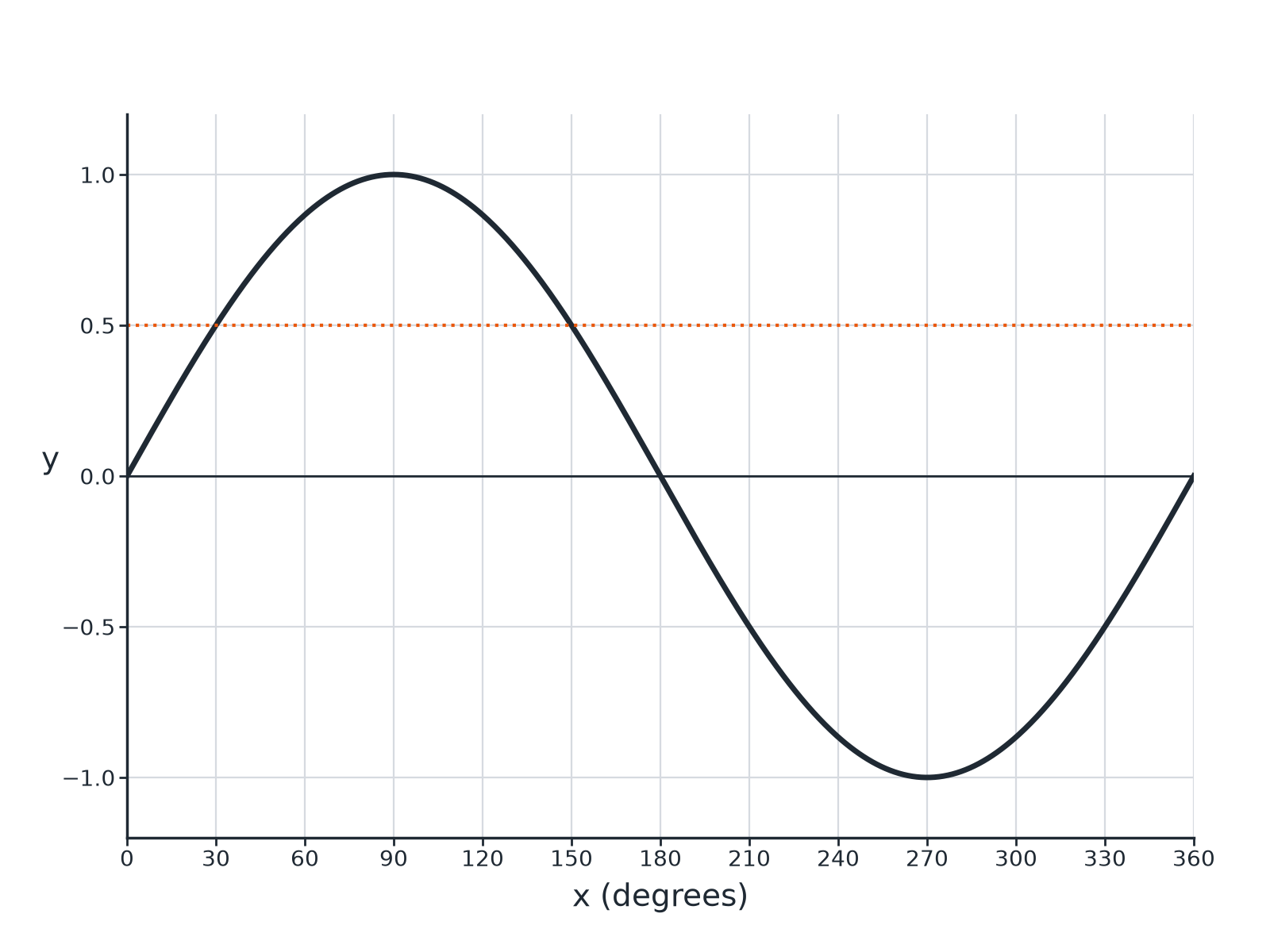
The graph shows \(y = \sin x\) for \(0^\circ \le x \le 360^\circ\). Use the graph to solve \(\sin x = 0.5\) and to write down the maximum value of \(\sin x\).
Mark scheme — 3 marks available
- 30 — B1
- 150 — B1
- 1 — B1
Model answer
\(x = 30^\circ\) and \(x = 150^\circ\); maximum value \(1\).
Solve \(\sin x = -0.3\) for \(0^\circ \le x \le 360^\circ\). Give your answers correct to 1 decimal place.
Mark scheme — 3 marks available
- Reference angle \(17.5^\circ\) — B1
- \(180 + 17.5\) or \(360 - 17.5\) — M1
- Both answers — A1
Model answer
\(x = 197.5^\circ\) and \(x = 342.5^\circ\)
Amir says that \(\sin x = 1.4\) has a solution. Explain why he is wrong.
Mark scheme — 2 marks available
- Maximum of sine is 1 — M1
- Conclusion — C1
Model answer
The sine graph never goes above 1 or below \(-1\), so there is no angle with sine 1.4.
\(\sin 40^\circ = 0.64\) (to 2 decimal places). Write down another angle between \(0^\circ\) and \(360^\circ\) with sine 0.64.
Mark scheme — 2 marks available
- \(180 - 40\) — M1
- 140 — A1
Model answer
\(140^\circ\)
What is the maximum value of \(\sin x\)?
Why: The graph rises to 1 at 90 degrees.
\(\sin 30^\circ = 0.5\). Another solution between 0 and 360 is...
Why: \(180 - 30 = 150\).
The period of \(y = \sin x\) is...
Why: The wave repeats every 360 degrees.
\(\sin x = -1\) at \(x =\)...
Why: The minimum of sine is at 270 degrees.
How many solutions does \(\sin x = 0.2\) have for \(0 \le x \le 360\)?
Why: Two: one on each side of 90 degrees.
\(\sin x = -0.4\) has solutions in which range?
Why: Negative sine values occur between 180 and 360 degrees.