Viewing as
Teacher view: planning notes, the answers to every question, and the teacher copies of the files.
Maths · Multiplicative reasoning
Ratio and proportion
Solve direct and inverse proportion problems, use the constant of proportionality, and write and use proportionality equations, including squares and roots at Higher tier.
Teacher resources
The teacher copies: slides with the questions built in, the answers, and anything else attached to this lesson for whoever is teaching it.
- Ratio and proportion - Teacher Slides.pptx Teacher The lesson slides with the teacher's notes on each slide, and every question and mark scheme built in. Built from the lesson script on 30 September 2026. View
- Ratio and proportion - Teacher Notes.docx Teacher The complete notes with the teacher's notes and every model answer in full. Built from the lesson script on 30 September 2026. View
Student handouts
The same files the students see, to print or hand out.
- Ratio and proportion.pptx Built from the lesson script on 30 September 2026. View
- Ratio and proportion - Completed Notes.docx The full notes for the lesson, to revise from. Built from the lesson script on 30 September 2026. View
- Ratio and proportion - Exam Questions.docx Built from the lesson script on 30 September 2026. View
Warm-up
Answer each one, then check.
-
1
4 pens cost £3.20. How much does 1 pen cost?
Show answerHide answer
£0.80
-
2
If \(y = 3x\) and \(x = 5\), what is \(y\)?
Show answerHide answer
15
-
3
Solve \(12 = \dfrac{k}{4}\).
Show answerHide answer
\(k = 48\)
-
4
Work out \(48 \div 6\).
Show answerHide answer
8
-
5
What does "directly proportional" mean?
Show answerHide answer
Both increase in the same ratio
Learning Objectives
- 1Solve direct proportion problems with \(y = kx\).
- 2Solve inverse proportion problems with \(y = \dfrac{k}{x}\).
- 3Recognise proportion from a table or graph.
- 4Use \(y \propto x^2\), \(y \propto x^3\) and \(y \propto \sqrt{x}\) (Higher).
Proportion Graphs
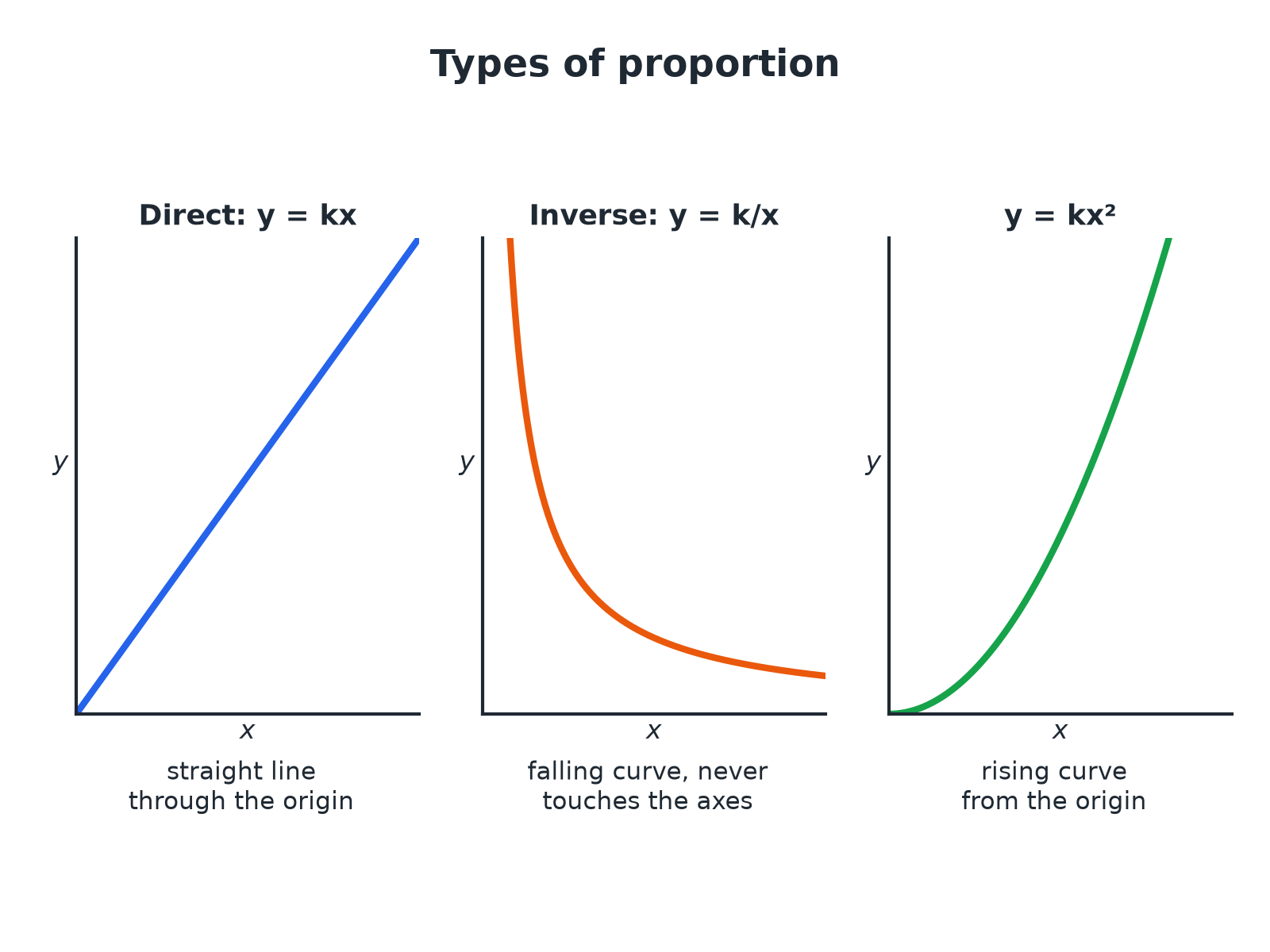
The shape of the graph tells you the type of proportion.
Direct and Inverse Proportion
Direct proportion
- As x increases, y increases in the same ratio.
- \(y = kx\), so \(\dfrac{y}{x}\) is constant.
- The graph is a straight line through the origin.
Inverse proportion
- As x increases, y decreases in the opposite ratio.
- \(y = \dfrac{k}{x}\), so \(xy\) is constant.
- The graph is a curve that never touches the axes.
Direct Proportion
\(y\) is directly proportional to \(x\). When \(x = 7\), \(y = 21\). Find \(y\) when \(x = 10\).
Show the solutionHide the solution
- 1 Write \(y = kx\) \(21 = k \times 7\)
- 2 Find k \(k = 3\)
- 3 Substitute \(x = 10\) \(y = 3 \times 10\)
Answer\(y = 30\)
Inverse Proportion
\(y\) is inversely proportional to \(x\). When \(x = 4\), \(y = 12\). Find \(y\) when \(x = 6\).
Show the solutionHide the solution
- 1 Write \(y = \dfrac{k}{x}\) \(12 = \dfrac{k}{4}\)
- 2 Find k \(k = 48\)
- 3 Substitute \(x = 6\) \(y = \dfrac{48}{6}\)
Answer\(y = 8\)
A Worker Problem
5 workers take 12 days to build a wall. How long would 8 workers take, working at the same rate?
Show the solutionHide the solution
- 1 More workers means fewer days: inverse proportion Workers \(\times\) days is constant
- 2 Constant \(5 \times 12 = 60\)
- 3 Days for 8 workers \(60 \div 8\)
Answer7.5 days
Proportional to a Square
\(y\) is directly proportional to \(x^2\). When \(x = 2\), \(y = 20\). Find \(y\) when \(x = 3\).
Show the solutionHide the solution
- 1 Write \(y = kx^2\) \(20 = k \times 4\)
- 2 Find k \(k = 5\)
- 3 Substitute \(x = 3\) \(y = 5 \times 9\)
Answer\(y = 45\)
Proportional to a Square Root
\(y\) is directly proportional to \(\sqrt{x}\). When \(x = 4\), \(y = 6\). Find \(y\) when \(x = 25\).
Show the solutionHide the solution
- 1 Write \(y = k\sqrt{x}\) \(6 = k \times 2\)
- 2 Find k \(k = 3\)
- 3 Substitute \(x = 25\) \(y = 3 \times 5\)
Answer\(y = 15\)
Types of Proportion
Learn the equation for each phrase.
-
\(y\) is proportional to \(x\)
Equation: \(y = kx\)
-
\(y\) is inversely proportional to \(x\)
Equation: \(y = \dfrac{k}{x}\)
-
\(y\) is proportional to \(x^2\)
Equation: \(y = kx^2\)
-
\(y\) is proportional to \(x^3\)
Equation: \(y = kx^3\)
-
\(y\) is proportional to \(\sqrt{x}\)
Equation: \(y = k\sqrt{x}\)
-
\(y\) is inversely proportional to \(x^2\)
Equation: \(y = \dfrac{k}{x^2}\)
Which Type?
For each situation decide whether it is direct or inverse proportion, and write an equation with a constant \(k\). (a) The cost of buying \(n\) identical books (b) the time \(t\) to fill a pool with \(p\) identical pumps (c) the area \(A\) of a circle with radius \(r\).
1. Say what happens when one doubles.
2. Write the equation.
A good answer shows: (a) Direct: \(C = kn\). (b) Inverse: \(t = \dfrac{k}{p}\). (c) \(A = kr^2\) (with \(k = \pi\)).
Can I...?
- 1Solve a direct proportion problem.
- 2Solve an inverse proportion problem.
- 3Find the constant \(k\).
- 4Write \(y = kx\) and \(y = \dfrac{k}{x}\).
- 5Recognise proportion from a graph.
- 6Use \(y = kx^2\) (Higher).
- 7Use \(y = k\sqrt{x}\) (Higher).
- 8Explain the type of proportion.
Summary & Exam Focus
- Direct: \(y = kx\). Inverse: \(y = \dfrac{k}{x}\).
- Find \(k\) from the first pair of values.
- Higher: \(y = kx^2\), \(y = kx^3\), \(y = k\sqrt{x}\).
- Check your answer makes sense.
Exam focus
\(y\) is directly proportional to \(x^2\). When \(x = 2\), \(y = 20\). Find the value of \(y\) when \(x = 3\). (3 marks) (3 marks)
Write the equation with \(k\) first, use the given pair to find \(k\), then substitute the new value.
Key terms
The vocabulary this lesson expects you to use. Each one is linked from the first place it appears above.
- Direct proportion
- Two quantities that increase together in the same ratio.
- Inverse proportion
- As one quantity increases the other decreases in the opposite ratio.
- Constant of proportionality
- The number \(k\) in a proportion equation.
- Proportional to
- Written \(y \propto x\).
- Unitary method
- Finding the value of one unit first.
- Rate
- How much of one quantity per unit of another.
Questions and answers
12 questions set on this lesson, with the mark schemes and model answers open.
5 workers can build a wall in 12 days. All the workers work at the same rate. Work out how many days it would take 8 workers to build the wall.
Mark scheme — 3 marks available
- 60 worker-days — M1
- \(60 \div 8\) — M1
- 7.5 — A1
Model answer
\(5 \times 12 = 60\) worker-days. \(60 \div 8 = 7.5\) days.
\(y\) is directly proportional to \(x\). When \(x = 7\), \(y = 21\). Find the value of \(y\) when \(x = 10\).
Mark scheme — 3 marks available
- \(y = kx\) — M1
- \(k = 3\) — A1
- 30 — A1
Model answer
\(y = kx\), so \(21 = 7k\) and \(k = 3\). When \(x = 10\), \(y = 30\).
\(y\) is inversely proportional to \(x\). When \(x = 4\), \(y = 12\). Find the value of \(y\) when \(x = 6\).
Mark scheme — 3 marks available
- \(y = \dfrac{k}{x}\) — M1
- \(k = 48\) — A1
- 8 — A1
Model answer
\(y = \dfrac{k}{x}\), so \(12 = \dfrac{k}{4}\) and \(k = 48\). When \(x = 6\), \(y = 8\).
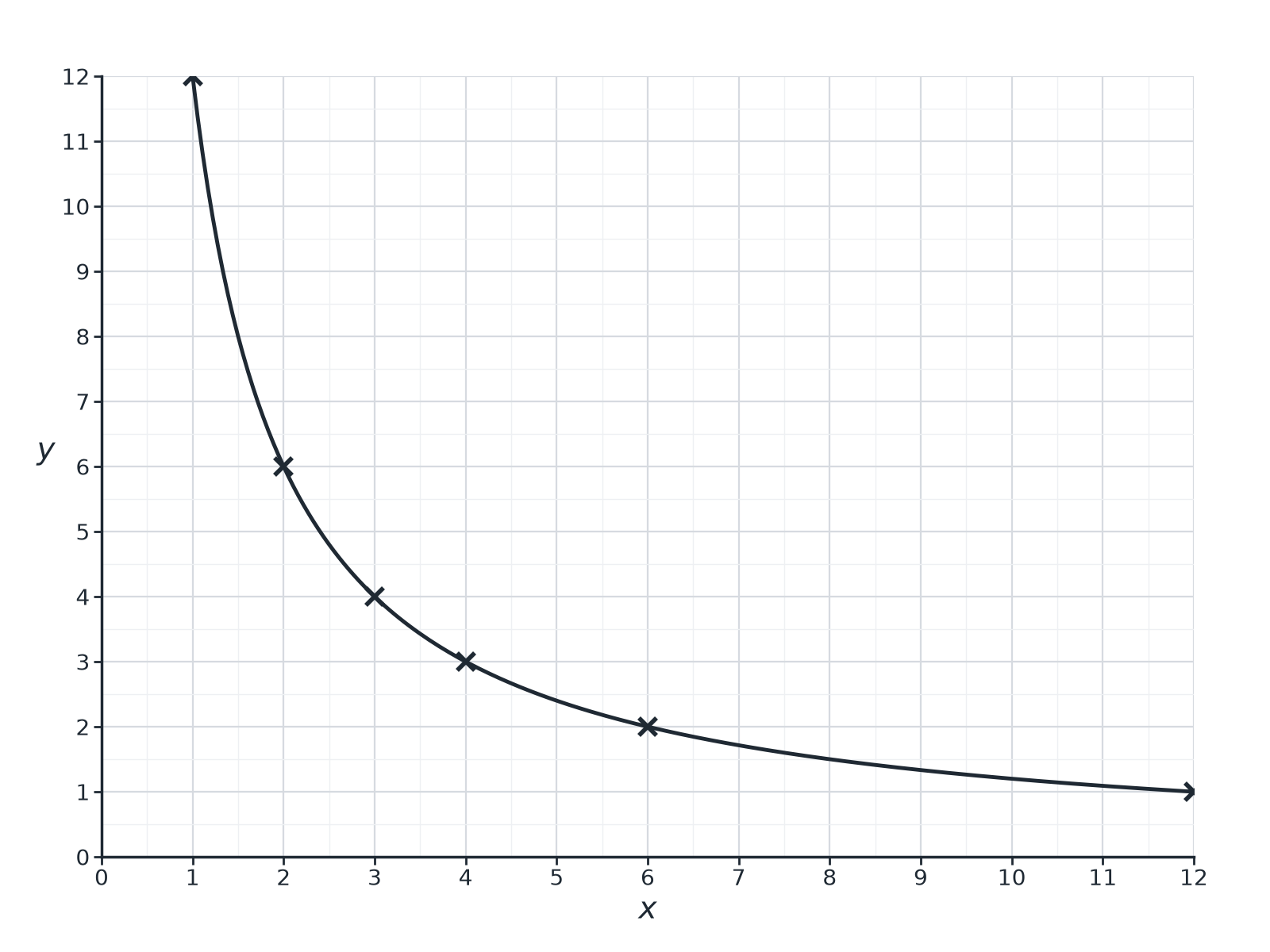
The graph shows the relationship between \(x\) and \(y\). Write down an equation connecting \(x\) and \(y\).
Mark scheme — 3 marks available
- Recognising inverse proportion — M1
- \(k = 12\) — M1
- \(y = \dfrac{12}{x}\) — A1
Model answer
The points show that \(xy = 12\) each time, so \(y = \dfrac{12}{x}\) (inverse proportion).
\(y\) is directly proportional to \(x^2\). When \(x = 2\), \(y = 20\). Find the value of \(y\) when \(x = 3\).
Mark scheme — 3 marks available
- \(y = kx^2\) — M1
- \(k = 5\) — A1
- 45 — A1
Model answer
\(y = kx^2\), so \(20 = 4k\) and \(k = 5\). When \(x = 3\), \(y = 5 \times 9 = 45\).
\(y\) is directly proportional to \(\sqrt{x}\). When \(x = 4\), \(y = 6\). Find the value of \(y\) when \(x = 25\).
Mark scheme — 3 marks available
- \(y = k\sqrt{x}\) — M1
- \(k = 3\) — A1
- 15 — A1
Model answer
\(y = k\sqrt{x}\), so \(6 = 2k\) and \(k = 3\). When \(x = 25\), \(y = 3 \times 5 = 15\).
\(y = 4x\). What happens to \(y\) when \(x\) doubles?
Why: Direct proportion: \(y\) doubles too.
4 people take 6 days to paint a fence. How long do 8 people take?
Why: Inverse proportion: \(4 \times 6 = 24\), and \(24 \div 8 = 3\) days.
Which equation shows \(y\) inversely proportional to \(x\)?
Why: \(y = \dfrac{k}{x}\).
\(y = kx\) with \(y = 12\) when \(x = 3\). What is \(k\)?
Why: \(k = 12 \div 3 = 4\).
The graph of \(y = kx\) is...
Why: A straight line through the origin.
\(y \propto x^2\) and \(y = 18\) when \(x = 3\). What is \(y\) when \(x = 5\)?
Why: \(k = 2\), so \(y = 2 \times 25 = 50\).