Viewing as
Teacher view: planning notes, the answers to every question, and the teacher copies of the files.
Physics · Forces
Pressure in a fluid
Use \(p = F \div A\), explain how pressure in fluids acts at right angles to surfaces, and explain everyday examples of pressure.
Teacher resources
The teacher copies: slides with the questions built in, the answers, and anything else attached to this lesson for whoever is teaching it.
- Pressure in a fluid - Teacher Slides.pptx Teacher The lesson slides with the teacher's notes on each slide, and every question and mark scheme built in. Built from the lesson script on 30 September 2026. View
- Pressure in a fluid - Teacher Notes.docx Teacher The complete notes with the teacher's notes and every model answer in full. Built from the lesson script on 30 September 2026. View
Student handouts
The same files the students see, to print or hand out.
- Pressure in a fluid.pptx Built from the lesson script on 30 September 2026. View
- Pressure in a fluid - Completed Notes.docx The full notes for the lesson, to revise from. Built from the lesson script on 30 September 2026. View
- Pressure in a fluid - Exam Questions.docx Built from the lesson script on 30 September 2026. View
Warm-up
Answer each one, then check.
-
1
What is area?
Show answerHide answer
The amount of surface
-
2
What is the unit of area?
Show answerHide answer
Square metres (m²)
-
3
What is a fluid?
Show answerHide answer
A liquid or a gas
-
4
What is the unit of force?
Show answerHide answer
Newton
-
5
What is the unit of pressure?
Show answerHide answer
Pascal (Pa)
Learning Objectives
PRESSURE
pressure \(=\) force normal to a surface \(\div\) area of that surface \(p = \dfrac{F}{A}\)
Pressure is in pascals (Pa), force in newtons (N) and area in square metres (m²). 1 Pa = 1 N/m².
Same Force, Different Pressure
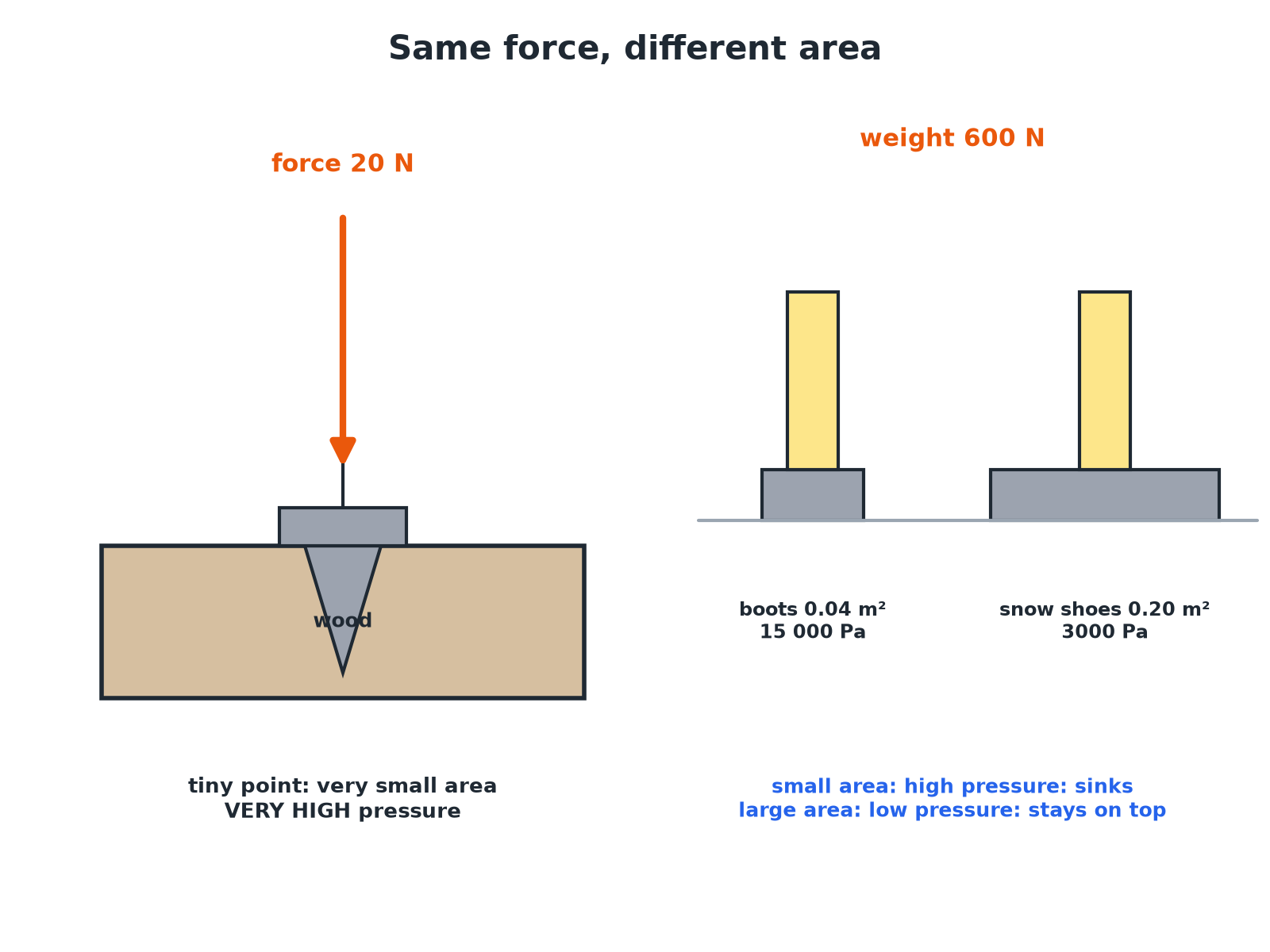
A smaller area gives a greater pressure for the same force.
Calculating Pressure
A person of weight 600 N stands on an area of 0.04 m². Calculate the pressure on the ground.
Show the solutionHide the solution
- 1 Write the equation \(p = F \div A\)
- 2 Substitute \(p = 600 \div 0.04\)
- 3 Answer \(p = 15\,000\) Pa
Answer15 000 Pa
Finding the Force
A pressure of 2000 Pa acts on a surface of area 0.50 m². Calculate the force.
Show the solutionHide the solution
- 1 Rearrange \(F = pA\)
- 2 Substitute \(F = 2000 \times 0.50\)
- 3 Answer \(F = 1000\) N
Answer1000 N
Explaining Everyday Examples
Explain why a sharp knife cuts better than a blunt one.
Show the solutionHide the solution
- 1 Same force The same force is applied to both
- 2 Sharp edge Has a very small area
- 3 Pressure A small area gives a large pressure, so it cuts
AnswerThe sharp knife has a smaller area, so for the same force it exerts a higher pressure.
Pressure in Fluids
Liquids and gases.
-
Direction
Pressure in a fluid causes a force normal (at right angles) to any surface.
-
Gases
Produced by collisions of particles with surfaces.
-
Liquids
Particles collide with the container walls in all directions.
-
Uses
Tyres, hydraulics and sealed containers use fluid pressure.
Shoe Pressure
A 500 N person wears stiletto heels of total area 0.0004 m² and then flat shoes of area 0.04 m². Calculate the pressure each exerts and explain which damages a floor.
1. Calculate each pressure.
2. Compare.
A good answer shows: Heels: 500 ÷ 0.0004 = 1 250 000 Pa. Flat: 500 ÷ 0.04 = 12 500 Pa. The heels exert 100 times more pressure, so they damage the floor.
Can I...?
- 1Define pressure.
- 2Use \(p = F \div A\).
- 3Rearrange for force or area.
- 4Convert cm² to m².
- 5Explain sharp and blunt objects.
- 6Explain wide tyres.
- 7State the direction of fluid pressure.
- 8Give the unit.
Summary & Exam Focus
- \(p = F \div A\).
- Smaller area, larger pressure.
- Fluid pressure acts at right angles to surfaces.
- 1 Pa = 1 N/m².
Exam focus
A person of weight 600 N stands on 0.04 m² of ground. Calculate the pressure. (2 marks) (2 marks)
Divide force by area.
Key terms
The vocabulary this lesson expects you to use. Each one is linked from the first place it appears above.
- Pressure
- Force per unit area.
- Pascal
- The unit of pressure; 1 N/m².
- Fluid
- A liquid or a gas.
- Normal
- At right angles to a surface.
- Area
- The size of a surface.
- Force
- A push or pull.
Questions and answers
10 questions set on this lesson, with the mark schemes and model answers open.
A person weighs 600 N and stands on an area of 0.04 m². Calculate the pressure on the ground. Use the equation: pressure = force ÷ area
Mark scheme — 2 marks available
- Correct substitution — 1 mark
- 15 000 Pa — 1 mark
Model answer
\(600 \div 0.04 = 15\,000\) Pa
A nail has a sharp point. Explain why it is easier to push into wood than a blunt object.
Mark scheme — 2 marks available
- Small area — 1 mark
- Greater pressure for the same force — 1 mark
Model answer
The point has a small area, so the same force gives a greater pressure.
A tractor with wide tyres does not sink into soft ground as much as a car with narrow tyres of the same weight. Explain why.
Mark scheme — 3 marks available
- Weight is the same — 1 mark
- Larger area — 1 mark
- Smaller pressure — 1 mark
Model answer
The wide tyres spread the weight over a larger area, so the pressure on the ground is smaller.
A pressure of 2000 Pa acts on a surface of area 0.50 m². Calculate the force on the surface.
Mark scheme — 3 marks available
- Rearranges to F = pA — 1 mark
- Correct substitution — 1 mark
- 1000 N — 1 mark
Model answer
\(F = pA = 2000 \times 0.50 = 1000\) N
A 500 N person wears shoes with a total area of 0.0004 m² on a floor. Calculate the pressure. Then state how many times greater it is than the pressure from flat shoes of area 0.04 m².
Mark scheme — 4 marks available
- 1 250 000 Pa — 1 mark
- 12 500 Pa — 1 mark
- Ratio 100 — 1 mark
- States 100 times greater — 1 mark
Model answer
\(500 \div 0.0004 = 1\,250\,000\) Pa; \(500 \div 0.04 = 12\,500\) Pa; the pressure is 100 times greater.
Pressure is...
Why: p = F ÷ A.
The unit of pressure is...
Why: 1 Pa = 1 N/m².
A smaller area with the same force gives...
Why: p = F ÷ A.
100 N on 2 m² gives...
Why: 100 ÷ 2.
A fluid is...
Why: Both can flow.