Viewing as
Teaching this? The teacher view adds 2 files, the mark schemes and the model answers.
Physics · Magnetism and electromagnetism
Alternators, dynamos and microphones
Describe how alternators and dynamos generate alternating and direct current, interpret potential difference–time graphs, and explain how a microphone works (Physics only; microphones Higher tier only).
Warm-up
Answer each one, then check.
-
1
What is a.c.?
Show answerHide answer
Alternating current
-
2
What is d.c.?
Show answerHide answer
Direct current
-
3
What is the generator effect?
Show answerHide answer
p.d. induced by a changing magnetic field
-
4
What is the UK mains frequency?
Show answerHide answer
50 Hz
-
5
What is a slip ring?
Show answerHide answer
A continuous ring that keeps contact with a brush
Learning Objectives
- 1Describe how an alternator generates an alternating current.
- 2Describe how a dynamo generates direct current.
- 3Interpret potential difference–time graphs from a.c. and d.c. generators.
- 4Describe how a microphone converts sound to an electrical signal (Higher).
GENERATORS
An alternator rotates a coil in a magnetic field using slip rings and brushes to produce an alternating potential difference. A dynamo uses a split-ring commutator so the output is direct current (p.d. in one direction).
The output increases with faster rotation, more turns or a stronger field. Faster rotation also increases the frequency.
Alternator and Dynamo Graphs
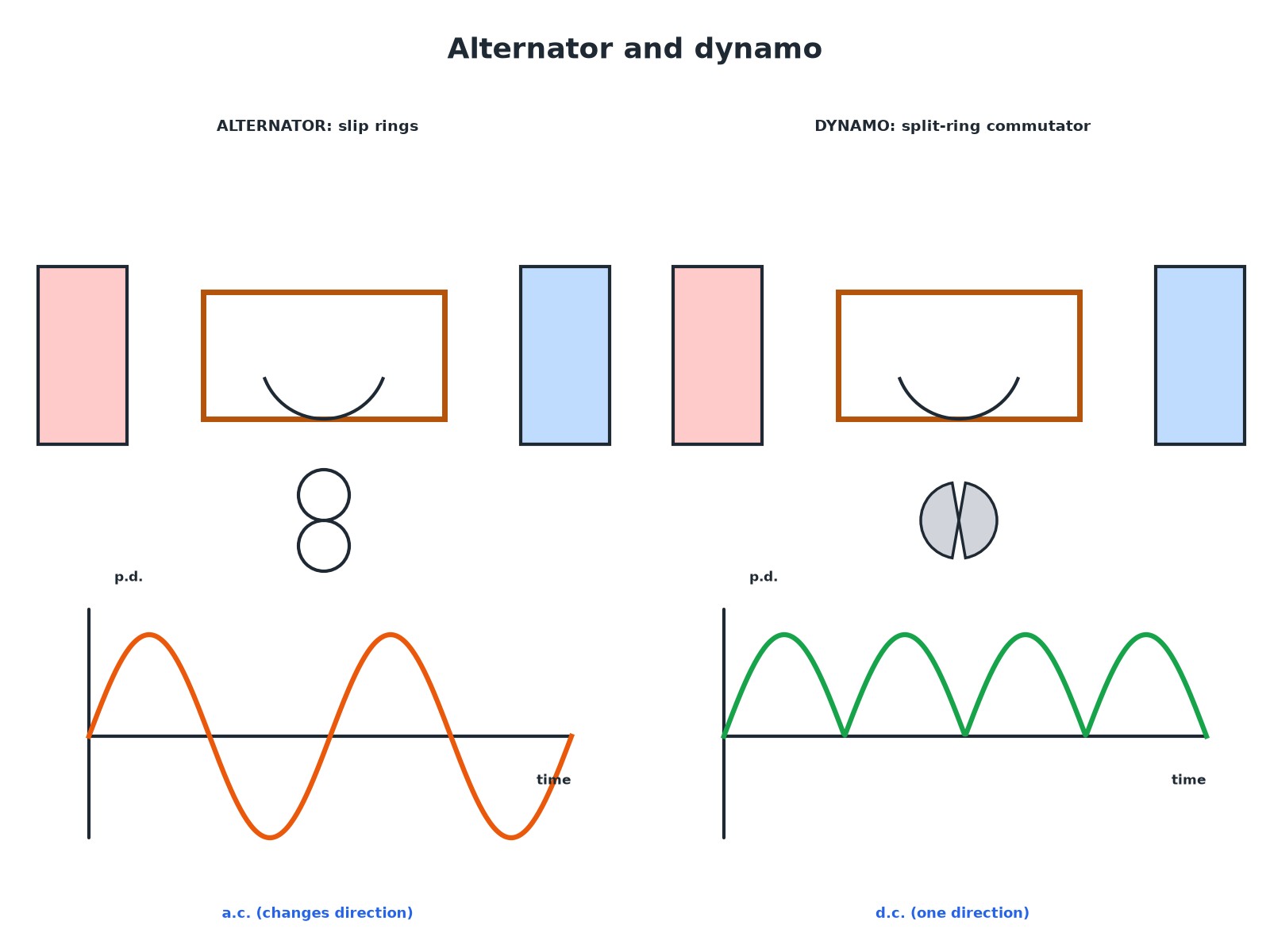
Slip rings give a.c.; a commutator gives d.c.
Alternator or Dynamo?
Alternator
- Coil rotates in a magnetic field.
- Slip rings and brushes.
- Output: alternating p.d., changing direction each half turn.
Dynamo
- Coil rotates in a magnetic field.
- Split-ring commutator and brushes.
- Output: direct p.d., always in one direction.
Changing the Output
Learn what changes the graph.
-
Faster rotation
Effect on the graph: Larger amplitude and higher frequency
-
Stronger magnet
Effect on the graph: Larger amplitude
-
More turns
Effect on the graph: Larger amplitude
-
Slower rotation
Effect on the graph: Smaller amplitude and lower frequency
Reading an a.c. Graph
The graph shows a sine wave with period 0.020 s. Find the frequency.
Show the solutionHide the solution
- 1 Equation \(f = 1 \div T\)
- 2 Substitute \(f = 1 \div 0.020\)
- 3 Answer \(f = 50\) Hz
Answer50 Hz
How a Microphone Works (Higher)
Explain how a moving-coil microphone changes sound into an electrical signal.
Show the solutionHide the solution
- 1 Sound waves Make a diaphragm vibrate
- 2 Coil Attached to the diaphragm, moves in the field of a magnet
- 3 Generator effect Induces an a.c. p.d. in the coil with the same frequency as the sound
AnswerSound vibrates the diaphragm, the coil moves in a magnetic field, and a p.d. is induced.
Generator Graphs
Sketch the p.d.–time graph for an alternator. Then sketch it when the coil spins twice as fast.
1. Count the number of cycles.
A good answer shows: Sine wave; twice as fast gives twice the amplitude and twice the frequency.
Can I...?
- 1Describe an alternator.
- 2Describe a dynamo.
- 3Name slip rings.
- 4Name the commutator.
- 5Sketch a.c. and d.c. graphs.
- 6Change the output.
- 7Describe a microphone.
- 8Calculate frequency.
Summary & Exam Focus
- Alternator: slip rings, a.c.
- Dynamo: split ring, d.c.
- Faster rotation increases the p.d. and the frequency.
- Microphone: sound makes a coil move in a field, inducing an a.c.
Exam focus
Explain the difference between the output of an alternator and a dynamo. (2 marks) (2 marks)
Alternator a.c., dynamo d.c.
Key terms
The vocabulary this lesson expects you to use. Each one is linked from the first place it appears above.
- Alternator
- A generator that produces alternating current.
- Dynamo
- A generator that produces direct current.
- Slip rings
- Rings that keep the coil connected to the brushes without reversing the output.
- Commutator
- A split ring that reverses the connections each half turn.
- Microphone
- A device that converts sound into an electrical signal.
- Brush
- A carbon contact that touches a ring.
Practice questions
Have a go at each one before you open its answer.
-
Question 1 State 2 marks
State the type of current produced by (a) an alternator and (b) a dynamo.
Show answerHide answer
Model answer
(a) Alternating current. (b) Direct current.
Mark scheme
- Alternator a.c. — 1 mark
- Dynamo d.c. — 1 mark
-
Question 2 Explain 3 marks
An alternator rotates at a constant speed. Describe how the output potential difference changes with time.
Show answerHide answer
Model answer
It is an alternating p.d. that changes from positive to negative and back in a regular sine wave. It reverses every half turn of the coil.
Mark scheme
- Alternating or repeating pattern — 1 mark
- Positive and negative — 1 mark
- Reverses every half turn — 1 mark
-
Question 3 Explain 3 marks
The speed of rotation of the coil in an alternator is doubled. Describe two changes to the potential difference–time graph.
Show answerHide answer
Model answer
The amplitude doubles (larger p.d.) and the frequency doubles (shorter period).
Mark scheme
- Larger amplitude — 1 mark
- Higher frequency — 1 mark
- Shorter period / more waves in same time — 1 mark
-
Question 4 Calculate 2 marks
A potential difference–time graph of an alternator shows one complete wave lasts 0.020 s. Calculate the frequency.
Show answerHide answer
Model answer
\(f = 1 \div T = 1 \div 0.020 = 50\) Hz
Mark scheme
- Substitution — 1 mark
- 50 Hz — 1 mark
-
Question 5 Explain 4 marks
Explain how a moving-coil microphone converts sound waves into an electrical signal.
Show answerHide answer
Model answer
Sound waves make the diaphragm vibrate. The coil attached to it moves in the field of a magnet. By the generator effect, a potential difference is induced in the coil. It has the same frequency as the sound, so an a.c. signal is produced.
Mark scheme
- Sound makes the diaphragm vibrate — 1 mark
- Coil moves in a magnetic field — 1 mark
- Generator effect / induced p.d. — 1 mark
- a.c. with the same frequency as the sound — 1 mark
Quick check
-
An alternator produces...
Show answerHide answer
D: alternating current
Slip rings.
-
A dynamo produces...
Show answerHide answer
A: direct current
Commutator.
-
Faster rotation makes the frequency...
Show answerHide answer
B: increase
More rotations a second.
-
A period of 0.05 s gives a frequency of...
Show answerHide answer
C: 20 Hz
1 ÷ 0.05.
-
A microphone uses the...
Show answerHide answer
D: generator effect
Coil moves in a field.
Downloads
Free to keep, print and annotate.
- Alternators dynamos and microphones.pptx Built from the lesson script on 30 September 2026. View
- Alternators dynamos and microphones - Completed Notes.docx The full notes for the lesson, to revise from. Built from the lesson script on 30 September 2026. View
- Alternators dynamos and microphones - Exam Questions.docx Built from the lesson script on 30 September 2026. View
Something here looks wrong?
Tell us what and we will go and look. It goes to whoever writes these pages, nobody else, and we do not ask who you are — so there is nothing to sign and nothing comes back to you.