Biology · Communicable Diseases
Pathogens and the Spread of Disease
Some diseases can be passed from one living thing to another. This lesson introduces the four types of pathogen, explains how they spread in animals and plants and how the spread can be reduced or prevented.
Learning Objectives
- 1Describe the four types of pathogen that cause communicable diseases.
- 2Explain how pathogens are spread in animals and plants by direct contact, by water and by air.
- 3Describe how bacteria and viruses make us ill.
- 4Explain how the spread of disease can be reduced or prevented.
Retrieval practice
-
1
What is a communicable disease?
Show answerHide answer
A disease caused by a pathogen that can be passed from one organism to another.
-
2
What is a non-communicable disease?
Show answerHide answer
A disease that is not caused by a pathogen and cannot be passed on.
-
3
What is a prokaryotic cell?
Show answerHide answer
A cell with no nucleus, such as a bacterium.
-
4
What do white blood cells do?
Show answerHide answer
Defend the body against pathogens.
Microorganisms that cause disease
Most microorganisms are harmless, and many are useful. A pathogen is a microorganism that causes infectious disease. Pathogens may infect plants or animals, and they depend on their host to provide the conditions and nutrients they need to grow and reproduce. Infectious diseases are also called communicable diseases, because they can be passed on.
Four types of pathogen
Pathogens belong to four groups.
-
Viruses
Tiny particles that can only reproduce inside the cells of a living host. They damage or destroy the cells as they do.
-
Bacteria
Single-celled prokaryotes that reproduce rapidly by dividing in two. Many produce toxins, which are poisons that damage tissues.
-
Protists
Eukaryotic single-celled organisms. Some are parasites that live in a host, such as the protist that causes malaria.
-
Fungi
Some fungi are single-celled and others form thread-like bodies. Fungal diseases are common in plants and can also infect animals.
The four types of pathogen
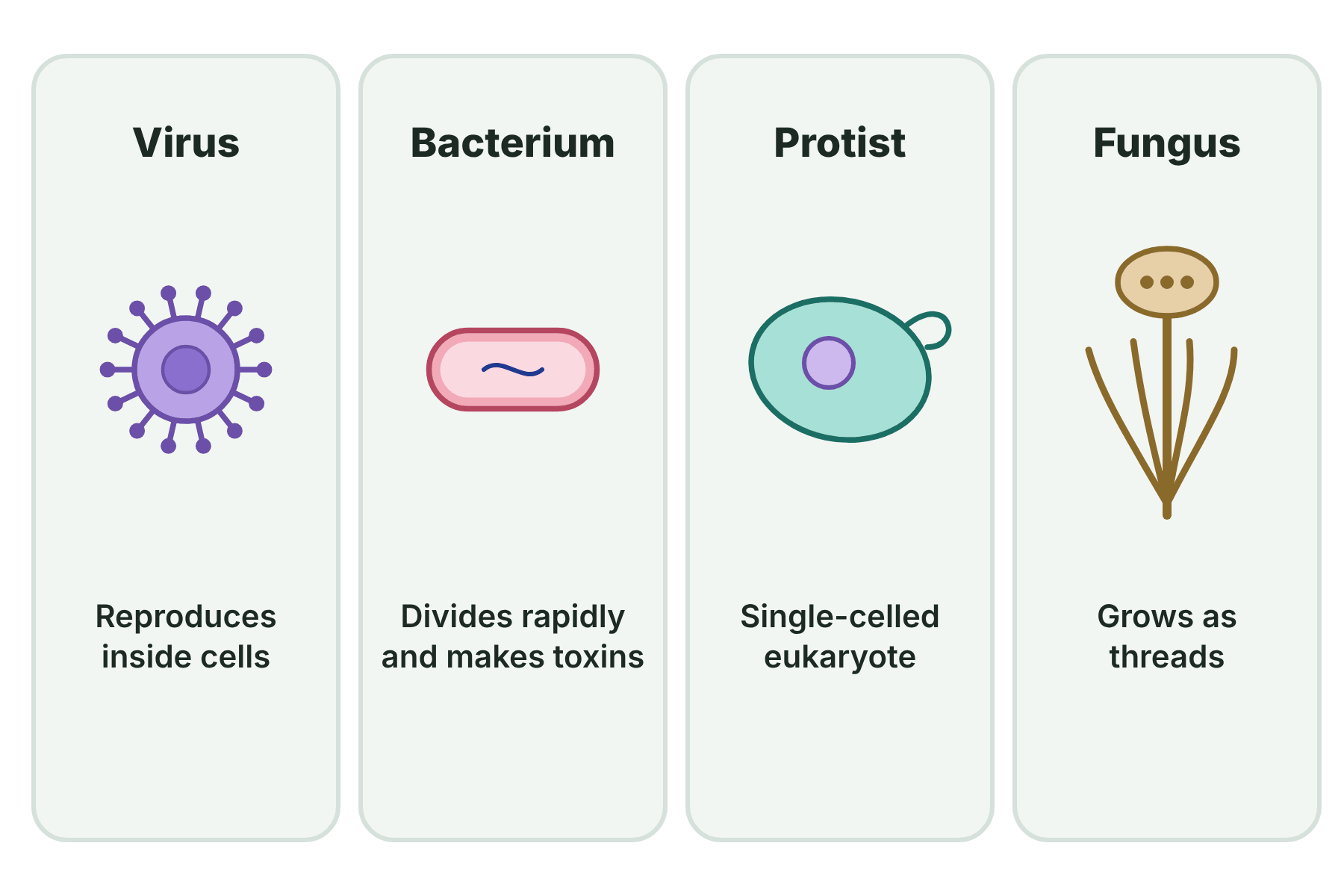
Pathogens come in four types.
How pathogens make us ill
What happens inside the body depends on the type of pathogen.
-
Rapid reproduction
Bacteria and viruses can reproduce rapidly inside the body, so the number of pathogens rises quickly.
-
Toxins
Bacteria may produce toxins, which are poisons that damage tissues and make us feel ill.
-
Cell damage
Viruses live and reproduce inside cells, which causes cell damage.
-
Symptoms
The damage and the body's response cause symptoms such as a fever, a rash, vomiting or diarrhoea.
How pathogens spread
Pathogens can be passed on in several ways.
-
Direct contact
By touching an infected person, or their body fluids, or by contact with an infected plant.
-
By water
Pathogens in contaminated water or in food prepared with dirty water can be swallowed.
-
By air
Droplets from sneezing and coughing carry pathogens that other people breathe in. Spores of fungi can be blown from plant to plant.
-
By a vector
An organism that carries a pathogen from one host to another, such as the mosquito that carries malaria.
Three routes of infection
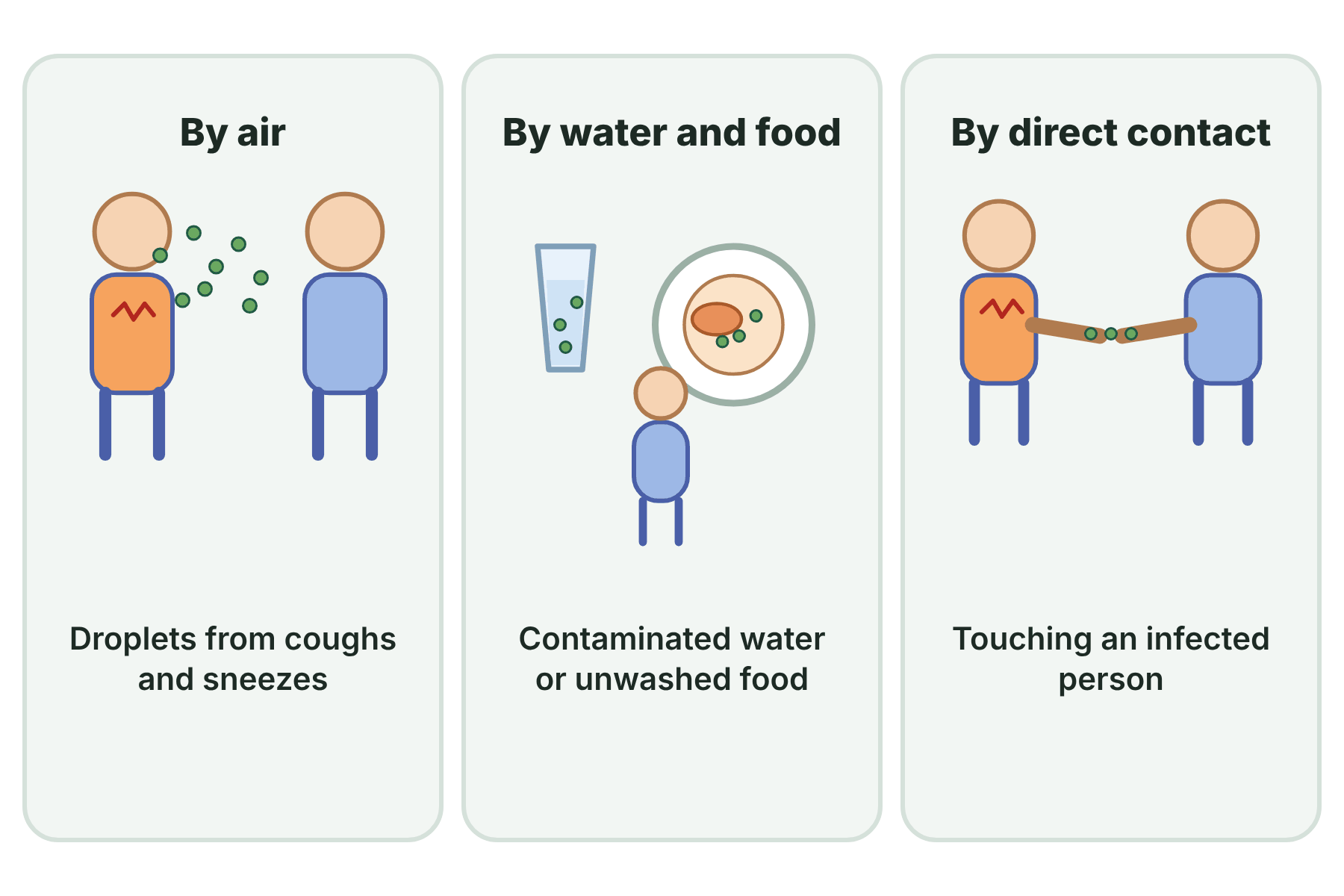
Pathogens spread by air, by water and by direct contact.
Reducing and preventing the spread
You should be able to suggest how the spread of a disease can be reduced.
-
Hygiene
Washing hands, covering the mouth when sneezing and cooking food thoroughly stop pathogens being passed on.
-
Isolation
Keeping infected people away from others stops them passing on the disease.
-
Destroying vectors
Controlling the organisms that carry a pathogen, such as mosquitoes, breaks the link between hosts.
-
Vaccination
Makes people immune, so they are protected and cannot pass the disease on.
-
Clean water and sewage treatment
Remove pathogens from drinking water.
Case study
Washing hands
Many pathogens are passed on by hands. Washing your hands with soap and water after using the toilet and before handling food removes bacteria and viruses. It is one of the cheapest and most effective ways of reducing the spread of disease, and in hospitals it helps to protect patients who are already weak.
The big idea
Pathogens can be viruses, bacteria, protists or fungi, and they spread by direct contact, by water and by air.
Communicable disease
Communicable disease
-
Pathogens
- viruses
- bacteria
- protists
- fungi
-
Effects
- rapid reproduction
- toxins
- cell damage
-
Spread
- direct contact
- water
- air
- vectors
-
Reduce spread
- hygiene
- isolation
- destroy vectors
- vaccination
Summary and exam focus
- Pathogens are microorganisms that cause infectious disease: viruses, bacteria, protists and fungi.
- Bacteria and viruses reproduce rapidly in the body, bacteria make toxins and viruses damage cells.
- Pathogens spread by direct contact, by water and by air.
- Spread can be reduced by hygiene, isolation, destroying vectors and vaccination.
- Pathogens can infect both plants and animals.
Exam focus
Explain how the spread of a disease caused by bacteria in food could be reduced. (4 marks) (4 marks)
Name measures and say why each one works. Wash hands and surfaces to remove bacteria, cook food thoroughly to kill them, store food in a fridge to slow their growth, and separate raw and cooked food.
Key terms
The words this lesson expects you to use. Each one is linked from the first place it appears above.
- Pathogen
- A microorganism that causes disease.
- Communicable disease
- A disease caused by a pathogen that can be spread from one organism to another.
- Virus
- A tiny pathogen that can only reproduce inside the cells of its host.
- Bacterium
- A single-celled prokaryote. Many bacteria cause disease. The plural is bacteria.
- Protist
- A single-celled eukaryotic organism. Some protists are pathogens.
- Fungus
- An organism, such as a mould, that grows as threads. Some fungi are pathogens.
- Toxin
- A poison produced by bacteria that damages tissues.
- Vector
- An organism that carries a pathogen from one host to another.
You've finished the notes
Check your understanding
Test yourself while it is fresh. Start with the flashcards, then try the exam questions.
Something here looks wrong?
Tell us what and we will go and look. It goes to whoever writes these pages, nobody else, and we do not ask who you are — so there is nothing to sign and nothing comes back to you.