Biology · Communicable Diseases
Viral Diseases
Viruses cause diseases in people and in plants. This lesson covers three of them: measles, HIV and tobacco mosaic virus, including their symptoms, how they spread and how they can be controlled.
Learning Objectives
- 1Describe the symptoms of measles, how it spreads and why children are vaccinated against it.
- 2Describe how HIV is spread and how it leads to AIDS.
- 3Describe the effect of tobacco mosaic virus on plants.
- 4Explain how the spread of each of these diseases can be reduced.
Retrieval practice
-
1
Where do viruses reproduce?
Show answerHide answer
Inside the cells of a living host.
-
2
What is a vector?
Show answerHide answer
An organism that carries a pathogen from one host to another.
-
3
How does a sneeze spread disease?
Show answerHide answer
In droplets containing pathogens, which others breathe in.
-
4
What do white blood cells do?
Show answerHide answer
Defend the body against pathogens.
Three viral diseases
Every virus is a tiny particle that has to get inside a living cell before it can reproduce, so it can only cause disease by damaging the cells of its host. The specification names three examples that you need to know in detail: measles and HIV, which affect humans, and tobacco mosaic virus, which affects plants.
Measles
Measles is a serious viral illness, especially in young children.
-
Symptoms
A fever and a red skin rash.
-
Danger
It can be fatal if complications arise, so most young children are vaccinated against it.
-
Spread
The measles virus is spread by inhalation of droplets from sneezes and coughs.
HIV
HIV stands for human immunodeficiency virus.
-
Early stage
HIV first causes a flu-like illness.
-
Attack on immune cells
Unless it is controlled with antiretroviral drugs, the virus attacks the body's immune cells.
-
AIDS
In late-stage HIV infection, or AIDS, the immune system is so badly damaged that it can no longer deal with other infections or cancers.
-
Spread
By sexual contact, or by the exchange of body fluids such as blood, which happens when drug users share needles.
Tobacco mosaic virus
Tobacco mosaic virus, or TMV, is a widespread plant pathogen.
-
Hosts
It affects many species of plant, including tomatoes.
-
The mosaic
It gives the leaves a distinctive mosaic pattern of discolouration.
-
Effect on growth
Parts of the leaf lose chlorophyll, so there is less photosynthesis and the plant does not grow well.
Three viral diseases
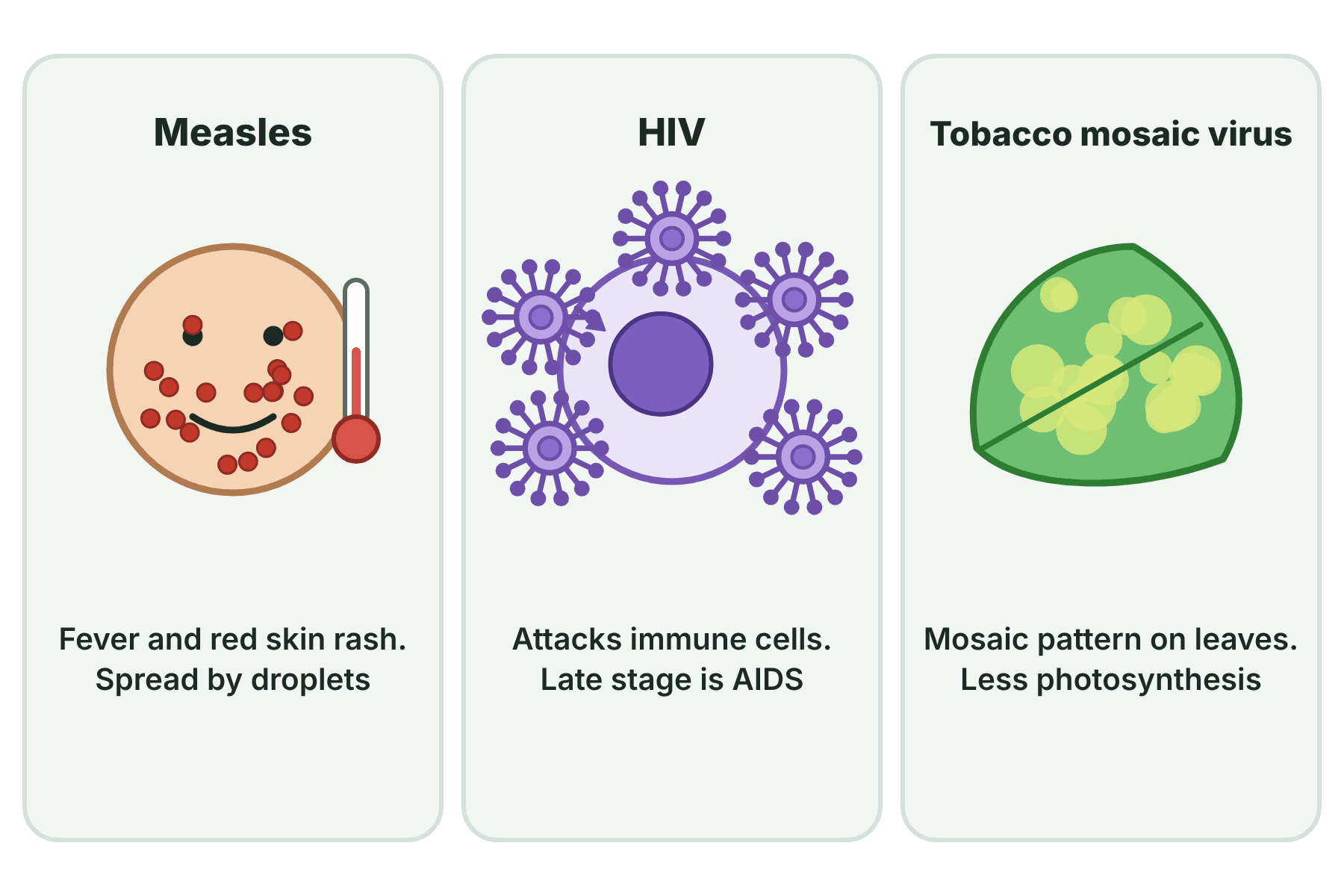
Each virus damages the cells it infects.
Measles and HIV compared
Measles
- Fever and a red skin rash
- Spread by droplets from coughs and sneezes
- Prevented by vaccination
- Can be fatal if complications arise
HIV
- A flu-like illness at first, then attacks immune cells
- Spread by sexual contact or exchange of blood and body fluids
- Controlled with antiretroviral drugs
- Late stage is AIDS, when other infections take hold
Reducing the spread
The way a virus spreads decides how it can be controlled.
-
Measles
Vaccinate young children, and isolate infected people.
-
HIV
Use a condom, do not share needles, and test blood used for transfusions. Antiretroviral drugs control the infection.
-
TMV
There is no cure. Remove and destroy infected plants and control the spread by contact on tools and hands.
Case study
Vaccination and measles
Measles was once a common cause of death in young children. Since a measles vaccine was introduced, the number of cases has fallen sharply in countries where most children are vaccinated. When too few children are vaccinated the virus spreads again quickly, because it is so infectious that one infected child can pass it on to many others.
Know your three viruses
Measles and HIV affect people. Tobacco mosaic virus affects plants. All three viruses damage the cells that they infect.
Viral diseases
Viral diseases
-
Measles
- fever and red rash
- droplets
- vaccination
-
HIV
- flu-like
- attacks immune cells
- AIDS
- body fluids
- antiretroviral drugs
-
TMV
- mosaic on leaves
- less photosynthesis
- growth affected
-
Control
- vaccination
- condoms
- destroy infected plants
Summary and exam focus
- Measles causes a fever and a red skin rash and spreads in droplets from coughs and sneezes.
- Most young children are vaccinated against measles.
- HIV attacks immune cells and can lead to AIDS.
- HIV spreads by sexual contact and by exchange of body fluids such as blood.
- TMV gives plant leaves a mosaic pattern, which reduces photosynthesis and growth.
Exam focus
Describe how HIV is spread and how it can lead to AIDS. (4 marks) (4 marks)
Give two ways HIV spreads (sexual contact and exchange of body fluids such as blood), then describe how the virus attacks immune cells so the immune system can no longer deal with other infections and cancers.
Key terms
The words this lesson expects you to use. Each one is linked from the first place it appears above.
- Measles
- A viral disease with a fever and a red skin rash, spread by droplets.
- HIV
- A virus that attacks the immune cells and can lead to AIDS.
- AIDS
- The late stage of HIV infection, when the immune system is so damaged that it cannot deal with other infections or cancers.
- Antiretroviral drug
- A drug that controls HIV infection.
- Tobacco mosaic virus
- A virus that causes a mosaic pattern of discolouration on the leaves of plants.
- Mosaic
- A pattern of patches of different colours on a leaf.
- Immune cell
- A white blood cell that helps defend the body against pathogens.
- Body fluid
- A liquid in the body, such as blood.
You've finished the notes
Check your understanding
Test yourself while it is fresh. Start with the flashcards, then try the exam questions.
Something here looks wrong?
Tell us what and we will go and look. It goes to whoever writes these pages, nobody else, and we do not ask who you are — so there is nothing to sign and nothing comes back to you.