Biology · Defence Against Disease
Vaccination
Vaccination trains the immune system before a dangerous pathogen arrives. This lesson explains how a vaccine works, how immunising many people protects the whole population and how to evaluate the global use of vaccination.
Learning Objectives
- 1Explain how vaccination prevents illness in an individual.
- 2Explain how immunising a large proportion of the population reduces the spread of pathogens.
- 3Describe why a second infection with the same pathogen is dealt with more quickly.
- 4Evaluate the global use of vaccination in the prevention of disease.
Retrieval practice
-
1
What is an antigen?
Show answerHide answer
A molecule on the surface of a pathogen.
-
2
What do lymphocytes make?
Show answerHide answer
Antibodies.
-
3
Why is an antibody specific?
Show answerHide answer
Its shape fits the antigen of only one type of pathogen.
-
4
Why are young children vaccinated against measles?
Show answerHide answer
It can be fatal, and vaccination protects them.
Practice before the real thing
When a pathogen enters the body for the first time, the immune system is slow to make the right antibodies, and the patient can become seriously ill before the body has caught up. A vaccine is a way of giving the immune system a practice run, without the illness. If the real pathogen arrives later, the body is ready for it.
How a vaccine works
Vaccination involves introducing small quantities of dead or inactive forms of a pathogen into the body.
-
The vaccine
Contains dead or weakened pathogens, or parts of them. They carry the antigens but cannot cause disease.
-
White blood cells respond
The antigens stimulate the white blood cells to produce antibodies, which takes a few days.
-
Memory
Some white blood cells remember the antigen after the infection or the vaccine is over.
-
The real pathogen
If the same pathogen enters the body later, the white blood cells respond very quickly and make the correct antibodies. The pathogen is destroyed before it can make the person ill.
How vaccination protects you
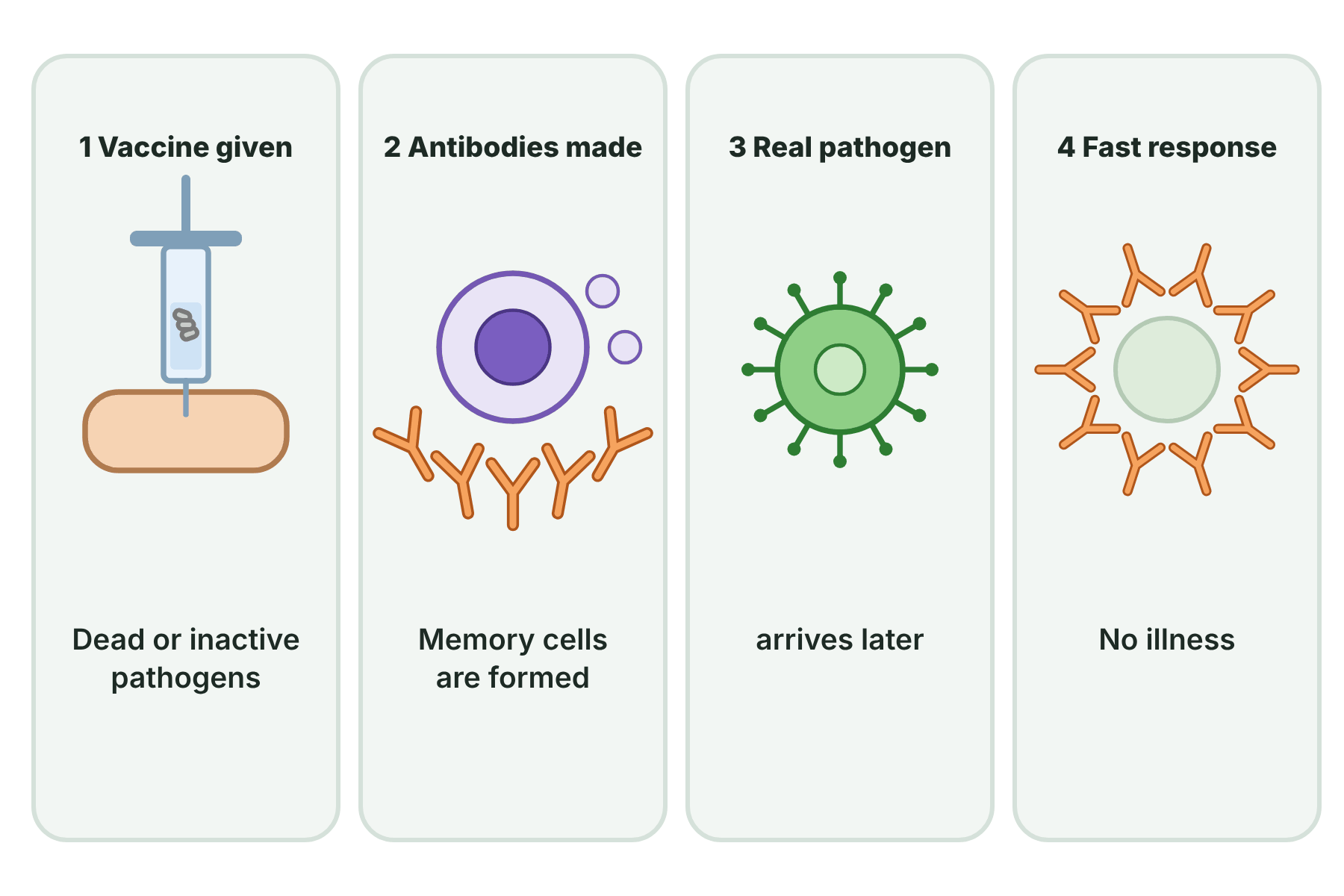
A vaccinated person responds quickly to the real pathogen, so they do not become ill.
The immune response after vaccination
The vaccine uses the same steps as a real infection, but with no danger.
-
1
Vaccination
A small amount of dead or inactive pathogen is injected.
-
2
Antibodies are made
The white blood cells recognise the antigens and make antibodies.
-
3
Memory cells
Some white blood cells stay in the body.
-
4
Later infection
The same pathogen enters the body.
-
5
Quick response
The white blood cells make the correct antibodies much faster, so infection does not take hold.
Protecting the whole population
Vaccination protects the people who are vaccinated, and also others.
-
Fewer cases
If a large proportion of the population is vaccinated, the pathogen cannot spread easily, because most people it meets are immune.
-
Herd immunity
People who cannot be vaccinated, such as babies and the very ill, are protected because the disease is rare.
-
Eradication
If almost everyone is immune for long enough, a disease can be wiped out, as happened to smallpox.
-
Falling rates
If the proportion vaccinated falls, the disease can return.
Herd immunity
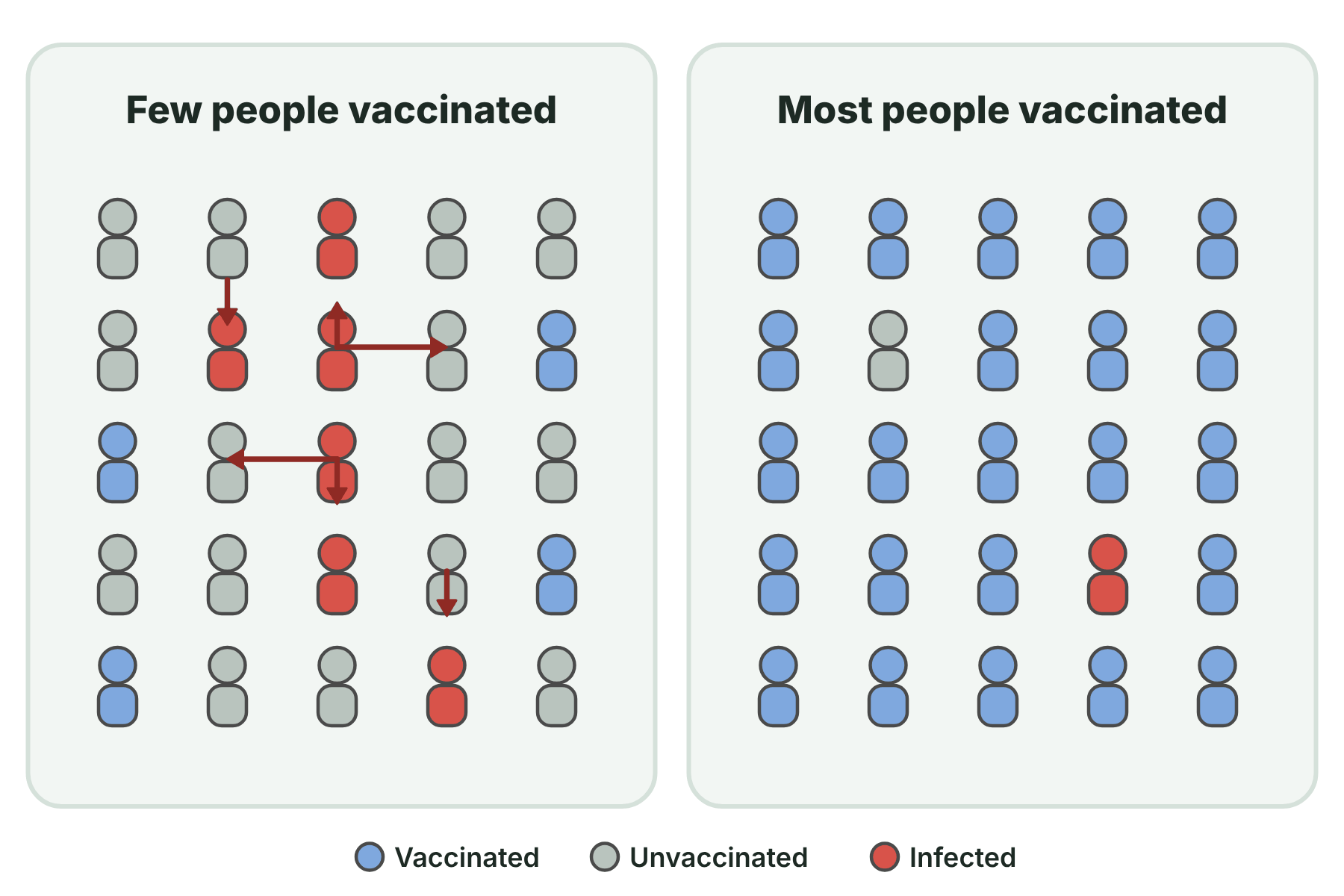
When most people are vaccinated, the pathogen has few people to spread to.
Evaluating vaccination
In the exam you may be asked to weigh up the use of vaccination around the world. You do not need the details of vaccination schedules or the side effects of particular vaccines.
-
Benefits
Vaccination has eradicated smallpox, almost wiped out polio and greatly reduced measles, so millions of lives have been saved.
-
Cost
Vaccines are cheap compared with treating a disease, so they save money for health services.
-
Limits
Vaccines can take years to develop, and some pathogens change quickly, such as flu viruses, so new vaccines are needed.
-
Concerns
A very small number of people have a bad reaction. Fear of this can reduce the number vaccinated, which can bring diseases back.
Case study
The eradication of smallpox
Smallpox was a deadly viral disease that killed millions of people. After a world-wide programme of vaccination, the last natural case was in 1977, and in 1980 the disease was declared eradicated. It is the only human disease so far to have been wiped out completely. The success relied on vaccinating enough people in every country that the virus had nowhere left to spread.
The big idea
A vaccine contains dead or inactive pathogens, which trigger the production of antibodies without making you ill.
Vaccination
Vaccination
-
How it works
- dead or inactive pathogen
- antibodies
- memory
-
Individual
- quick response to real pathogen
-
Population
- fewer cases
- herd immunity
- eradication
-
Evaluate
- saves lives
- cheap
- some pathogens change
- concerns
Summary and exam focus
- A vaccine contains small amounts of dead or inactive pathogens.
- It stimulates white blood cells to produce antibodies.
- If the real pathogen enters later, the correct antibodies are made quickly.
- If a large proportion of the population is vaccinated, the spread of the pathogen is reduced.
- Vaccines have eradicated or greatly reduced several diseases.
Exam focus
Explain how vaccination prevents illness in an individual and reduces the spread of a pathogen in a population. (6 marks) (6 marks)
Describe the individual first: dead or inactive pathogen, antibodies, a quick response next time. Then the population: most people immune, fewer cases, the pathogen cannot spread, which protects those who are not vaccinated.
Key terms
The words this lesson expects you to use. Each one is linked from the first place it appears above.
- Vaccination
- Introducing a dead or inactive form of a pathogen into the body to stimulate the production of antibodies.
- Vaccine
- The preparation containing dead or inactive pathogens that is used in vaccination.
- Immune
- Protected against a disease because the body can make the right antibodies quickly.
- Memory cell
- A white blood cell that stays in the body and allows a faster response next time.
- Herd immunity
- Protection of a whole population when most people are immune.
- Eradication
- Wiping out a disease completely.
- Inactive
- Not able to cause disease.
- Immunisation
- Making a person immune to a disease, usually by vaccination.
You've finished the notes
Check your understanding
Test yourself while it is fresh. Start with the flashcards, then try the exam questions.
Something here looks wrong?
Tell us what and we will go and look. It goes to whoever writes these pages, nobody else, and we do not ask who you are — so there is nothing to sign and nothing comes back to you.