Biology · Monoclonal Antibodies
Uses of Monoclonal Antibodies
Because monoclonal antibodies target one specific chemical, they can find and deliver things in the body with great accuracy. This lesson covers their uses in diagnosis, laboratories, research and treatment, and how to evaluate them.
Learning Objectives
- 1Describe uses of monoclonal antibodies in diagnosis, in laboratories, in research and in treatment.
- 2Explain how a pregnancy test works.
- 3Explain how monoclonal antibodies can be used to treat cancer.
- 4Evaluate the advantages and disadvantages of monoclonal antibodies.
Retrieval practice
-
1
What does specific mean for an antibody?
Show answerHide answer
It binds to only one binding site on one antigen.
-
2
How are monoclonal antibodies made?
Show answerHide answer
From hybridoma cells, made by combining lymphocytes with tumour cells, then cloned.
-
3
What is cancer?
Show answerHide answer
Uncontrolled cell division.
-
4
What is a hormone?
Show answerHide answer
A chemical messenger carried in the blood.
A targeted tool
A monoclonal antibody is made to recognise one chemical, so it acts like a tracking device. If it is attached to something else, such as a dye or a drug, it carries that to the target and nowhere else. This makes monoclonal antibodies useful for finding, measuring and treating, but they have not lived up to everything that was expected of them when they were first developed. You are not expected to recall specific tests or treatments, but you should be able to explain how they work when you are given the information.
Four main uses
The uses depend on what the antibody is attached to.
-
Diagnosis
In pregnancy tests, the antibodies detect the hormone hCG in a woman's urine.
-
In laboratories
To measure the levels of hormones and other chemicals in the blood, or to detect pathogens.
-
In research
To locate or identify specific molecules in a cell or tissue, by binding to them with a fluorescent dye.
-
To treat disease
In cancer, the antibody is bound to a radioactive substance, a toxic drug or a chemical that stops cells growing and dividing.
A pregnancy test
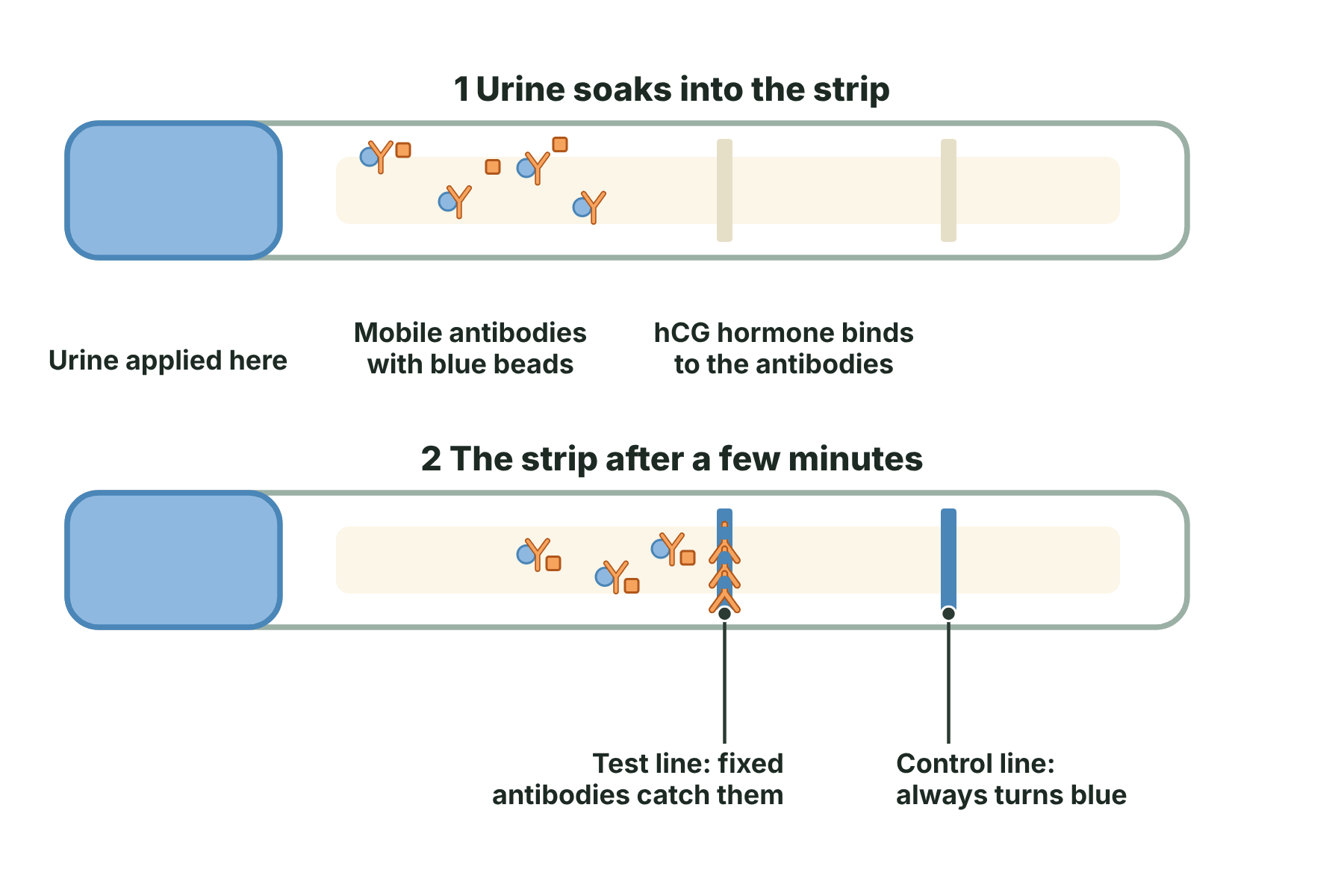
The test line only turns blue if the hormone hCG is present in the urine.
How a pregnancy test works
A pregnant woman's urine contains the hormone hCG, which monoclonal antibodies on the test strip can detect.
-
1
Urine applied
The urine soaks into the strip and picks up antibodies that carry blue beads.
-
2
Hormone binds
If hCG is present, it binds to the mobile antibodies.
-
3
Capture at the test line
Further along the strip, fixed antibodies on the test line bind to the hCG. This traps the blue beads, so the line turns blue.
-
4
The control line
Antibodies on the control line bind the mobile antibodies whether or not there is hCG. It always turns blue, to show that the test has worked.
Treating cancer
Cancer cells have antigens on their surface that normal body cells do not have, so a monoclonal antibody can be made to bind to them.
-
Attach a drug
The antibody is bound to a radioactive substance, a toxic drug or a chemical that stops cells growing and dividing.
-
Injected into the patient
The antibody travels in the blood and binds only to the cancer cells.
-
Delivered to the target
The drug is delivered to the cancer cells without harming other cells in the body.
Delivering a drug to cancer cells
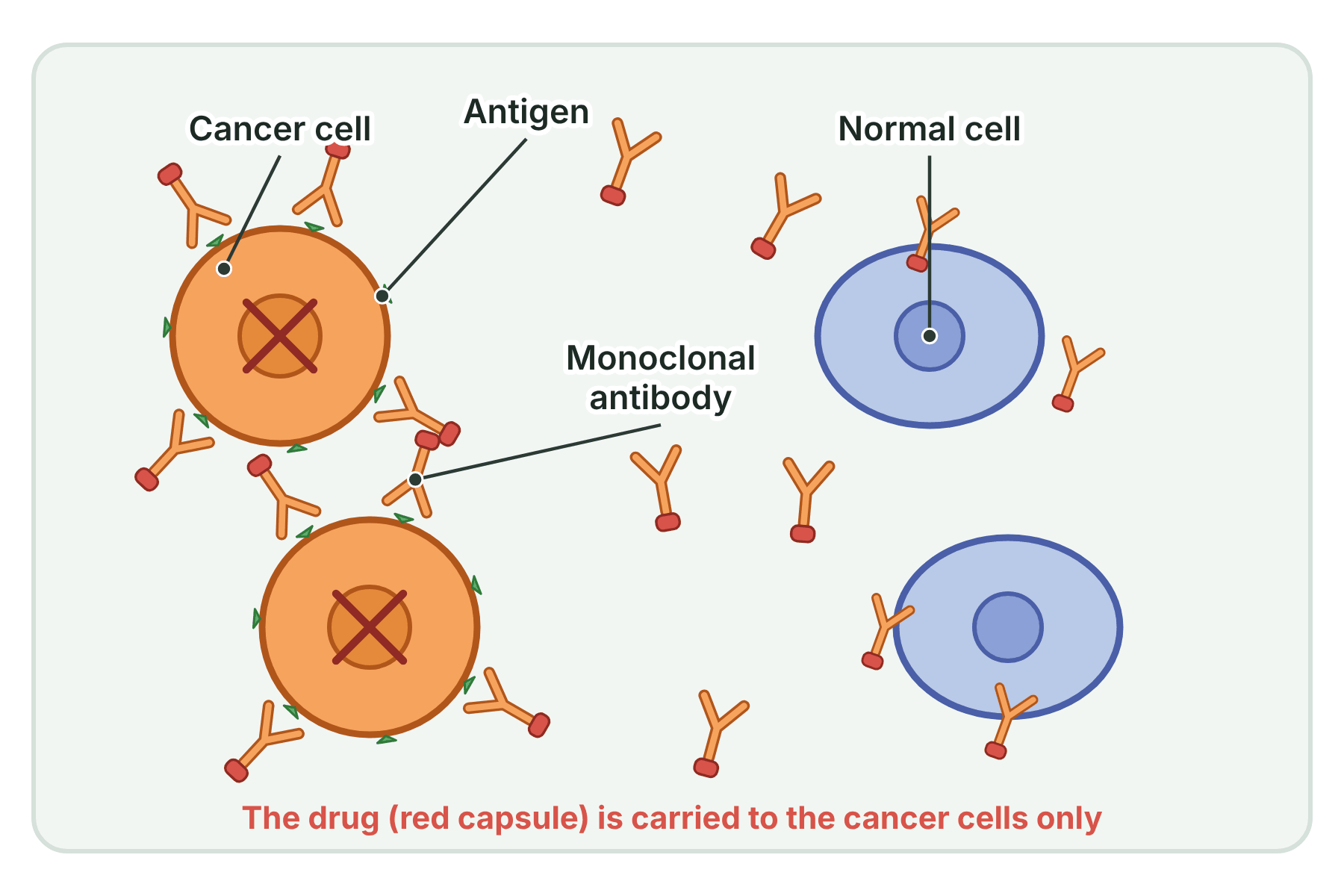
The drug is delivered to the cancer cells, while normal cells are left alone.
Advantages and disadvantages
Advantages
- Very specific, so they target only one chemical
- Can deliver drugs straight to cancer cells without harming other cells
- Can be used in quick, simple tests such as pregnancy tests
- Can be used to find and measure chemicals in the blood
Disadvantages
- They create more side effects than expected
- They are not yet as widely used as was hoped when they were first developed
- They are expensive to make
- Some patients react badly, and mice are used to make them
Explaining a test from information
A test strip uses monoclonal antibodies to detect a hormone in urine. A line turns blue only if the hormone is present. Explain why the line does not turn blue if the hormone is absent.
Show the solutionHide the solution
- 1 Identify the target The antibodies are specific to the hormone, so they bind only to it.
- 2 Say what happens at the line The beads are only held at the test line if they are linked to the hormone.
- 3 Conclude No hormone means no beads at the line, so it does not turn blue.
AnswerThe fixed antibodies on the test line bind only to the hormone, attached to the mobile antibodies. With no hormone, no beads are trapped, so the line stays white.
Case study
Fluorescent antibodies in research
Scientists can make a monoclonal antibody against a particular protein and attach a fluorescent dye to it. When the antibody is added to a sample of tissue, it sticks to the protein wherever it is found. Under a special microscope the dye glows, so the scientists can see exactly where the protein is in the cell. This is a powerful way of mapping the molecules in cells.
The big idea
A monoclonal antibody finds one target, and whatever it carries goes only to that target.
Uses of monoclonal antibodies
Uses of monoclonal antibodies
-
Diagnosis
- pregnancy tests
- hormone hCG
-
Laboratories
- measure hormones and chemicals
- detect pathogens
-
Research
- fluorescent dye shows where molecules are
-
Treatment
- carry drugs to cancer cells
-
Evaluation
- specific and targeted
- more side effects
- not as widely used
Summary and exam focus
- Monoclonal antibodies are used for diagnosis, in laboratories, in research and to treat disease.
- In a pregnancy test they detect the hormone hCG in urine.
- In cancer treatment they carry a drug to the cancer cells without harming other cells.
- They have created more side effects than expected.
- They are not yet as widely used as was hoped.
Exam focus
Evaluate the advantages and disadvantages of using monoclonal antibodies to treat cancer. (4 marks) (4 marks)
Give two advantages (specific to cancer cells, drug delivered without harming other cells) and two disadvantages (more side effects than expected, not as widely used as hoped). Finish with a short judgement.
Key terms
The words this lesson expects you to use. Each one is linked from the first place it appears above.
- Pregnancy test
- A test that uses monoclonal antibodies to detect the hormone hCG in urine.
- hCG
- The hormone that is present in the urine of a pregnant woman.
- Fluorescent dye
- A dye that glows under certain light, used to show where an antibody has bound.
- Diagnosis
- Identifying a disease or condition from its signs.
- Target
- The chemical or cell that a monoclonal antibody is designed to bind to.
- Radioactive substance
- A material that gives out radiation, which can kill cancer cells.
- Side effect
- An unwanted effect of a treatment.
- Evaluate
- To weigh up the advantages and disadvantages and reach a judgement.
You've finished the notes
Check your understanding
Test yourself while it is fresh. Start with the flashcards, then try the exam questions.
Something here looks wrong?
Tell us what and we will go and look. It goes to whoever writes these pages, nobody else, and we do not ask who you are — so there is nothing to sign and nothing comes back to you.