Biology · Respiration and Metabolism
Metabolism
A cell carries out thousands of chemical reactions at once. This lesson names them collectively as metabolism, and links together how sugars, amino acids, fatty acids and glycerol are used to build and break down carbohydrates, proteins and lipids.
Learning Objectives
- 1Define metabolism as the sum of all the reactions in a cell or the body.
- 2Explain that the energy transferred by respiration is used for the enzyme-controlled processes of metabolism that synthesise new molecules.
- 3Explain the importance of sugars, amino acids, fatty acids and glycerol in the synthesis and breakdown of carbohydrates, proteins and lipids.
- 4Describe the examples of metabolism: starch, glycogen and cellulose, lipids, amino acids and proteins, respiration, and the breakdown of excess proteins to form urea.
Retrieval practice
-
1
What are proteins broken down into during digestion?
Show answerHide answer
Amino acids.
-
2
What are lipids broken down into during digestion?
Show answerHide answer
Fatty acids and glycerol.
-
3
What do enzymes do?
Show answerHide answer
They speed up chemical reactions as biological catalysts.
-
4
What is made from glucose in a plant to store energy?
Show answerHide answer
Starch.
Thousands of reactions at once
Inside every cell, thousands of chemical reactions take place at the same time. Some build large molecules from small ones. Some break large molecules down. Some release energy. Together they are called metabolism, and almost all of them are controlled by enzymes. The reactions are linked, so that the products of one are the raw materials for another.
What is metabolism?
Metabolism is the sum of all the reactions in a cell or the body.
-
A sum of reactions
Metabolism includes every chemical reaction that takes place in a cell or in the body.
-
Controlled by enzymes
The processes of metabolism are continual and enzyme controlled.
-
Needs energy
The energy transferred by respiration is used by the organism for the processes of metabolism that synthesise new molecules.
-
Building and breaking down
Some reactions build up larger molecules (synthesis). Others break molecules down, such as when proteins are digested.
Building and breaking down large molecules
Large molecules are made from small ones, and can be broken down into them again.
-
Carbohydrates
Sugars, such as glucose, are joined to make carbohydrates like starch, glycogen and cellulose. They are broken down into sugars again.
-
Proteins
Amino acids are joined to make proteins. Proteins are broken down into amino acids.
-
Lipids
Fatty acids and glycerol are joined to make lipids. Lipids are broken down into fatty acids and glycerol.
Reactions of metabolism
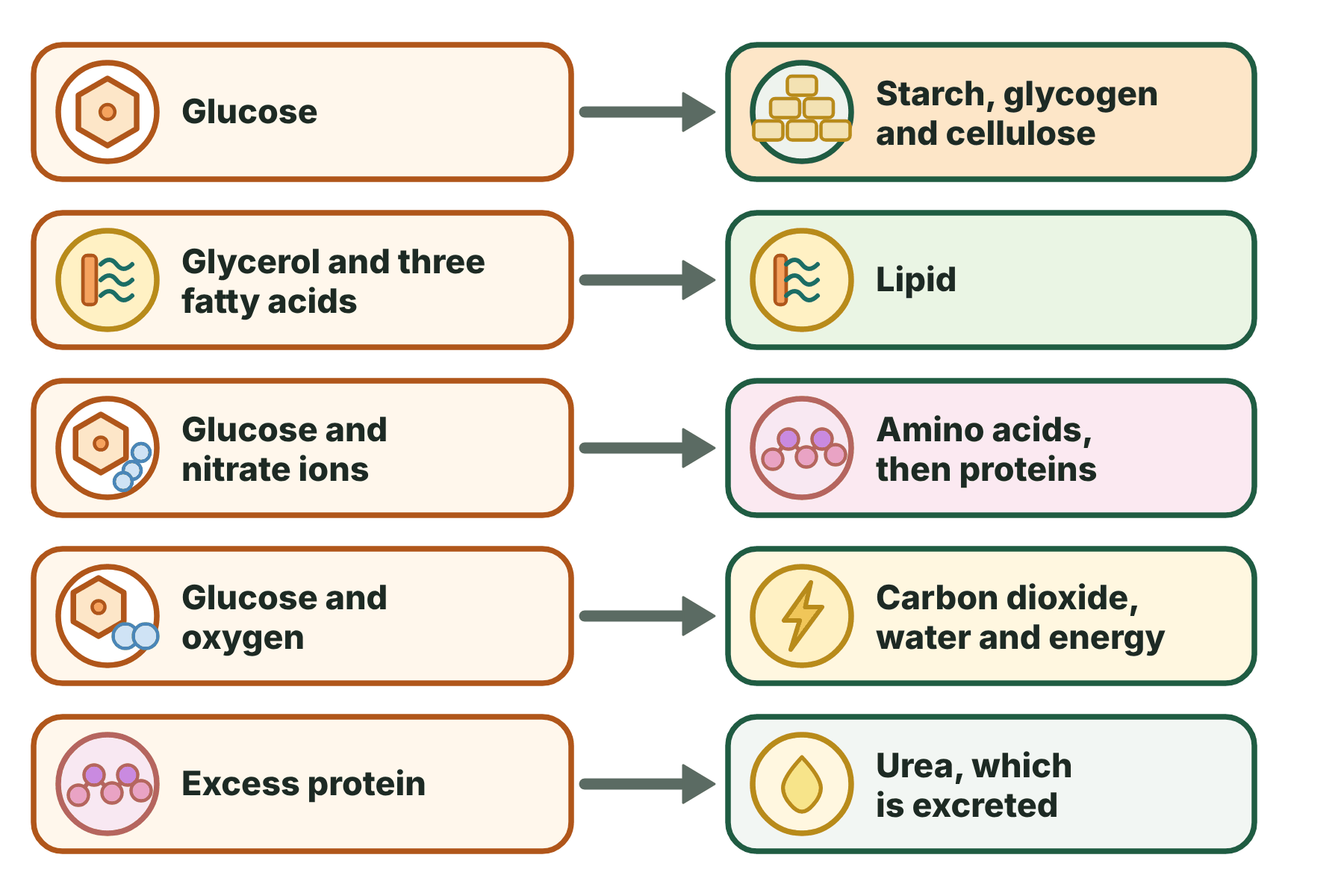
Metabolism includes building new molecules, releasing energy and breaking down excess protein.
Examples of metabolism
The specification names five examples of metabolism, which are covered in more detail elsewhere.
-
Glucose to starch, glycogen and cellulose
Plants make starch for storage and cellulose for their cell walls. Animals store glucose as glycogen in the liver and muscles.
-
Lipids
A lipid molecule is made from one molecule of glycerol and three molecules of fatty acids.
-
Amino acids and proteins
Glucose and nitrate ions are used to make amino acids, which are then joined to make proteins.
-
Respiration
Glucose is oxidised to transfer the energy that drives metabolism.
-
Breakdown of excess protein
The body cannot store extra protein, so it is broken down to form urea, which is excreted.
Making a lipid
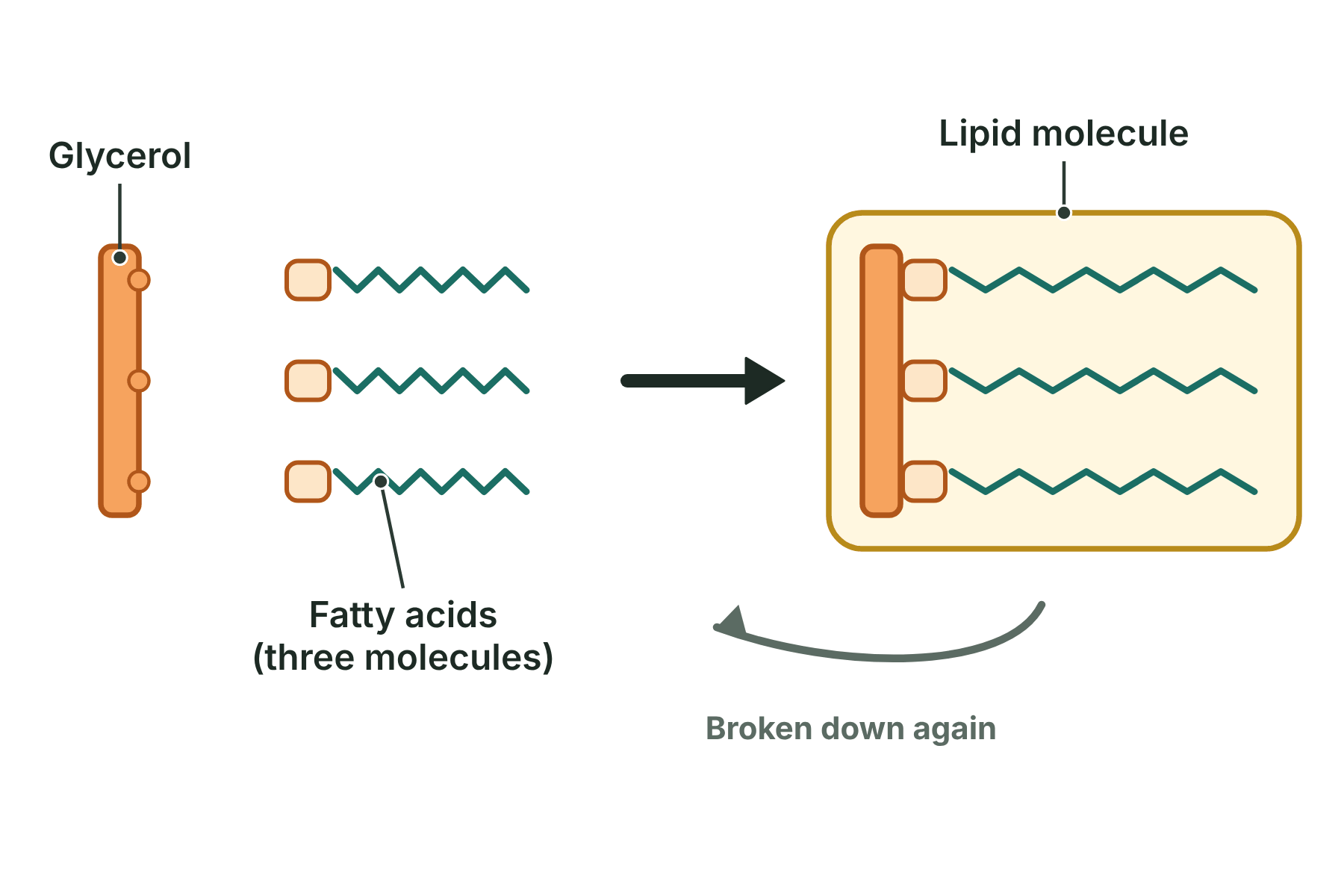
One glycerol molecule and three fatty acid molecules join to make a lipid.
Building up and breaking down
Building up (synthesis)
- Small molecules are joined to make larger ones
- Needs energy from respiration
- Controlled by enzymes
- For example amino acids to protein
Breaking down
- Larger molecules are split into smaller ones
- Controlled by enzymes
- For example protein to amino acids in digestion
- Excess protein is broken down to form urea
Case study
Why farmers add nitrate fertiliser
Plants make glucose by photosynthesis, but glucose alone cannot make protein. Proteins need amino acids, and amino acids need nitrogen, which plants take in as nitrate ions from the soil. A plant that cannot get enough nitrate cannot make enough protein, so it grows slowly. Farmers add fertilisers that contain nitrate ions so that the plants can make the amino acids and proteins they need to grow.
The big idea
Metabolism is the sum of all the reactions in a cell or the body, and the energy from respiration drives the reactions that build new molecules.
Metabolism
Metabolism
-
Carbohydrates
- glucose to starch
- glycogen and cellulose
-
Lipids
- glycerol and three fatty acids
-
Proteins
- glucose and nitrate ions to amino acids
- then proteins
-
Respiration
- oxidises glucose to transfer energy
-
Excess protein
- broken down to form urea for excretion
Summary and exam focus
- Metabolism is the sum of all the reactions in a cell or the body.
- The energy from respiration is used for the enzyme controlled processes that synthesise new molecules.
- Sugars are used to make starch, glycogen and cellulose.
- A lipid is made from one molecule of glycerol and three molecules of fatty acids.
- Glucose and nitrate ions are used to make amino acids, which are used to make proteins.
- Excess protein is broken down to form urea for excretion.
Exam focus
Explain what is meant by metabolism and give two examples of metabolic reactions. (4 marks) (4 marks)
Define it as the sum of all the reactions in a cell or the body, then name two reactions with what goes in and what is made, such as amino acids joined to make protein, or glycerol and three fatty acids joined to make a lipid.
Key terms
The words this lesson expects you to use. Each one is linked from the first place it appears above.
- Metabolism
- The sum of all the reactions in a cell or the body.
- Synthesis
- Building a larger molecule from smaller ones.
- Glycogen
- A carbohydrate in which animals store glucose, in the liver and muscles.
- Cellulose
- A carbohydrate made from glucose that strengthens plant cell walls.
- Amino acid
- A small molecule that is joined with others to make proteins.
- Fatty acid
- A small molecule that joins with glycerol to make a lipid.
- Glycerol
- A small molecule that joins with three fatty acids to make a lipid.
- Urea
- A waste substance made from the breakdown of excess protein, which is excreted.
You've finished the notes
Check your understanding
Test yourself while it is fresh. Start with the flashcards, then try the exam questions.
Something here looks wrong?
Tell us what and we will go and look. It goes to whoever writes these pages, nobody else, and we do not ask who you are — so there is nothing to sign and nothing comes back to you.