Exam questions · Biology
Communicable Diseases
- 28 exam questions
- 70 marks
- 32 quick checks
Pathogens and the Spread of Disease
Just this lesson-
1 State [1 mark]
Name two types of pathogen.
Show answerHide answer
Model answer
Any two of: viruses, bacteria, protists, fungi.
Mark scheme
- Two types named — 1 mark
-
2 Describe [2 marks]
Describe two ways in which pathogens can be spread.
Show answerHide answer
Model answer
By direct contact, for example touching an infected person. By air, for example in droplets from a cough or sneeze. By water, for example in contaminated drinking water.
Mark scheme
- A first way — 1 mark
- A second way — 1 mark
-
3 Explain [2 marks]
Explain how bacteria can make a person feel ill.
Show answerHide answer
Model answer
Bacteria reproduce rapidly inside the body. They may produce toxins (poisons) that damage tissues and make us feel ill.
Mark scheme
- Reproduce rapidly — 1 mark
- Produce toxins that damage tissues — 1 mark
-
4 Explain [2 marks]
Explain why viruses are harmful to the cells they infect.
Show answerHide answer
Model answer
Viruses live and reproduce inside cells. This causes cell damage.
Mark scheme
- Live and reproduce inside cells — 1 mark
- Damage the cells — 1 mark
-
5 Suggest [3 marks]
A student has a cold. Suggest three ways the student could reduce the spread of the cold to others.
Show answerHide answer
Model answer
Cover the mouth and nose when coughing or sneezing, use tissues and put them in the bin. Wash hands often. Stay away from other people while infectious.
Mark scheme
- Cover mouth when sneezing — 1 mark
- Wash hands — 1 mark
- Stay away from others / isolate — 1 mark
-
6 Explain [3 marks]
Malaria is spread by mosquitoes. Explain how destroying the breeding sites of mosquitoes reduces the spread of malaria.
Show answerHide answer
Model answer
Mosquitoes are the vector that carries the pathogen from one person to another. Mosquitoes breed in standing water. If the breeding sites are destroyed there are fewer mosquitoes, so fewer people are bitten and infected.
Mark scheme
- Mosquito is the vector — 1 mark
- Fewer mosquitoes — 1 mark
- Fewer people infected — 1 mark
-
7 Explain [4 marks]
Explain why a disease caused by a pathogen spreads more quickly in a crowded town than in a village in the countryside.
Show answerHide answer
Model answer
In a crowded town there are more people close together, so there is more direct contact between them. Pathogens that spread by air are breathed in by more people, and pathogens in water or on surfaces can be passed on more easily. Fewer people can isolate themselves, so more people are exposed.
Mark scheme
- More people in close contact — 1 mark
- Spread by air or droplets more easily — 1 mark
- Spread by surfaces and water — 1 mark
- Harder to isolate infected people — 1 mark
Quick check
-
1
Which of these is a pathogen?
Show answerHide answer
C: A virus
A virus can cause infectious disease, so it is a pathogen.
-
2
What are toxins?
Show answerHide answer
A: Poisons made by bacteria
Toxins are poisons made by bacteria that damage tissues.
-
3
Where do viruses reproduce?
Show answerHide answer
D: Inside living cells
Viruses can only reproduce inside the cells of a host.
-
4
Which way of spreading disease does a sneeze involve?
Show answerHide answer
B: By air
A sneeze sends droplets containing pathogens into the air.
-
5
What is a vector?
Show answerHide answer
C: An organism that carries a pathogen
A vector carries a pathogen from one host to another.
-
6
Which of these helps to stop the spread of disease?
Show answerHide answer
A: Washing hands
Washing hands removes pathogens, so it stops them being passed on.
-
7
Which pathogen is a single-celled eukaryote?
Show answerHide answer
D: A protist
Protists are single-celled eukaryotes, and some of them cause disease.
-
8
Why is vaccination a good way of controlling a disease?
Show answerHide answer
B: It makes people immune
Vaccinated people are immune, so they do not catch or pass on the disease.
Viral Diseases
Just this lesson-
1 State [1 mark]
Name the virus that causes a mosaic pattern of discolouration on the leaves of tomato plants.
Show answerHide answer
Model answer
Tobacco mosaic virus (TMV).
Mark scheme
- Tobacco mosaic virus — 1 mark
-
2 Describe [2 marks]
Describe the symptoms of measles.
Show answerHide answer
Model answer
A fever and a red skin rash.
Mark scheme
- Fever — 1 mark
- Red skin rash — 1 mark
-
3 Explain [2 marks]
Explain why most young children are vaccinated against measles.
Show answerHide answer
Model answer
Measles is a serious illness that can be fatal if complications arise. Vaccination protects the children and reduces the spread of the virus.
Mark scheme
- Serious / can be fatal — 1 mark
- Vaccination protects / prevents the spread — 1 mark
-
4 Describe [3 marks]
Describe how HIV is spread between people.
Show answerHide answer
Model answer
HIV is spread by sexual contact. It is also spread by the exchange of body fluids such as blood, for example when drug users share needles.
Mark scheme
- Sexual contact — 1 mark
- Exchange of body fluids / blood — 1 mark
- Sharing needles as an example — 1 mark
-
5 Explain [3 marks]
Explain how HIV can lead to AIDS.
Show answerHide answer
Model answer
HIV attacks the body's immune cells. Over time the immune system is so badly damaged that it can no longer deal with other infections or cancers. This late stage of the infection is called AIDS.
Mark scheme
- Attacks immune cells — 1 mark
- Immune system badly damaged — 1 mark
- Cannot deal with other infections or cancers — 1 mark
-
6 Explain [3 marks]
Explain why a plant infected with tobacco mosaic virus does not grow well.
Show answerHide answer
Model answer
The virus makes patches of the leaves lose their chlorophyll, giving a mosaic pattern. There is less photosynthesis in the leaves, so the plant makes less glucose and cannot grow properly.
Mark scheme
- Mosaic / discolouration of leaves — 1 mark
- Less photosynthesis — 1 mark
- Less glucose so poor growth — 1 mark
-
7 Suggest [4 marks]
Suggest how the spread of measles and the spread of HIV could each be reduced.
Show answerHide answer
Model answer
Measles spreads in droplets, so it can be reduced by vaccinating children and by isolating people who are infected. HIV spreads by body fluids, so it can be reduced by using condoms during sex, by not sharing needles, and by treating infected people with antiretroviral drugs.
Mark scheme
- Measles: vaccination — 1 mark
- Measles: isolation — 1 mark
- HIV: condoms or not sharing needles — 1 mark
- HIV: antiretroviral drugs — 1 mark
Quick check
-
1
Which disease causes a fever and a red skin rash?
Show answerHide answer
B: Measles
Fever and a red skin rash are symptoms of measles.
-
2
How is measles spread?
Show answerHide answer
C: By droplets from coughs and sneezes
The measles virus is spread by breathing in droplets from coughs and sneezes.
-
3
What does HIV attack?
Show answerHide answer
A: Immune cells
HIV attacks the immune cells, which weakens the body's defences.
-
4
What is the name for late-stage HIV infection?
Show answerHide answer
D: AIDS
AIDS is the late stage, when the immune system can no longer fight other infections.
-
5
Which of these affects plants?
Show answerHide answer
C: Tobacco mosaic virus
Tobacco mosaic virus infects the leaves of many plants.
-
6
Why does TMV reduce a plant's growth?
Show answerHide answer
B: It reduces photosynthesis
The discoloured leaf patches carry out less photosynthesis.
-
7
How can the spread of HIV be reduced?
Show answerHide answer
A: Using condoms and not sharing needles
Condoms and not sharing needles reduce contact with infected body fluids.
-
8
What controls HIV in an infected person?
Show answerHide answer
D: Antiretroviral drugs
Antiretroviral drugs control the virus.
Bacterial Diseases
Just this lesson-
1 State [1 mark]
State two symptoms of salmonella food poisoning.
Show answerHide answer
Model answer
Any two of: fever, abdominal cramps, vomiting, diarrhoea.
Mark scheme
- Two symptoms named — 1 mark
-
2 Describe [2 marks]
Describe how gonorrhoea is spread and one way of controlling its spread.
Show answerHide answer
Model answer
Gonorrhoea is spread by sexual contact. Its spread can be controlled by using a barrier method of contraception, such as a condom, or by treating infected people with antibiotics.
Mark scheme
- Spread by sexual contact — 1 mark
- Condom / antibiotics — 1 mark
-
3 Explain [2 marks]
In the UK, poultry are vaccinated against salmonella. Explain how this reduces cases of food poisoning in people.
Show answerHide answer
Model answer
Vaccinated poultry do not become infected with salmonella. So fewer eggs and meat contain the bacteria, and fewer people eat contaminated food.
Mark scheme
- Poultry not infected — 1 mark
- Less contaminated food eaten — 1 mark
-
4 Suggest [3 marks]
Suggest three ways in which a person can reduce the risk of getting salmonella food poisoning from chicken.
Show answerHide answer
Model answer
Cook the chicken thoroughly so that the bacteria are killed. Wash hands and surfaces after touching raw chicken. Keep raw chicken away from other foods, which prevents cross-contamination.
Mark scheme
- Cook thoroughly — 1 mark
- Wash hands and surfaces — 1 mark
- Keep raw and cooked food apart — 1 mark
-
5 Explain [3 marks]
Gonorrhoea was once easily treated with penicillin. Explain why this is no longer true.
Show answerHide answer
Model answer
Some gonorrhoea bacteria have changed so that they are resistant to penicillin. The antibiotic kills the non-resistant bacteria, but the resistant ones survive and reproduce. Many resistant strains have therefore appeared.
Mark scheme
- Some bacteria resistant — 1 mark
- Resistant bacteria survive and reproduce — 1 mark
- Many resistant strains now — 1 mark
-
6 Compare [4 marks]
Compare how salmonella food poisoning and gonorrhoea are spread and controlled.
Show answerHide answer
Model answer
Salmonella is spread in food, but gonorrhoea is spread by sexual contact. Salmonella is controlled by vaccinating poultry and by good food hygiene, such as cooking food thoroughly. Gonorrhoea is controlled by using condoms and by treating infected people with antibiotics.
Mark scheme
- Salmonella spread in food — 1 mark
- Gonorrhoea spread by sexual contact — 1 mark
- Salmonella control: vaccination / hygiene — 1 mark
- Gonorrhoea control: condoms / antibiotics — 1 mark
-
7 Explain [2 marks]
Explain why a condom is described as a barrier method.
Show answerHide answer
Model answer
A condom physically stops body fluids passing from one person to the other. This stops the bacteria that cause gonorrhoea being passed on.
Mark scheme
- Stops body fluids passing between people — 1 mark
- Stops the bacteria being passed on — 1 mark
Quick check
-
1
Which disease is caused by bacteria and spread in food?
Show answerHide answer
C: Salmonella food poisoning
Salmonella food poisoning is caused by bacteria in food.
-
2
Which of these is a symptom of salmonella poisoning?
Show answerHide answer
D: Vomiting and diarrhoea
Fever, cramps, vomiting and diarrhoea are all symptoms.
-
3
How is gonorrhoea spread?
Show answerHide answer
A: By sexual contact
Gonorrhoea is spread by sexual contact.
-
4
What do poultry in the UK get vaccinated against?
Show answerHide answer
B: Salmonella
Vaccinating poultry against salmonella reduces the spread to humans.
-
5
Which method reduces the spread of gonorrhoea?
Show answerHide answer
C: Using a condom
A condom is a barrier method that stops the bacteria passing between people.
-
6
Why is gonorrhoea harder to treat than it once was?
Show answerHide answer
A: Many strains are resistant to penicillin
Many strains of the bacterium are now resistant to penicillin.
-
7
What is cross-contamination?
Show answerHide answer
D: Passing bacteria from raw food to other food
It is the passing of pathogens from raw food or surfaces to other food.
-
8
Which symptom is typical of gonorrhoea?
Show answerHide answer
B: Pain when urinating
A thick yellow or green discharge and pain on urinating are typical.
Fungal and Protist Diseases
Just this lesson-
1 State [1 mark]
Name the type of pathogen that causes rose black spot.
Show answerHide answer
Model answer
A fungus.
Mark scheme
- Fungus — 1 mark
-
2 Name [3 marks]
Figure 1 shows how malaria is spread. Name the parts labelled A, B and C and state what B does.
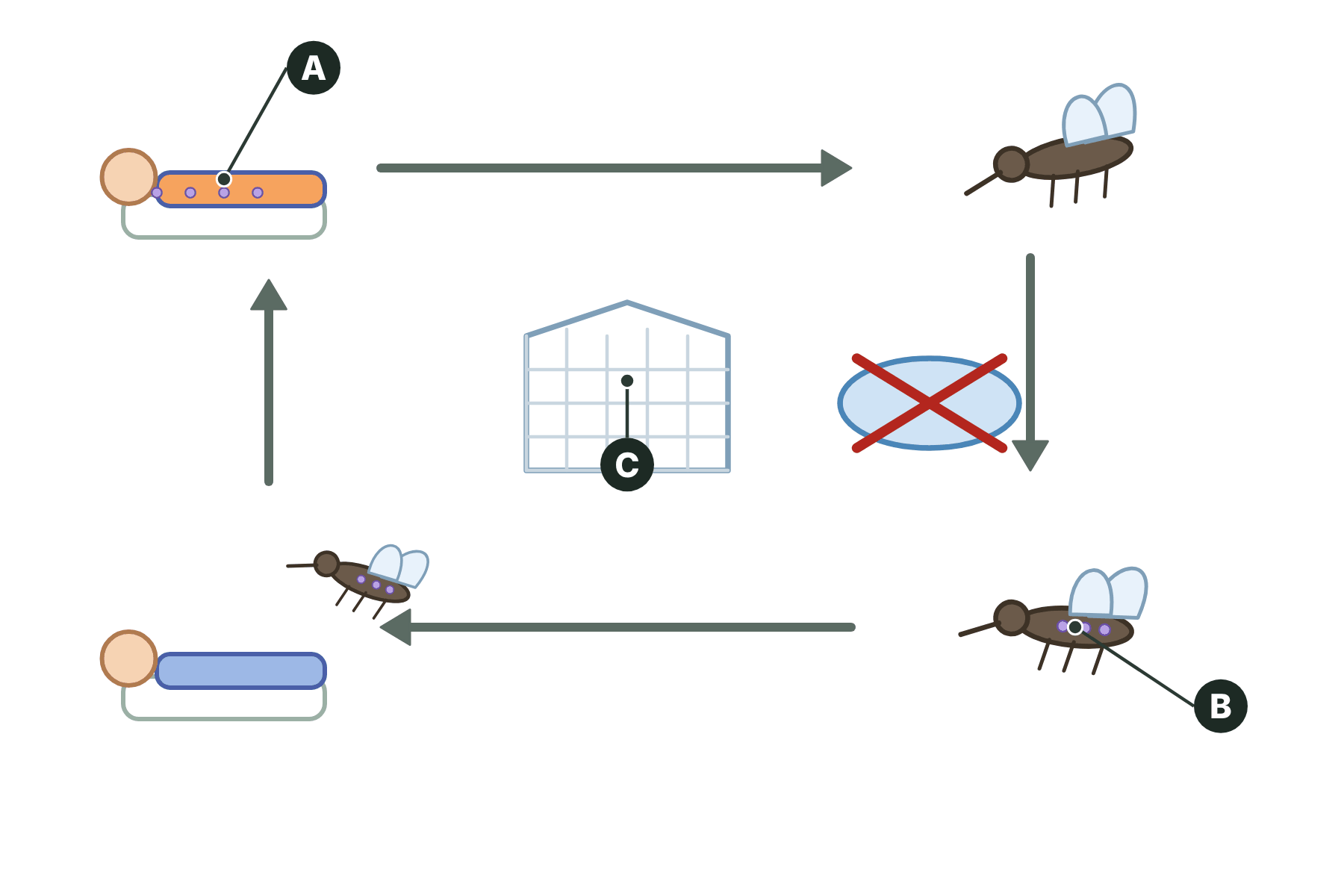
Show answerHide answer
Model answer
A is an infected person. B is the mosquito, which is the vector that carries the protists from person to person. C is the (bed) net.
Mark scheme
- A: infected person — 1 mark
- B: mosquito / vector carries the protist — 1 mark
- C: bed net — 1 mark
-
3 Describe [2 marks]
Describe the symptoms of rose black spot.
Show answerHide answer
Model answer
Purple or black spots on the leaves. The leaves often turn yellow and fall off early.
Mark scheme
- Purple or black spots — 1 mark
- Leaves turn yellow and drop early — 1 mark
-
4 Explain [3 marks]
Explain why rose black spot reduces the growth of a rose plant.
Show answerHide answer
Model answer
The spots damage the leaves, which turn yellow and fall early. The leaves have less surface to absorb light, so there is less photosynthesis. The plant makes less glucose, so it cannot grow as well.
Mark scheme
- Leaves damaged / fall off — 1 mark
- Less photosynthesis — 1 mark
- Less glucose so less growth — 1 mark
-
5 Describe [2 marks]
Describe two ways to control rose black spot.
Show answerHide answer
Model answer
Treat the plant with fungicide. Remove and destroy the infected leaves.
Mark scheme
- Fungicide — 1 mark
- Remove and destroy infected leaves — 1 mark
-
6 Explain [3 marks]
Explain how a mosquito spreads malaria between people.
Show answerHide answer
Model answer
A mosquito bites an infected person and takes up the protists that cause malaria in their blood. The protists stay in the mosquito, which is a vector. When it bites another person it passes the protists into that person's blood.
Mark scheme
- Takes up protists from an infected person — 1 mark
- Acts as a vector / carries them — 1 mark
- Passes them on to a new person — 1 mark
-
7 Explain [4 marks]
Explain how the spread of malaria can be reduced in a village near a swamp.
Show answerHide answer
Model answer
Draining the swamp, or covering standing water, stops mosquitoes breeding, so there are fewer vectors. Villagers can sleep under mosquito nets, which stops the mosquitoes biting them. With fewer bites, fewer people are infected and fewer protists are passed on. Insecticides can also be used.
Mark scheme
- Remove breeding sites — 1 mark
- Fewer mosquitoes / vectors — 1 mark
- Nets stop bites — 1 mark
- Fewer people infected — 1 mark
Quick check
-
1
What type of pathogen causes malaria?
Show answerHide answer
B: A protist
Malaria is caused by a protist, which is spread by mosquitoes.
-
2
What is a mosquito in the spread of malaria?
Show answerHide answer
A: A vector
A mosquito is a vector, because it carries the pathogen from one person to another.
-
3
Which symptom is typical of malaria?
Show answerHide answer
D: Recurrent fever
Malaria causes recurrent episodes of fever.
-
4
What causes rose black spot?
Show answerHide answer
C: A fungus
Rose black spot is caused by a fungus.
-
5
How can rose black spot be treated?
Show answerHide answer
B: With a fungicide
Fungicides kill the fungus, and removing infected leaves stops it spreading.
-
6
How is rose black spot spread?
Show answerHide answer
A: By water and wind
The fungus spreads in the environment by water and wind.
-
7
Why do mosquito nets reduce the spread of malaria?
Show answerHide answer
C: They stop people being bitten
Nets stop people being bitten, so the protist cannot be passed on.
-
8
Where do mosquitoes breed?
Show answerHide answer
D: In standing water
Mosquitoes lay their eggs in standing water.