Biology · Communicable Diseases
Fungal and Protist Diseases
Fungi and protists cause important diseases in plants and animals. This lesson covers rose black spot, which is a fungal disease of plants, and malaria, a protist disease of people that is spread by mosquitoes.
Learning Objectives
- 1Describe the symptoms of rose black spot, how it spreads and how it is controlled.
- 2Describe the symptoms of malaria and the part played by the mosquito in its life cycle.
- 3Explain how the spread of malaria can be controlled.
- 4Explain what a vector is.
Retrieval practice
-
1
What is a vector?
Show answerHide answer
An organism that carries a pathogen from one host to another.
-
2
What is a protist?
Show answerHide answer
A single-celled eukaryotic organism.
-
3
What is photosynthesis?
Show answerHide answer
The process in which plants use light energy to make glucose.
-
4
Name two ways that pathogens spread.
Show answerHide answer
Any two of by direct contact, by water and by air.
Two more pathogens
Fungi and protists are both eukaryotes. A fungal disease can reduce the growth of a whole crop, and a protist disease, malaria, is one of the most serious diseases in the world. Both are named in the specification, and each one is controlled in a way that depends on how it spreads.
Rose black spot
Rose black spot is a fungal disease of rose plants.
-
Symptoms
Purple or black spots develop on the leaves, which often turn yellow and drop early.
-
Effect on the plant
The damaged leaves cannot photosynthesise so well, so the growth of the plant is affected.
-
Spread
The fungus is spread in the environment by water, such as rain splashing, or by wind.
-
Treatment
It can be treated with fungicides, and by removing and destroying the affected leaves.
Malaria
The pathogens that cause malaria are protists.
-
Symptoms
Recurrent episodes of fever. Malaria can be fatal.
-
The vector
The malarial protist has a life cycle that includes the mosquito. The mosquito does not suffer from the disease but carries the protists from one person to another.
-
How it spreads
A mosquito bites an infected person and takes up the protists in their blood. When it bites a second person, it passes the protists into their blood.
-
Control
Prevent the vectors, the mosquitoes, from breeding, and use mosquito nets to avoid being bitten.
How malaria spreads
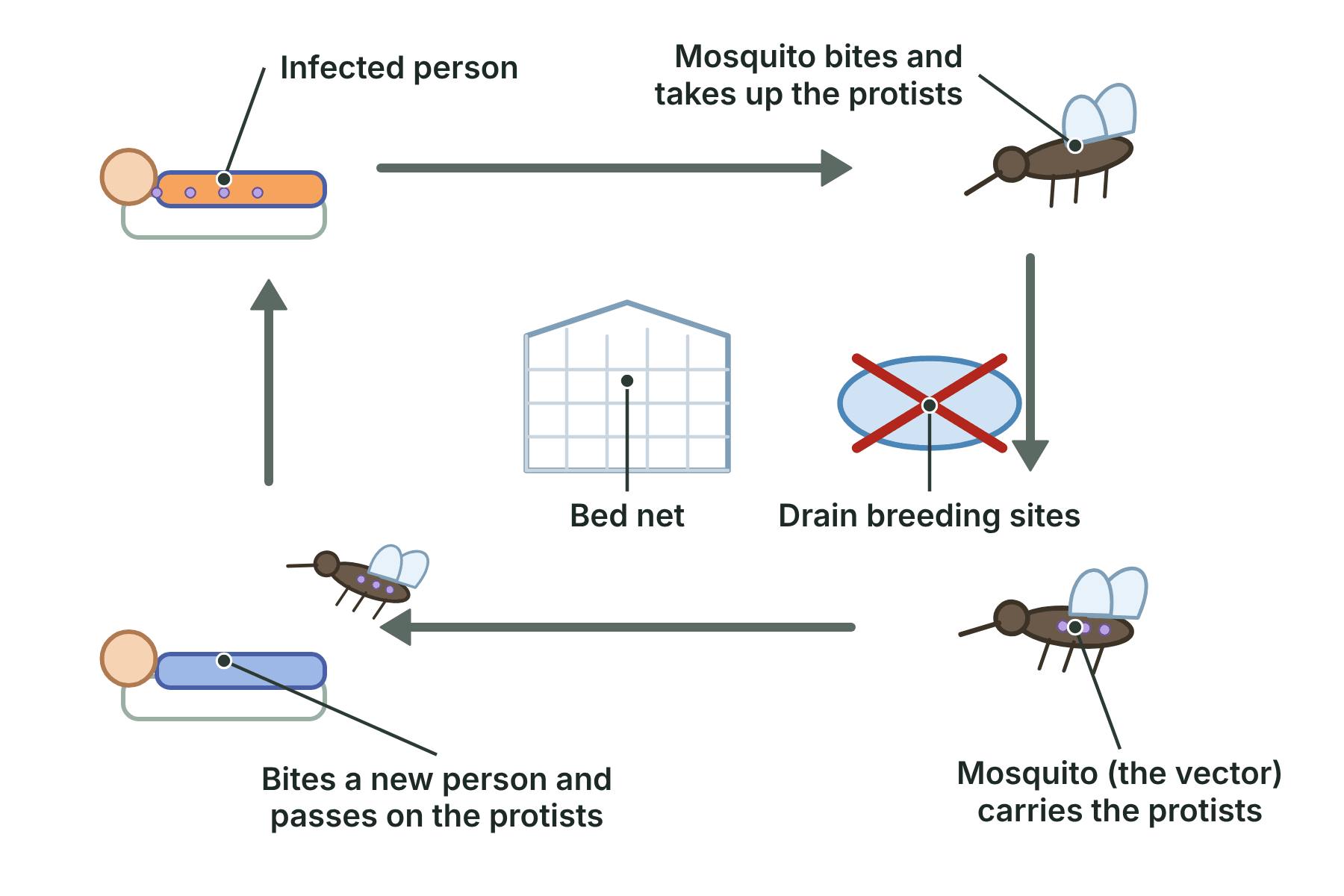
The mosquito is a vector that carries the malarial protist from person to person.
The malaria cycle
The disease depends on the mosquito to travel between people.
-
1
Infected person
The blood of an infected person contains the protists.
-
2
Mosquito bites
A mosquito feeds on the infected person's blood and takes up the protists.
-
3
Carried by the vector
The protists live in the mosquito, which does not become ill.
-
4
A new person
The mosquito bites a healthy person and passes the protists on. That person becomes ill with malaria.
Controlling malaria
Because the vector spreads malaria, controlling the vector controls the disease.
-
Prevent breeding
Mosquitoes breed in standing water. Draining swamps and covering water stores means fewer mosquitoes.
-
Mosquito nets
Sleeping under a net, especially one treated with insecticide, stops people being bitten.
-
Insecticides and repellents
Spraying kills mosquitoes, and repellents reduce bites.
-
Treating patients
Anti-malarial drugs treat the infection and stop the protist being passed on.
Rose black spot and malaria compared
Rose black spot (fungus)
- Affects plants (roses)
- Purple or black spots on leaves
- Spread by water and wind
- Treated with fungicides and by removing leaves
Malaria (protist)
- Affects humans
- Recurrent fever, and can be fatal
- Spread by the mosquito vector
- Controlled by preventing breeding and using nets
Case study
Mosquito nets in Africa
In parts of Africa, malaria kills a child every few minutes. Sleeping under a bed net treated with insecticide has been one of the most effective ways of reducing deaths. The net stops the mosquito biting at night, when it feeds, and the insecticide kills mosquitoes that land on the net. It is cheap and easy to use, so large numbers of nets have been given out in areas where malaria is common.
Know the difference
Rose black spot is spread by water and wind. Malaria is spread by a mosquito, which is a vector.
Fungal and protist diseases
Fungal and protist diseases
-
Rose black spot
- fungus
- spots on leaves
- less photosynthesis
- water and wind
-
Treatment
- fungicide
- destroy leaves
-
Malaria
- protist
- recurrent fever
- mosquito vector
-
Control
- stop mosquitoes breeding
- nets
Summary and exam focus
- Rose black spot is a fungal disease that causes purple or black spots on leaves.
- It reduces photosynthesis and is spread by water and wind.
- It is treated with fungicides and by destroying the affected leaves.
- Malaria is caused by a protist and causes recurrent fever.
- Mosquitoes are vectors for malaria, so it is controlled by preventing mosquito breeding and using nets.
Exam focus
Explain how the spread of malaria can be controlled. (4 marks) (4 marks)
Link each measure to the mosquito. Draining standing water stops it breeding, so there are fewer mosquitoes. Nets stop it biting people. Both cut the number of times the protist is passed on.
Key terms
The words this lesson expects you to use. Each one is linked from the first place it appears above.
- Rose black spot
- A fungal disease of roses that causes purple or black spots on the leaves.
- Fungicide
- A chemical that kills fungi.
- Malaria
- A disease caused by a protist, which causes recurrent fever and can be fatal.
- Mosquito
- An insect that feeds on blood and acts as the vector for malaria.
- Vector
- An organism that carries a pathogen from one host to another.
- Life cycle
- The series of stages in the life of an organism or a pathogen.
- Insecticide
- A chemical that kills insects.
- Standing water
- Water that does not flow, where mosquitoes lay their eggs.
You've finished the notes
Check your understanding
Test yourself while it is fresh. Start with the flashcards, then try the exam questions.
Something here looks wrong?
Tell us what and we will go and look. It goes to whoever writes these pages, nobody else, and we do not ask who you are — so there is nothing to sign and nothing comes back to you.