Biology · Communicable Diseases
Bacterial Diseases
Many bacteria are harmless, but some cause serious disease. This lesson covers two bacterial diseases, salmonella food poisoning and gonorrhoea, including how they spread and how they can be controlled.
Learning Objectives
- 1Describe the symptoms of salmonella food poisoning and how it is spread and controlled.
- 2Describe the symptoms of gonorrhoea and how it is spread and controlled.
- 3Explain why antibiotic resistance makes gonorrhoea harder to treat.
- 4Compare the two diseases.
Retrieval practice
-
1
What do bacteria produce that makes us feel ill?
Show answerHide answer
Toxins.
-
2
What is a pathogen?
Show answerHide answer
A microorganism that causes disease.
-
3
How do bacteria reproduce?
Show answerHide answer
By dividing rapidly, as often as every 20 minutes in good conditions.
-
4
Name an antibiotic.
Show answerHide answer
Bacteria and disease
Bacteria are single-celled prokaryotes. When some types get into the human body they multiply rapidly and release toxins that damage tissues. The specification names two bacterial diseases that are spread in very different ways: salmonella, which is passed on in food, and gonorrhoea, which is passed on by sexual contact.
Salmonella food poisoning
Salmonella bacteria live in the gut of some animals, particularly poultry, and can get into eggs and meat.
-
How it is spread
The bacteria are eaten in food, or on food that has been prepared in unhygienic conditions.
-
Symptoms
Fever, abdominal cramps, vomiting and diarrhoea. They are caused by the bacteria and the toxins they make.
-
Control in poultry
In the UK, poultry are vaccinated against salmonella, which reduces the number of infected eggs and chickens.
-
Control at home
Cook meat and eggs thoroughly, wash hands and surfaces after touching raw meat, and keep raw and cooked food separate.
Gonorrhoea
Gonorrhoea is a sexually transmitted disease, or STD, caused by a bacterium.
-
Symptoms
A thick yellow or green discharge from the vagina or penis, and pain when urinating.
-
How it is spread
By sexual contact.
-
Treatment
It was easily treated with the antibiotic penicillin, until many resistant strains appeared.
-
Control
The spread can be controlled by treating infected people with antibiotics, and by using a barrier method of contraception, such as a condom.
Two bacterial diseases
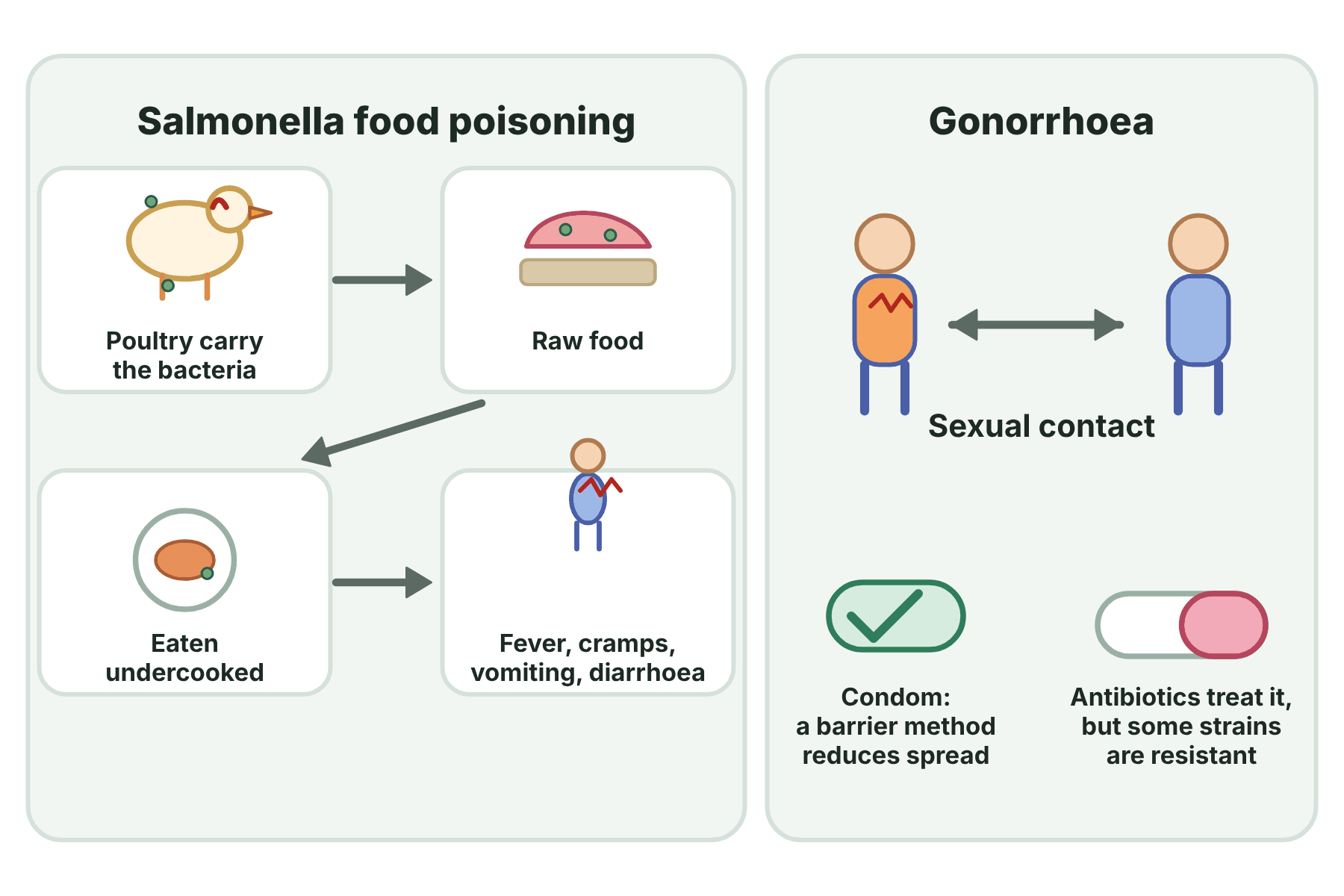
The two diseases spread in different ways, so they are controlled in different ways.
Salmonella and gonorrhoea compared
Salmonella food poisoning
- Spread in food or unhygienic kitchens
- Fever, cramps, vomiting and diarrhoea
- Poultry vaccinated in the UK
- Prevented by good food hygiene
Gonorrhoea
- Spread by sexual contact
- Thick discharge and pain when urinating
- Once treated with penicillin, now many resistant strains
- Controlled by condoms and by antibiotics
How antibiotic resistance spreads
Penicillin was once a reliable cure for gonorrhoea. Now many strains are resistant.
-
1
Variation
In a large population of bacteria, a few have a gene that makes them resistant to penicillin.
-
2
Antibiotic use
The antibiotic kills the non-resistant bacteria but not the resistant ones.
-
3
Survival
The resistant bacteria survive and reproduce, and pass on the gene.
-
4
A resistant strain
Over time, most of the bacteria in the population are resistant and the antibiotic stops working.
Case study
Food hygiene in a kitchen
A chef prepares raw chicken on a chopping board and then uses the same board and unwashed knife to cut up salad. The salad is not cooked, so any salmonella bacteria that moved from the chicken stay alive and are eaten. This is called cross-contamination. Using separate boards, washing hands and surfaces and cooking chicken until there is no pink meat all prevent it.
Know the difference
Salmonella is spread by food. Gonorrhoea is spread by sexual contact.
Bacterial diseases
Bacterial diseases
-
Salmonella
- in food
- fever, cramps, vomiting, diarrhoea
- vaccinate poultry
- hygiene
-
Gonorrhoea
- sexual contact
- discharge and pain
- condoms
- antibiotics
-
Resistance
- penicillin once worked
- resistant strains now
-
Bacteria
- reproduce rapidly
- toxins
Summary and exam focus
- Salmonella is spread in food, and causes fever, abdominal cramps, vomiting and diarrhoea.
- In the UK, poultry are vaccinated against salmonella.
- Gonorrhoea is spread by sexual contact, and causes a thick discharge and pain on urinating.
- Gonorrhoea was treated with penicillin until resistant strains appeared.
- Condoms and antibiotics control the spread of gonorrhoea.
Exam focus
Describe how the spread of gonorrhoea can be controlled and explain why treating it with antibiotics is becoming harder. (4 marks) (4 marks)
Give two methods of control (antibiotics and a barrier method such as a condom), then explain resistance: penicillin once cured it easily, but resistant strains have appeared and survive the treatment.
Key terms
The words this lesson expects you to use. Each one is linked from the first place it appears above.
- Salmonella
- A bacterium that causes food poisoning.
- Food poisoning
- An illness caused by eating food that contains pathogens or their toxins.
- Gonorrhoea
- A sexually transmitted disease caused by a bacterium.
- Sexually transmitted disease
- A disease that is passed on by sexual contact. It is also called an STD.
- Penicillin
- An antibiotic that kills bacteria.
- Resistant
- Not killed by an antibiotic.
- Barrier method
- A method of contraception, such as a condom, that stops body fluids passing between people.
- Cross-contamination
- The transfer of pathogens from one food or surface to another.
You've finished the notes
Check your understanding
Test yourself while it is fresh. Start with the flashcards, then try the exam questions.
Something here looks wrong?
Tell us what and we will go and look. It goes to whoever writes these pages, nobody else, and we do not ask who you are — so there is nothing to sign and nothing comes back to you.