Biology · Health, Disease and Cancer
Risk Factors and Lifestyle
Some diseases are made more likely by the way people live. This lesson explains risk factors, the effects of diet, smoking, alcohol, exercise and obesity, and how to weigh the human and financial cost of non-communicable disease.
Learning Objectives
- 1Explain what a risk factor is and how it is linked to an increased rate of disease.
- 2Explain the effect of diet, smoking, alcohol and exercise on non-communicable diseases.
- 3Discuss the human and financial cost of non-communicable diseases at local, national and global levels.
- 4Interpret data about risk factors, distinguishing a correlation from a proven cause.
Retrieval practice
-
1
What is a non-communicable disease?
Show answerHide answer
A disease that is not caused by a pathogen and cannot be passed on.
-
2
What builds up in the arteries in coronary heart disease?
Show answerHide answer
Fatty deposits.
-
3
What is a correlation?
Show answerHide answer
A pattern showing that two variables change together.
-
4
What is a carcinogen?
Show answerHide answer
A substance or radiation that can cause cancer.
What is a risk factor?
A risk factor is something that is linked to an increased rate of a disease. It does not mean that a person will definitely get the disease, only that they are more likely to. Risk factors can be aspects of a person's lifestyle, such as smoking, or substances in their body or environment, such as a high level of cholesterol. For some risk factors scientists have proved how they cause disease, but for others there is only a link.
Lifestyle and non-communicable disease
These are the effects of lifestyle you need to know.
-
Diet, smoking and exercise
A diet high in saturated fat, smoking and lack of exercise all increase the risk of cardiovascular disease.
-
Obesity
Being obese is a risk factor for type 2 diabetes, because the body becomes less able to control the level of glucose in the blood.
-
Alcohol
Too much alcohol can damage the liver, and it affects brain function.
-
Smoking and the lungs
Smoking causes lung diseases and lung cancer.
-
Pregnancy
Smoking and drinking alcohol in pregnancy can harm the unborn baby, for example by causing a low birth mass.
-
Carcinogens
Substances and radiation, including ionising radiation such as X-rays and gamma rays, that cause cancer.
Risk factors and the diseases they raise the risk of
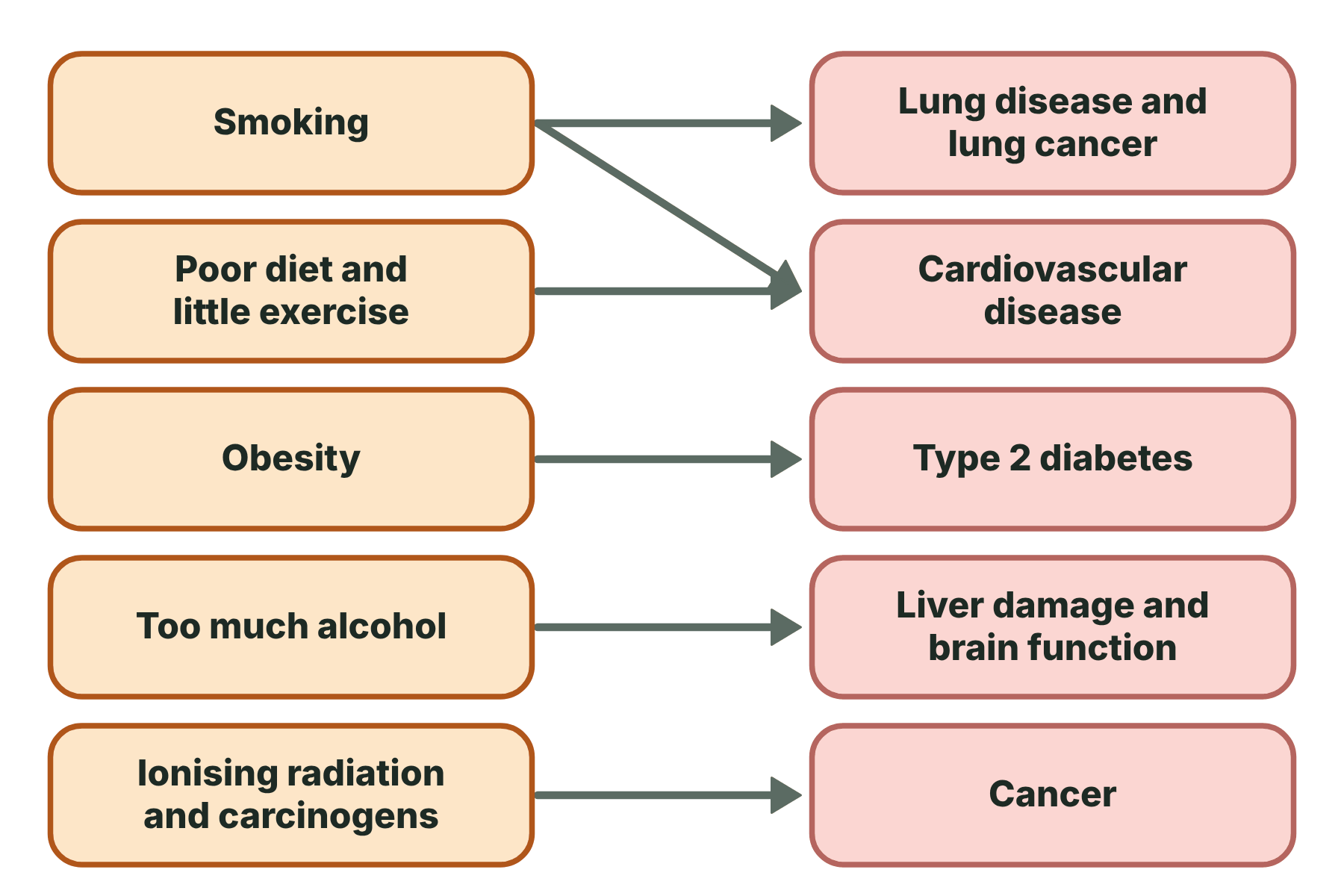
Many diseases are caused by an interaction of a number of factors, not just one.
Correlation and cause
Evidence about risk factors often comes from studies of large groups of people.
-
A causal mechanism
For some risk factors, such as smoking and lung cancer, scientists have proved how the risk factor causes the disease.
-
Only a correlation
For others, the evidence is a link only, and other factors could explain it.
-
Many factors together
Many diseases are caused by the interaction of a number of factors, such as diet, lifestyle and genes.
-
Sampling
A large, representative sample is needed, so that the link found really applies to the population.
The cost of non-communicable disease
You should be able to discuss the cost at several levels, for the individual, the community, the nation and the world.
-
The individual
Pain, lower quality of life, loss of earnings and the cost of drugs.
-
The local community
Carers, support services and local health clinics are stretched.
-
The nation
The health service pays for treatment, operations and drugs, and the country loses productivity when people cannot work.
-
Globally
Non-communicable diseases are a leading cause of death worldwide, and lifestyle changes in a growing number of countries are making them more common.
Interpreting risk factor data
A study finds that out of 1000 smokers, 120 develop lung disease, but out of 1000 non-smokers, only 20 do. Calculate the percentage of each group that develops lung disease and say what the data show.
Show the solutionHide the solution
- 1 Smokers \(120 \div 1000 \times 100 = 12\%\)
- 2 Non-smokers \(20 \div 1000 \times 100 = 2\%\)
- 3 Conclude The rate is six times higher in smokers, so smoking is linked to a much higher risk of lung disease.
Answer12% of smokers and 2% of non-smokers develop lung disease. Smoking is a risk factor for lung disease.
Case study
Smoking in pregnancy
The harmful chemicals in cigarette smoke pass from a pregnant woman's blood into her baby's blood. Smoking in pregnancy increases the risk of miscarriage, early birth and a baby born with a low mass. Alcohol also passes to the baby and can damage its developing brain. These risks are avoided if the mother does not smoke or drink during pregnancy.
Keep it precise
A risk factor makes a disease more likely. It does not mean the disease is certain.
Risk factors
Risk factors
-
Definition
- linked to an increased rate of a disease
-
Lifestyle
- diet
- smoking
- alcohol
- exercise
- obesity
-
Diseases
- cardiovascular disease
- type 2 diabetes
- lung disease
- cancer
-
Pregnancy
- smoking and alcohol affect the unborn baby
-
Cost
- individual
- community
- nation
- world
Summary and exam focus
- A risk factor is linked to an increased rate of a disease.
- Diet, smoking, alcohol and lack of exercise affect cardiovascular disease and other diseases.
- Obesity is a risk factor for type 2 diabetes.
- Smoking is a risk factor for lung disease and lung cancer, and smoking and alcohol harm unborn babies.
- Non-communicable diseases cost people, communities and countries.
Exam focus
Discuss the human and financial costs of non-communicable diseases to a nation. (4 marks) (4 marks)
Give at least one human cost, such as pain, early death and carers, and one financial cost, such as the health service's treatment bill and lost working days. Relate both to the nation rather than one person.
Key terms
The words this lesson expects you to use. Each one is linked from the first place it appears above.
- Risk factor
- Something linked to an increased rate of a disease.
- Lifestyle
- The way a person lives, including diet, exercise, smoking and alcohol use.
- Obesity
- Having so much body fat that health is at risk.
- Type 2 diabetes
- A disease in which the body's cells stop responding to insulin properly, so blood glucose is not controlled.
- Carcinogen
- A substance or radiation that can cause cancer.
- Ionising radiation
- Radiation such as X-rays and gamma rays that can damage DNA and cause cancer.
- Cirrhosis
- Scarring of the liver, often caused by long-term heavy drinking.
- Causal mechanism
- A proven way in which one factor produces an effect.
You've finished the notes
Check your understanding
Test yourself while it is fresh. Start with the flashcards, then try the exam questions.
Something here looks wrong?
Tell us what and we will go and look. It goes to whoever writes these pages, nobody else, and we do not ask who you are — so there is nothing to sign and nothing comes back to you.